Key Points
-
The Schwab U.S. Dividend Equity ETF and McDonald’s are rallying in lockstep with the consumer staples sector.
-
The Schwab U.S. Dividend Equity ETF has high turnover.
-
McDonald’s has impeccable fundamentals that support long-term dividend growth.
-
The major stock market indexes rallied following midterm election results, with the S&P 500 (SNPINDEX: ^GSPC) up 1.6% and the Dow Jones Industrial Average (DJINDICES: ^DJI) gaining 3% on the session. From a sector perspective, the biggest winners were healthcare and consumer staples — both of which closed at all-time highs. Amid Republican control of the Executive Branch and Democrats gaining the majority in the Senate and House, investors are piling into safe sectors that tend to do well regardless of political and economic uncertainty.
The Schwab U.S. Dividend Equity ETF (NYSEMKT: SCHD) — which we’ll simply refer to as SCHD going forward — is heavily concentrated in these sectors. So it’s no surprise it added to its already red-hot gains to close at an all-time high. Meanwhile, McDonald’s (NYSE: MCD) roared 6.5% higher on Nov. 4 but is still down big year-to-date. Here’s why McDonald’s stands out as an even better buy than SCHD.
Missed Nvidia in 2009? This Rare Signal Is Flashing Again. In 2009, a “Double Down” signal flashed for a little-known chipmaker called Nvidia. For the first time in years, that same “Total Conviction” signal is flashing for a company 1/100th the size of Nvidia. Continue »
High income, high turnover
The Schwab U.S. Dividend Equity ETF tracks the Dow Jones U.S. Dividend 100 Index, which is rebalanced quarterly into a basket of high-yield dividend stocks. The rebalancing emphasizes yield. So the index will sometimes cycle out of stocks whose yields are declining because their stock prices are rising faster than their dividend growth rates. And similarly, it will cycle into stocks and sectors with rising yields.
In March, the ETF had a 23.9% energy sector weighting. But after multiple rebalances, the energy sector weighting fell to 15.4% as of Sept. 30. In market-cap-weighted indexes like the S&P 500, outperforming sectors gain higher weightings, not lower ones.
With less energy sector weighting, SCHD cycled into more consumer staples, healthcare, and high-yield technology stocks. The strategy is paying off, as the energy sector sold off while consumer staples and healthcare rose following the midterm election results. But this practice leads to heavy trading, with the ETF featuring a 40.6% portfolio turnover rate as of Sept. 30, 2026, which is unappealing to long-term investors looking to build a portfolio around core holdings.
All told, SCHD is a good ETF for generating passive income because it prioritizes allocating toward high-yield, industry-leading companies. But investors should be aware that its year-to-date gains are particularly high because SCHD has been rotating into hot sectors and out of cold sectors simply by the nature of its rules-based methodology — not some magic formula. These mechanics are coincidentally maximizing gains this year. But that same method can backfire if a leading sector continues producing strong gains, or if a beaten-down sector continues to sell-off.
Meet the newest Dividend King
Due to SCHD’s turnover, I’d much rather put hard-earned savings to work in blue chip dividend stocks like McDonald’s. McDonald’s dividend is ultra-reliable. In September, McDonald’s announced its 50th consecutive dividend increase. In the process, it joined the list of Dividend Kings, companies that have raised their dividends for at least 50 years.
Because 96% of McDonald’s restaurants are franchised, the company generates highly reliable cash flows that have nothing to do with selling burgers and fries. These include licensing fees, rent, royalties, and other expenses. The franchise model is ideally suited for supporting a stable and growing dividend, regardless of political or economic cycles.
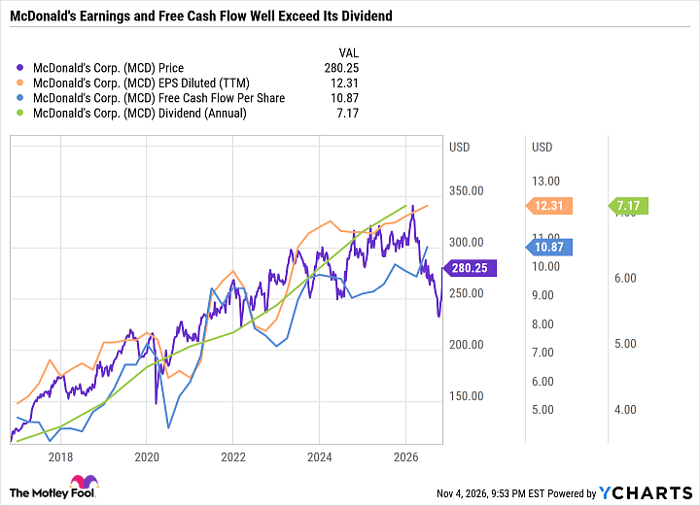
MCD data by YCharts
As you can see in the chart, McDonald’s stock price was at multi-year lows before its recent recovery. Meanwhile, its earnings and free cash flow continue to steadily rise and easily cover its dividend.
After its latest run-up, McDonald’s remains a good value — sporting a reasonable 22.8 price-to-earnings ratio.
A dividend stock to build a portfolio around
SCHD yields 3.2% — higher than 2.8% for McDonald’s. But McDonald’s could end up producing more passive income over the lifetime of the investment because the company regularly increases its dividend each year, giving investors a substantially higher yield on cost over time. Whereas SCHD will rotate in and out of stocks to maintain a competitive high yield.
With McDonald’s, investors can rest easy knowing they own shares in an excellent, fundamentally sound company. Whereas SCHD’s investment thesis is built around its mechanics, not its holdings.
Should you buy stock in Schwab U.S. Dividend Equity ETF right now?
Before you buy stock in Schwab U.S. Dividend Equity ETF, consider this:
The Motley Fool Stock Advisor analyst team just identified what they believe are the 10 best stocks for investors to buy now… and Schwab U.S. Dividend Equity ETF wasn’t one of them. The 10 stocks that made the cut could produce monster returns in the coming years.
Consider when Netflix made this list on December 17, 2004… if you invested $1,000 at the time of our recommendation, you’d have $341,966!* Or when Nvidia made this list on April 15, 2005… if you invested $1,000 at the time of our recommendation, you’d have $1,146,819!*
Now, it’s worth noting Stock Advisor’s total average return is 852% — a market-crushing outperformance compared to 203% for the S&P 500. Don’t miss the latest top 10 list, available with Stock Advisor, and join an investing community built by individual investors for individual investors.
See the 10 stocks »
*Stock Advisor returns as of November 7, 2026.
Daniel Foelber has positions in McDonald’s and Schwab U.S. Dividend Equity ETF. The Motley Fool recommends the following options: long January 2028 $320 calls on McDonald’s and short January 2028 $340 calls on McDonald’s. The Motley Fool has a disclosure policy.