Key Points
-
The Social Security Administration announced a 3.6% cost-of-living adjustment (COLA) for 2027 on Oct. 14, marking the fifth-largest annual raise since 1993.
-
Social Security’s outsize 2027 raise, driven by two of President Donald Trump’s policies, should be particularly beneficial to original Medicare enrollees.
-
However, Social Security’s Trump bump might accelerate the estimated timeline to sweeping benefit cuts.
-
For a majority of retirees, Social Security income is indispensable. A quarter century of annual surveys from national pollster Gallup show that 80% to 90% of retirees consistently rely on their monthly Social Security payout to cover their expenses, in some capacity.
Given how important this program is to the financial well-being of our nation’s aging workforce, there’s arguably no announcement more anticipated by Social Security’s 55 million retired workers than the annual cost-of-living adjustment (COLA) reveal in October.
Missed AI’s “Act 1”? Act 2 Could Be 15x Bigger. Most investors think they missed the AI boat because they didn’t buy Nvidia in 2005. But according to our analysts, we’re only at the end of “Act 1″—the R&D phase. “Act 2” is the global rollout. Continue »
Social Security’s COLA is effectively the “raise” passed on to beneficiaries to offset inflation (rising prices). If Social Security benefits didn’t rise in lockstep with inflation, the program’s recipients would see their purchasing power dwindle over time.
Social Security’s 2027 COLA has shaped up as a double-edged sword for tens of millions of retirees. On the one hand, a second consecutive year with a “Trump bump,” courtesy of President Donald Trump, should deliver a silver lining for the first time since 2023 for around 29 million retirees. However, this Trump bump also comes with unintended consequences for beneficiaries.
Social Security’s 2027 Trump bump can produce a rare silver lining
Following the release of the September inflation report on Oct. 14, the Social Security Administration announced that monthly payouts would climb by 3.6% in 2027. This ties for the fifth-largest raise over the last 35 years.
Additionally, it’s the sixth straight year in which payouts have risen by at least 2.5%, which is something that hasn’t been witnessed since the late 20th century (1988-1997).
While a modest level of inflation is perfectly normal, two of President Trump’s policies are primarily responsible for fueling this outsize COLA.
The president’s tariff and trade policy has lifted goods price inflation and increased domestic production costs for select items, which are then passed on to consumers. This is the second consecutive year that tariffs have increased the prevailing inflation rate and boosted Social Security’s cost-of-living adjustment.
The Trump-led Iran war is also directly influencing consumer prices and, therefore, Social Security payouts. The closure of the Strait of Hormuz has led to the largest energy supply disruption in modern history, sending fuel prices soaring.
What makes this 3.6% Trump bump-led Social Security COLA so special is that it may allow approximately 29 million traditional Medicare enrollees to retain more of their benefit in 2027.
Traditional Medicare has three Parts: A (inpatient hospital care), B (outpatient services), and D (prescription drugs). Whereas roughly 99% of workers pay nothing for Part A, Parts B and D have standard monthly premiums. In 2026, the standard monthly premium for Part B is $202.90, and it’s typically deducted from a retiree’s Social Security benefit.
Since the start of the 21st century, Part B premiums have pretty consistently risen at a quicker pace than Social Security’s annual COLA. For example, Social Security raises of 3.2% (2024), 2.5% (2025), and 2.8% (2026) were met by Medicare Part B premium hikes of 5.9% (2024), 5.9% (2025), and 9.7% (2026). When Part B rises substantially faster than Social Security’s COLA, it can result in beneficiaries giving up some or all of their annual raise.
According to the 2026 Medicare Trustees Report, the Part B premium is only expected to climb by 3.25% to $209.50 per month in 2027. If this estimate proves accurate, it would mark the first time since 2023 that Social Security’s COLA grew faster than the Part B premium, and it would enable tens of millions of retirees to hang onto more of next year’s COLA.

Image source: Getty Images.
Social Security’s outsize Trump bump also exacerbates the program’s solvency issues
While sizable nominal-dollar increases to monthly Social Security checks tend to put smiles on the faces of beneficiaries, outsize raises can come with unintended consequences for America’s leading retirement program.
For decades, Social Security’s financial foundation has been crumbling. The annually published Social Security Board of Trustees Report has warned of an unfunded long-term (75-year) obligation since 1985.
In other words, the estimated income to be collected in the 75 years after a report is published is expected to be insufficient to cover outlays (benefits plus Social Security’s administrative expenses). Ongoing demographic shifts (e.g., rising income inequality, lower net migration into the U.S., and historically low birth rates) have pushed this unfunded obligation through the year 2100 up to an estimated $29.3 trillion.
Yet this gargantuan figure isn’t the biggest worry for retirees. Rather, it’s the Trustees’ projection that the Old-Age and Survivors Insurance trust fund (OASI) — the fund that doles out monthly benefits to retired workers and survivors of deceased workers — will exhaust its asset reserves by the fourth quarter of 2032. These asset reserves are currently invested in special-issue, interest-bearing government bonds, as required by law.
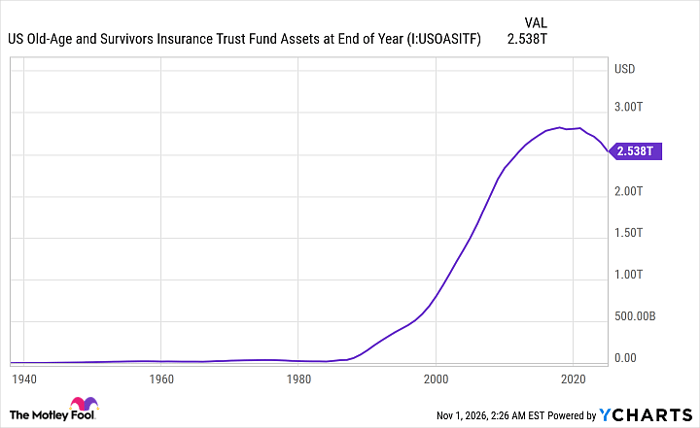
US Old-Age and Survivors Insurance Trust Fund Assets at End of Year data by YCharts.
The good news is the OASI doesn’t need a penny in its asset reserves to continue making payments to eligible beneficiaries. Since the 12.4% payroll tax on earned income generates more than 91% of the income collected by the program, as long as Americans keep working, Social Security can never go bankrupt.
But just because Social Security isn’t going bankrupt doesn’t mean the program is on solid financial footing. If the OASI’s asset reserves are fully depleted, it would confirm that the existing payout schedule, including annual COLAs, isn’t sustainable. The Trustees predict that sweeping benefit cuts of 22% will be needed once the OASI’s asset reserves run dry.
Social Security’s Trump bump-led 2027 COLA may have made things worse. While the Trustees’ estimates are based on a laundry list of variables and remain fluid, one core expectation is that Social Security’s annual COLA will be modest. That didn’t happen in 2027, with Trump’s policies leading to the fifth-largest raise since 1993.
A larger-than-normal annual COLA can drain the OASI’s already declining asset reserves even faster. This means the projected timeline to benefit cuts may now be less than six years away, and the needed reduction could ultimately be larger than 22%.
Social Security’s Trump bump-led COLA is truly a double-edged sword for retirees.
The $23,760 Social Security bonus most retirees completely overlook
If you’re like most Americans, you’re a few years (or more) behind on your retirement savings. But a handful of little-known “Social Security secrets” could help ensure a boost in your retirement income.
One easy trick could pay you as much as $23,760 more… each year! Once you learn how to maximize your Social Security benefits, we think you could retire confidently with the peace of mind we’re all after. Join Stock Advisor to learn more about these strategies.
View the “Social Security secrets” »
The Motley Fool has a disclosure policy.