Key Points
-
Artificial intelligence (AI) stocks are experiencing heavy volatility following the 2026 midterms.
-
While chip stocks and defense contracts are plummeting, AI hyperscaler stocks are seeing renewed enthusiasm.
-
Among the major hyperscalers, Microsoft looks like the safest bet right now.
-
The 2026 midterm elections ended in a major political shake-up, with Democrats winning control of both the House of Representatives and the Senate. While the results do not necessarily change the long-term outlook for artificial intelligence (AI), they could introduce new risks for some of the market’s most popular AI stocks.
Companies such as Nvidia (NASDAQ: NVDA) and Palantir Technologies (NASDAQ: PLTR) have benefited enormously from the AI revolution so far. However, potential changes to federal spending priorities and greater scrutiny of AI infrastructure could complicate their growth trajectories going forward.
Missed Nvidia in 2009? This Rare Signal Is Flashing Again. In 2009, a “Double Down” signal flashed for a little-known chipmaker called Nvidia. For the first time in years, that same “Total Conviction” signal is flashing for a company 1/100th the size of Nvidia. Continue »
For investors looking to capitalize on the AI theme without taking on quite as much uncertainty, I think Microsoft (NASDAQ: MSFT) offers an interesting alternative.
Why Nvidia and Palantir might face new challenges
Nvidia has become the backbone of the AI infrastructure boom. The company’s graphics processing units (GPUs) power many of the data centers being built by Amazon (NASDAQ: AMZN), Microsoft, Alphabet (NASDAQ: GOOGL) (NASDAQ: GOOG), and Meta Platforms (NASDAQ: META).
However, data centers have become a political issue, particularly regarding electricity consumption, utility costs, and the strain on local infrastructure. Should the incoming Democratic Congress pursue tougher oversight or legislation affecting data center build-outs, hyperscalers could face higher development costs or longer approval timelines. In turn, this could cause big tech to reevaluate the pace of their infrastructure investments, potentially impacting demand for Nvidia’s chips.
Palantir faces a different type of uncertainty. During the third quarter, the company generated $1.15 billion in government revenue, representing about half of its total sales. Although the company’s commercial business is expanding rapidly, government contracting remains a key tailwind. If lawmakers pursue different defense spending priorities, Palantir could face a more challenging environment for securing new business from the public sector.
Why Microsoft looks more resilient
Microsoft is not completely immune to these risks. The company operates one of the top three largest cloud computing businesses in the world and is also investing heavily in AI infrastructure. However, what separates Microsoft from Nvidia and Palantir is the diversity of its revenue streams and business model.
Through Azure, Microsoft benefits directly from accelerating demand for AI compute. Meanwhile, products such as Microsoft 365, Windows, Dynamics, and cybersecurity software help generate additional recurring revenue. This means Microsoft can monetize AI through software subscriptions and enterprise productivity tools, even if the pace of data center construction eventually moderates. There is also an interesting regulatory distinction between Microsoft and its hyperscaler peers.
Amazon has faced an antitrust lawsuit from the Federal Trade Commission (FTC) since 2023, with regulators alleging that its online marketplace practices unfairly restrict competing e-commerce platforms and harm third-party sellers. Google has faced its share of legal setbacks, including a recent federal court ruling that it illegally monopolized certain digital advertising markets.
Meanwhile, Meta’s regulatory challenges date back to a 2020 FTC lawsuit alleging that its acquisitions of Instagram and WhatsApp were designed to eliminate emerging competitors in the social media landscape. Although Meta won in court last November, the FTC appealed that decision in January — keeping the dispute alive.
Microsoft has certainly faced regulatory scrutiny as well, including an investigation by the European Commission into bundling Teams with Microsoft 365. Still, I think its broad enterprise software ecosystem makes it an attractive way to invest in AI without relying as heavily on digital advertising or consumer platforms. While Microsoft is not politically untouchable, its combination of cloud infrastructure, established software properties, and recurring enterprise subscriptions offers multiple avenues for growth.
Microsoft’s valuation is compelling
Microsoft’s latest earnings results illustrate why its business model is so attractive. During its fiscal first quarter of 2027 (ended Sept. 30), revenue increased 19% year over year to $92.3 billion. Azure revenue soared 48%, while Microsoft Cloud revenue climbed 30% to $63.9 billion.
Even more impressive, Microsoft’s commercial remaining performance obligations (RPO) increased 73% to $677 billion. This figure represents contracted business that has yet to be recognized as revenue, providing meaningful visibility into future sales.
The company’s cash flow is another important consideration. Microsoft generated $58 billion in operating cash flow during the quarter, increasing 29% year over year. However, capital expenditures (capex) totaled $45.2 billion, reflecting the enormous costs of building AI infrastructure. This means Microsoft generated roughly $18.6 billion in free cash flow during the quarter, illustrating how data center investments are consuming a meaningful portion of its cash generation.
This creates an interesting potential upside scenario: If Microsoft moderates its infrastructure spending while continuing to monetize its existing cloud capacity and software ecosystem, free cash flow could improve substantially.
From a valuation perspective, Microsoft trades at a forward price-to-earnings (P/E) ratio of about 27 following the election. While this is hardly a bargain in absolute terms, I think it’s a reasonable premium for a company delivering double-digit revenue growth, expanding AI-driven cloud adoption, and generating recurring cash flow.
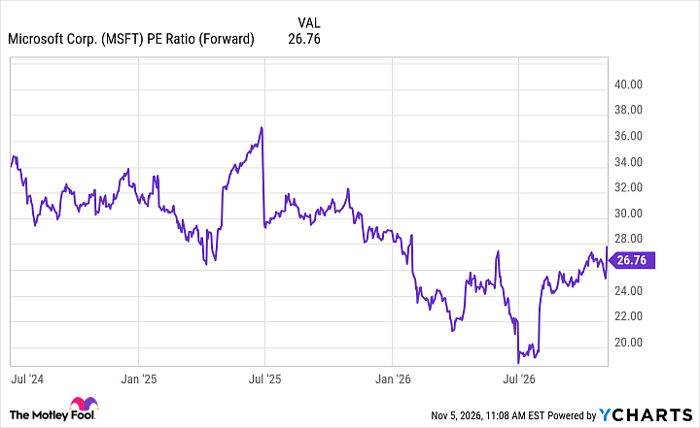
MSFT PE Ratio (Forward) data by YCharts
With a changing political landscape creating more uncertainty around infrastructure spending and federal contracts, Microsoft strikes me as a more balanced AI investment right now. For investors with a long-term time horizon, Microsoft may be one of the safer AI stocks to own following the midterms.
Should you buy stock in Microsoft right now?
Before you buy stock in Microsoft, consider this:
The Motley Fool Stock Advisor analyst team just identified what they believe are the 10 best stocks for investors to buy now… and Microsoft wasn’t one of them. The 10 stocks that made the cut could produce monster returns in the coming years.
Consider when Netflix made this list on December 17, 2004… if you invested $1,000 at the time of our recommendation, you’d have $358,037!* Or when Nvidia made this list on April 15, 2005… if you invested $1,000 at the time of our recommendation, you’d have $1,229,708!*
Now, it’s worth noting Stock Advisor’s total average return is 897% — a market-crushing outperformance compared to 211% for the S&P 500. Don’t miss the latest top 10 list, available with Stock Advisor, and join an investing community built by individual investors for individual investors.
See the 10 stocks »
*Stock Advisor returns as of November 6, 2026.
Adam Spatacco has positions in Alphabet, Amazon, Microsoft, Nvidia, and Palantir Technologies. The Motley Fool has positions in and recommends Alphabet, Amazon, Meta Platforms, Microsoft, Nvidia, and Palantir Technologies. The Motley Fool has a disclosure policy.