Key Points
-
BND and AGG are close cousins with slight variations.
-
VGSH holds only short-term Treasuries, while TLT’s roughly 15-year duration Treasury portfolio makes it the most rate-sensitive of the five.
-
BNDX holds non-U.S. investment-grade bonds, offering diversification beyond the U.S. bond market.
-
Vanguard Total Bond Market ETF (NASDAQ: BND), iShares Core U.S. Aggregate Bond ETF (NYSEMKET: AGG), Vanguard Short-Term Treasury ETF (NASDAQ: VGSH), iShares 20+ Year Treasury Bond ETF (NASDAQ: TLT), and Vanguard Total International Bond ETF (NASDAQ: BNDX) rank among the largest bond ETFs. While they might all look similar at first glance, these funds can be quite different.
Here’s a look at what you need to know about these top bond ETFs and when each one would fit in a portfolio.
Missed Nvidia in 2009? This Rare Signal Is Flashing Again. In 2009, a “Double Down” signal flashed for a little-known chipmaker called Nvidia. For the first time in years, that same “Total Conviction” signal is flashing for a company 1/100th the size of Nvidia. Continue »
BND and AGG: The one-fund core
The Vanguard Total Bond Market ETF and iShares Core U.S. Aggregate Bond ETF rank as the two largest bond ETFs by assets under management (AUM) at $167 billion and $139 billion, respectively. They both aim to provide broad exposure to the total U.S. bond market for investors seeking income and diversification. Here’s how these two top bond ETFs compare:
|
Bond ETF
|
Number of bonds
|
Yield to maturity
|
Weighted average coupon
|
Average effective maturity
|
Effective duration
|
|
BND
|
11,434
|
5.6%
|
3.8%
|
8.3 years
|
5.7 years
|
|
AGG
|
13,469
|
5.2%
|
3.9%
|
8.2 years
|
5.7 years
|
Data source: Vanguard and iShares.
As the table shows, these are very similar funds (they also share the same 0.03% expense ratio). BND provides investors with a slightly higher yield, while AGG holds more bonds. There are a few other subtle differences in their holdings (AGG has higher exposure to MBS, while BND has higher exposure to AAA-rated bonds).
Overall, the differences are so subtle that either fund would be an ideal core bond holding. You’d probably only hold one of these ETFs, with the choice likely coming down to sponsor preference (Vanguard or BlackRock).
VGSH and TLT: Opposite ends of the Treasury curve
Whereas BND and AGG are close cousins, the Vanguard Short-Term Treasury ETF and iShares 20+ Year Treasury Bond ETF are opposites. VGSH primarily invests in short-term U.S. Treasury bonds (one- to three-year maturities), while TLT invests in long-duration U.S. government debt (20+ years). That makes a huge difference in returns and volatility.
VGSH offers current income with modest price fluctuations, while TLT offers higher income potential but greater volatility. The big difference is duration, which measures the sensitivity of bond ETF prices to interest rate movements. For example, if a bond ETF has a duration of two years, its price would fall about 2% when interest rates rise 1 percentage point, while rising 2% if rates fall by 1 percentage point. The higher the duration, the greater the price movement when interest rates change. VGSH’s average duration is 1.9 years compared to 14.9 years for TLT. So, you’d want to buy VGSH for stability, and TLT if you expect interest rates to fall.
BNDX: Going global
Vanguard Total International Bond ETF provides broad exposure to major bond markets outside the U.S. It employs hedging strategies to mitigate foreign-currency risk. The ETF currently holds 6,837 bonds from across the world. Most of its bonds have investment-grade ratings, with 79% issued by foreign governments. Its portfolio has a 5.5% yield to maturity and a 6.4-year average duration. In many ways, it would be similar to owning BND or AGG, though with a bit more rate sensitivity. This ETF would be ideal for investors seeking to further diversify their bond portfolio with some international exposure. It would be a good long-term holding to complement either BND or AGG.
What could go wrong
Bond ETFs are lower-risk investments compared to stocks. However, they’re not risk-free investments. The biggest risk is duration. If interest rates rise, bond ETFs with high average durations would see price declines that could more than offset the income they provide. We can see that in the price changes of TLT versus the other bond ETFs over the past year:
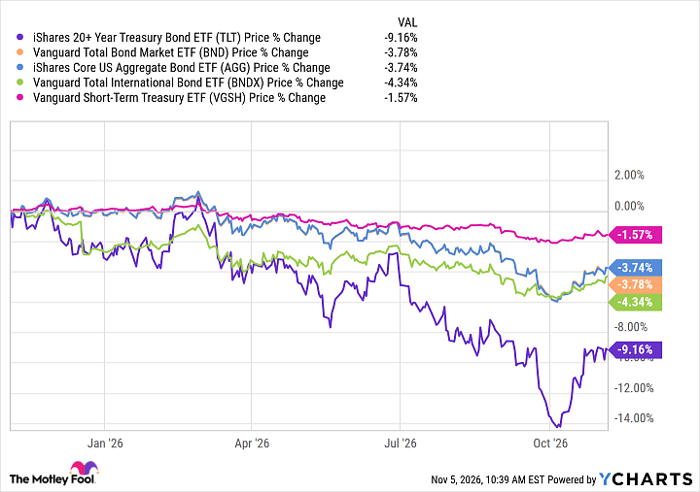
TLT data by YCharts
Investors need to consider this risk before adding a longer-duration bond ETF to their portfolios.
Match the bond ETF with its job
Before choosing a bond ETF, ask what job you want the investment to accomplish for your portfolio. BND and AGG are best for core bond holdings. Meanwhile, VGSH is best for money you may need soon. TLT and BNDX have more specialized jobs. BNDX provides international diversification, while TLT is a bet on falling interest rates. The key is to make sure the bond ETF aligns with the role you expect it to play in your portfolio.
The $23,760 Social Security bonus most retirees completely overlook
If you’re like most Americans, you’re a few years (or more) behind on your retirement savings. But a handful of little-known “Social Security secrets” could help ensure a boost in your retirement income.
One easy trick could pay you as much as $23,760 more… each year! Once you learn how to maximize your Social Security benefits, we think you could retire confidently with the peace of mind we’re all after. Join Stock Advisor to learn more about these strategies.
View the “Social Security secrets” »
Matt DiLallo has positions in Vanguard Total Bond Market ETF and iShares Trust-iShares Core U.s. Aggregate Bond ETF. The Motley Fool has positions in and recommends BlackRock and Vanguard Total Bond Market ETF. The Motley Fool has a disclosure policy.