Key Points
-
The S&P 500 and Dow Jones Industrial Average have delivered solid returns in 2026, but the Russell 2000 small-cap index is beating them both.
-
Companies in the Russell are benefiting from favorable U.S. government policies, and they are somewhat insulated from the volatile geopolitical landscape.
-
The Vanguard Russell 2000 ETF mimics the index, but it isn’t necessarily a buy right now.
-
The diversified S&P 500 (SNPINDEX: ^GSPC) and the blue-chip Dow Jones Industrial Average (DJINDICES: ^DJI) are two widely followed stock market indexes filled with America’s highest quality companies. They have returned 10.2% and 8.2% respectively so far in 2026, as of the market close on Nov. 2.
But then there is the Russell 2000 index, which has delivered an even bigger year-to-date gain of 13.3%. It tracks the performance of approximately 2,000 of America’s smallest listed companies, many of which generate the bulk of their revenue domestically. They are benefiting from a range of favorable government policies, and they are less sensitive to the ongoing geopolitical conflicts in the Middle East and Europe compared to multinational companies.
Missed AI’s “Act 1”? Act 2 Could Be 15x Bigger. Most investors think they missed the AI boat because they didn’t buy Nvidia in 2005. But according to our analysts, we’re only at the end of “Act 1″—the R&D phase. “Act 2” is the global rollout. Continue »
The Vanguard Russell 2000 ETF (NASDAQ: VTWO) is an exchange-traded fund (ETF) that mimics the Russell 2000. Can it continue outperforming indexes like the S&P 500 and the Dow Jones?
Economic conditions have favored small-cap stocks in 2026
The companies in the S&P 500 come from 11 different sectors of the U.S. economy, but the technology sector alone accounts for over 36% of the index’s value, so its performance can be heavily influenced by giants like Nvidia, Apple, and Microsoft.
The companies in the Russell 2000 also come from 11 economic sectors, but this index is far more balanced. The five largest sectors (by weight) in the Vanguard Russell 2000 ETF are as follows:
- Healthcare: 20.6%
- Financials: 18.4%
- Industrials: 15.6%
- Technology: 11.7%
- Consumer discretionary: 11.2%
Plus, the top five holdings in the Vanguard ETF represent just 1.8% of the value of its portfolio, so its performance isn’t beholden to a small handful of stocks.
|
Stock
|
Vanguard ETF Portfolio Weighting
|
|
1. Twist Bioscience (NASDAQ: TWST)
|
0.42%
|
|
2. Moog Inc (NYSE: MOGA)
|
0.36%
|
|
3. JFrog Ltd (NASDAQ: FROG)
|
0.35%
|
|
4. 10X Genomics (NASDAQ: TXG)
|
0.35%
|
|
5. UMB Financial (NASDAQ: UMBF)
|
0.32%
|
Data source: Vanguard. Portfolio weightings are accurate as of Sept. 30, 2026, and are subject to change.
Many of those stocks attract very little attention compared to those in the S&P 500 and the Dow, but they are packed with potential. Twist Bioscience stock, for instance, has rocketed higher by 300% so far in 2026 due to surging demand for the company’s synthetic DNA services. Moog stock, on the other hand, has returned 42% this year, thanks to strong financial results from its space and defense business.
Then there is 10X Genomics, which has returned more than 270% this year on strong demand for the company’s laboratory instruments and software which enable biological researchers to conduct high-resolution, single-cell analysis.
Most Russell 2000 companies primarily operate inside the U.S., so their revenue streams are insulated from the disruptive geopolitical issues happening around the world. They are also benefiting from U.S. government policies that are designed to favor domestic companies. For example, the Trump administration continues to levy tariffs on imported products, making American companies more competitive with foreign entities.
The administration is also slashing regulation to reduce the cost of doing business in the U.S., and with the help of Congress, it has adjusted the tax code to make it easier for enterprises to deduct the cost of capital investments upfront, which is a big tailwind for domestic manufacturers.
History suggests the Vanguard ETF is unlikely to continue outperforming
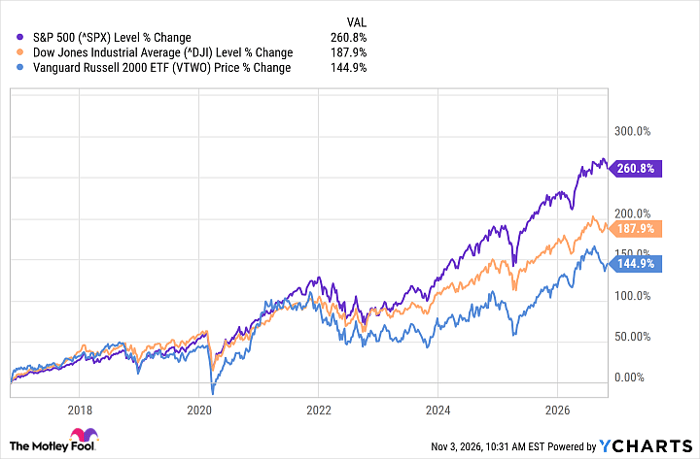
Although the Vanguard Russell 2000 ETF is beating the S&P 500 and the Dow this year, it normally underperforms over the long term because it lacks exposure to America’s biggest tech companies, which are a huge source of earnings growth for the major indexes.
An investor who bought the ETF 10 years ago would be sitting on a solid return of 144% today, but they would have earned much higher returns of 187% in the Dow and 260% in the S&P.
^SPX data by YCharts
Plus, the Russell faces another headwind: Interest rates. The Federal Reserve hiked rates at its September meeting for the first time since 2023, and additional increases might be on the way. Goldman Sachs says roughly 32% of the companies in the Russell 2000 hold floating rate debt, compared to just 6% of companies in the S&P 500.
Therefore, rate hikes are a much bigger headwind for small-cap companies, so they could derail the Russell’s recent stretch of outperformance.
With all of that in mind, this probably isn’t the best time for investors to pile into the Vanguard Russell 2000 ETF.
Should you buy stock in Vanguard Russell 2000 ETF right now?
Before you buy stock in Vanguard Russell 2000 ETF, consider this:
The Motley Fool Stock Advisor analyst team just identified what they believe are the 10 best stocks for investors to buy now… and Vanguard Russell 2000 ETF wasn’t one of them. The 10 stocks that made the cut could produce monster returns in the coming years.
Consider when Netflix made this list on December 17, 2004… if you invested $1,000 at the time of our recommendation, you’d have $358,037!* Or when Nvidia made this list on April 15, 2005… if you invested $1,000 at the time of our recommendation, you’d have $1,229,708!*
Now, it’s worth noting Stock Advisor’s total average return is 897% — a market-crushing outperformance compared to 211% for the S&P 500. Don’t miss the latest top 10 list, available with Stock Advisor, and join an investing community built by individual investors for individual investors.
See the 10 stocks »
*Stock Advisor returns as of November 6, 2026.
Anthony Di Pizio has no position in any of the stocks mentioned. The Motley Fool has positions in and recommends 10x Genomics, Apple, Goldman Sachs Group, Microsoft, Nvidia, and Twist Bioscience. The Motley Fool recommends JFrog and Moog. The Motley Fool has a disclosure policy.