Key Points
-
Democrats will control the House of Representatives and the Senate come early January, according to the Associated Press.
-
President Donald Trump working with a Democrat-led Congress may lead to some short-lived pain points for Wall Street.
-
No matter how the political puzzle pieces are arranged, the Dow Jones Industrial Average, S&P 500, Nasdaq Composite, and investors always end up as long-term beneficiaries.
-
Yesterday, tens of millions of Americans made their voices heard by casting or mailing in their ballots. These votes have charted a new course for America, with Democrats taking firm control of the House of Representatives and the Senate, according to the Associated Press. Starting in early January, President Donald Trump will be working with a Democrat-led Congress.
This congressional shake-up is a big win for Democrats. But at the end of the day, there’s an even bigger winner: Wall Street’s major stock indexes — the Dow Jones Industrial Average (DJINDICES:^DJI), S&P 500 (SNPINDEX:^GSPC), and Nasdaq Composite (NASDAQINDEX:^IXIC) — and investors.
Missed Nvidia in 2009? This Rare Signal Is Flashing Again. In 2009, a “Double Down” signal flashed for a little-known chipmaker called Nvidia. For the first time in years, that same “Total Conviction” signal is flashing for a company 1/100th the size of Nvidia. Continue »
President Trump will be working with a Democrat-led Congress in early January. Image source: Official White House Photo by Daniel Torok.
A Democrat-controlled Congress may come with some pain points
President Trump has enjoyed a unified Republican government in the first two years of both of his nonconsecutive terms. In each case, Congress passed, and he signed into law, a major tax and spending bill. The Tax Cuts and Jobs Act (TCJA) (signed December 2017) permanently lowered the peak marginal corporate income tax rate to 21%, fueling S&P 500 share buybacks, while the Big, Beautiful Bill (signed July 2025) made the personal income tax bracket reductions from the TCJA permanent.
A divided Congress likely takes major tax and spending legislation off the table, which isn’t necessarily bad news for Wall Street.
But a Democrat-controlled Congress does have some sticking points.
For instance, debt-ceiling negotiations become a lot trickier. The ideological differences between America’s two parties increase the likelihood of a lengthy government shutdown that could harm U.S. gross domestic product and corporate earnings.
Democratic lawmakers also favor stricter artificial intelligence (AI) regulations. Whereas the president has minimized AI regulation, Democrats prefer limiting data center expansion and ramping up the testing and vetting of large language models.
There’s definitely room for near-term uncertainty to creep into the picture ahead of January 2027.

Image source: Getty Images.
Election Night yields an even bigger winner than congressional Democrats
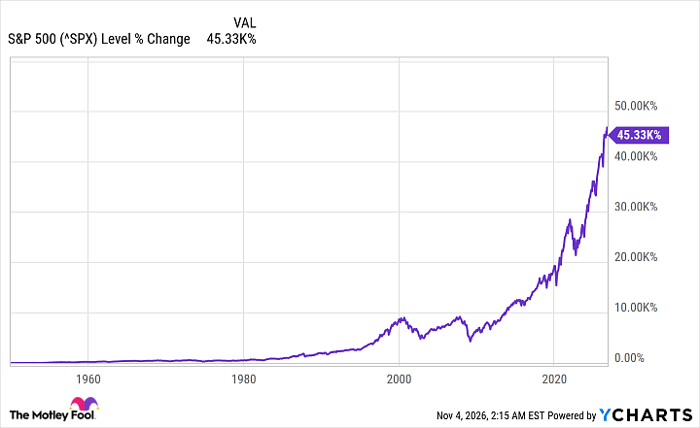
But if there’s one thing history has shown investors, it’s that they’re the biggest winners on Election Night. No matter how the political puzzle pieces are arranged, the Dow, S&P 500, Nasdaq Composite, and investors always come out as long-term beneficiaries.
Admittedly, certain political combinations work better than others. According to online retirement planning platform Retirement Researcher, the benchmark S&P 500 has, on average, gained 16.63% annually under a Democratic president and a divided Congress since 1926. By comparison, gains taper to an annual average of 7.33% with a Republican president and a split Congress.
However, a 7.33% average annual return still tops other popular asset classes, including Treasury bonds, commodities, and real estate. Even in less-than-ideal historical scenarios, the stock market delivers superior returns.
^SPX data by YCharts
Furthermore, this data shows that while fiscal policy does play a role in corporate America, it’s the operating results, management actions, and innovative prowess of public companies that ultimately push the Dow Jones Industrial Average, S&P 500, and Nasdaq Composite higher over the long term.
The AI infrastructure build-out, the evolution of quantum computing, significant S&P 500 share buybacks, and record-breaking initial public offerings won’t stop just because the congressional puzzle pieces will be rearranged in January. With another election in the books, investors are yet again the big winners.
Should you buy stock in S&P 500 Index right now?
Before you buy stock in S&P 500 Index, consider this:
The Motley Fool Stock Advisor analyst team just identified what they believe are the 10 best stocks for investors to buy now… and S&P 500 Index wasn’t one of them. The 10 stocks that made the cut could produce monster returns in the coming years.
Consider when Netflix made this list on December 17, 2004… if you invested $1,000 at the time of our recommendation, you’d have $336,195!* Or when Nvidia made this list on April 15, 2005… if you invested $1,000 at the time of our recommendation, you’d have $1,241,567!*
Now, it’s worth noting Stock Advisor’s total average return is 875% — a market-crushing outperformance compared to 208% for the S&P 500. Don’t miss the latest top 10 list, available with Stock Advisor, and join an investing community built by individual investors for individual investors.
See the 10 stocks »
*Stock Advisor returns as of November 4, 2026.
Sean Williams has no position in any of the stocks mentioned. The Motley Fool has no position in any of the stocks mentioned. The Motley Fool has a disclosure policy.