Key Points
-
Fed Chair Kevin Warsh warned that inflation remains above target and vowed the Fed will “deliver price stability.”
-
Past rate-hike cycles have led to everything from recessions and bear markets to soft landings, with Powell’s 2022-2023 hikes looking most similar to today.
-
Investors should prepare for more rate hikes by favoring high-quality dividend stocks and avoiding richly valued, rate-sensitive growth stocks.
-
Federal Reserve Chair Kevin Warsh holds things closer to the vest than his predecessors did. However, he has consistently reinforced a strong message since his first press conference in June. Warsh has reiterated on several occasions that inflation is emphatically not under control.
At the most recent Federal Open Market Committee (FOMC) meeting on Oct. 29, 2026, the Fed held interest rates steady after previously increasing rates. But Warsh stated in the press conference after the meeting that Americans “are still dealing with inflation that has been running above the Committee’s objective for close to 6 years.” He added, “It’s our responsibility to get inflation down.”
Missed Nvidia in 2009? This Rare Signal Is Flashing Again. In 2009, a “Double Down” signal flashed for a little-known chipmaker called Nvidia. For the first time in years, that same “Total Conviction” signal is flashing for a company 1/100th the size of Nvidia. Continue »
Later in the press conference, Warsh responded to a question by saying, “We will deliver price stability. No ifs, ands, or buts.”
Warsh gave a fresh and clear warning on inflation. And he stressed that the Fed won’t sit idly by. Here’s what history says is likely coming next.
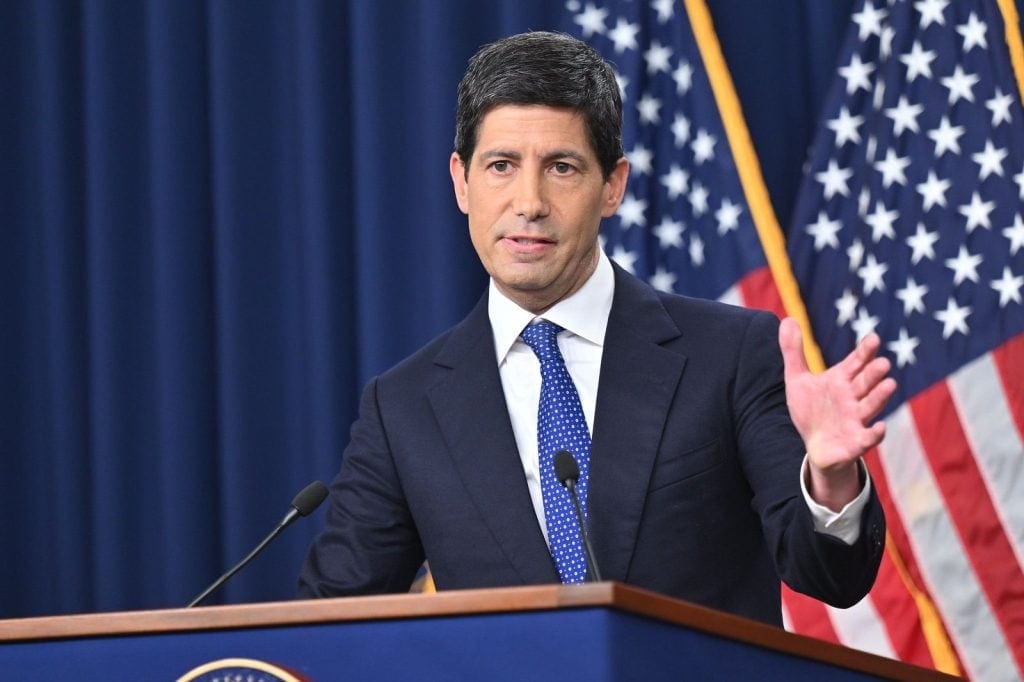
Federal Reserve Chair Kevin Warsh. Image source: Official Federal Reserve Photo. Image source: Official Federal Reserve Photo.
What Warsh’s warning means
Importantly, cautioning about the dangers of inflation is nothing new for Warsh. He warned in a March 2010 speech, “Central banks that desire just a little more inflation may well end up with a lot more.”
The Federal Reserve has two primary weapons in its arsenal to combat inflation. It can raise the federal funds rate, the rate that banks charge each other for overnight loans. It can also reduce the size of its balance sheet.
Raising the federal funds rate makes borrowing more expensive. This move slows the economy and lowers inflation over time.
Shrinking the Fed’s balance sheet (also known as quantitative tightening) involves the Fed allowing its U.S. Treasury bonds and mortgage-backed securities to mature without reinvesting the money. This action can drive bond yields and market interest rates higher, which raises the cost of borrowing for U.S. businesses and consumers.
Warsh was asked in his recent press conference about his previous references to shrinking the Fed’s balance sheet. He replied that the Fed’s Balance Sheet Task Force is working to make recommendations, but the FOMC probably won’t receive feedback until the first quarter of 2027. Warsh added, “And if we decide to make changes in the balance sheet, it’ll be after a serious consideration of their proposals and their recommendations.”
Practically speaking, the Fed isn’t likely to wait on the task force’s recommendations to take action in lowering inflation. That means more rate hikes are almost certainly on the way.
What history says comes next
Three past rate-hike cycles provide clues about what could happen to the U.S. economy and stock market if the Fed continues raising rates.
The first is when the Fed, led by former Chair Paul Volcker, dramatically raised the federal funds rate to 20% from 1979 through 1981 to break the persistent high inflation of the 1970s. Volcker and company’s move indeed led to a decline in inflation; it also triggered a recession and a more than 20% decline in the S&P 500 (SNPINDEX:^GSPC) from early 1981 to mid-1982.
Former Fed Chair Alan Greenspan spearheaded multiple rate increases in 1994 and early 1995. His action wasn’t taken to lower surging inflation but instead to pre-emptively address fears that inflation would rise. The result: Greenspan guided the economy to a soft landing that many believe set the stage for the tremendous stock market boom of the second half of the 1990s.
The third example is when the Fed, under the leadership of Warsh’s predecessor, Jerome Powell, aggressively raised rates in 2022 and 2023. The tightening brought down inflation from over 9% to below 3% without triggering a recession. However, the S&P 500 fell into a bear market in 2022.
Which of these historical precedents is most similar to today? Probably Powell’s rate hikes in 2022 and 2023. He faced inflation that had been elevated for an extended period. The Fed’s credibility was also under the microscope. The big difference between then and now, though, is that inflation was significantly higher before Powell took action than it is in 2026. On the other hand, the stock market is more richly valued now than it was in 2022.
What investors should do
More rate hikes appear to be coming. CME Group‘s (NASDAQ:CME) FedWatch estimates the probability of the FOMC raising rates at its December 2026 meeting at 70.9%. The odds of another rate increase in January are 79%.
The stock market typically responds negatively to aggressive rate-hike cycles. However, as demonstrated under Greenspan in the 1990s, soft landings are possible.
What should investors do? Be ready for any scenario. Avoid stocks that are highly sensitive to rates (for example, growth stocks with stretched valuations). Focus on high-quality stocks, especially dividend stocks, which tend to outperform during turbulent times.
The most important thing investors should do, though, is to be patient. Interest rates rise and fall. But a diversified portfolio of solid stocks should deliver positive returns over the long term.
Missed Nvidia in 2009? This Rare Signal Is Flashing Again
In 2009, a “Double Down” signal flashed for a little-known chipmaker called Nvidia. If you’d invested $5,000 then, you’d be sitting on $2,660,110 today.*
Now, for the first time in years, that same “Total Conviction” signal is flashing for a company 1/100th the size of Nvidia. It’s a key player in the $1.8 trillion space race, and with the stock recently sitting 20% off its highs, the window to get in early is closing fast.
Continue »
*Stock Advisor returns as of November 2, 2026.
Keith Speights has no position in any of the stocks mentioned. The Motley Fool has positions in and recommends CME Group. The Motley Fool has a disclosure policy.