Key Points
-
The economy added 165,000 jobs, well above expectations.
-
70,000 of these gains came in the professional and business services category.
-
Job reports have been inconsistent this year, so it’s tough to take too much from one report.
-
The U.S. economy added a seasonally adjusted 165,000 jobs in October, according to recently published data from the Bureau of Labor Statistics (BLS). That’s well above the 59,000 economists had been expecting.
The unemployment rate fell slightly to 4.1%. Meanwhile, average hourly earnings increased 0.4% for the month and are up 3.1% year over year.
Missed Nvidia in 2009? This Rare Signal Is Flashing Again. In 2009, a “Double Down” signal flashed for a little-known chipmaker called Nvidia. For the first time in years, that same “Total Conviction” signal is flashing for a company 1/100th the size of Nvidia. Continue »
Strong monthly job gains were made in professional and business services (70,000); healthcare and social assistance (55,000); and transportation (24,800). Jobs were lost in leisure and hospitality (13,000), wholesale trade (9,100), and construction (3,000).
BLS also revised job gains from the prior two months meaningfully higher. The economy actually added 60,000 jobs in September, 31,000 higher than first reported. In August, gains actually totaled 186,000, 53,000 higher than first reported.
Here’s what all of this means for interest rates.
Image source: Getty Images.
Strength in the economy
There’s been lots of concern that high prices, stemming from the Iran war, may be pressuring the consumer, which makes up over two-thirds of U.S. gross domestic product. But the October jobs report shows the opposite.
“You have to look pretty hard to find something to dislike in there,” Allianz Trade North America’s Senior Economist Dan North said, according to CNBC. “It’s a really, really good report, and all around I think you’d say it’s stronger than expected and the best one in a while, and it kind of fits with what I call the stable but perhaps unexciting labor market.”
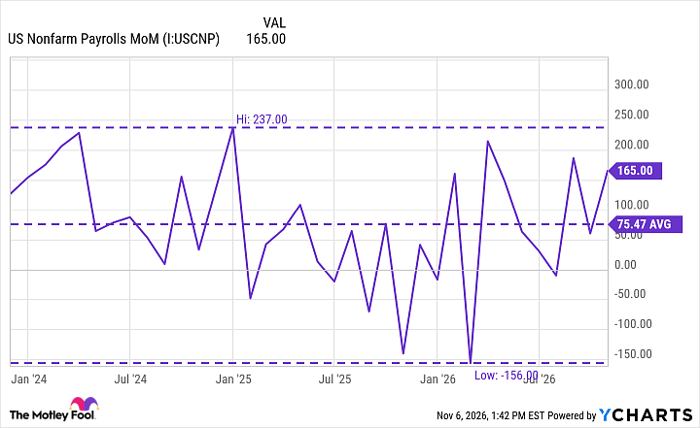
US Nonfarm Payrolls MoM data by YCharts
In particular, the large gains in professional and business services generally reflect underlying economic strength, as many are high-paying jobs.
In prior reports, gains had largely come from healthcare and social assistance, which can grow at any point in the economic cycle.
Jobs reports can affect how the Federal Reserve sets interest rates because when people have jobs, they often have money to spend, and consumer spending accounts for the majority of U.S. GDP.
In recent years, there has been a bad-news-is-good-news mentality, in which investors have perceived strong jobs reports as negative because they are likely to lead to higher or persistently elevated inflation, forcing the Federal Reserve to hike interest rates, which can negatively impact stocks.
How does this impact the trajectory of the Fed?
To assess the probability of the Federal Open Market Committee (FOMC) hiking rates, we can look at CME Group’s FedWatch tool, which looks at 30-day futures to assign probabilities of what the FOMC will do at its upcoming meetings.
On Nov. 5, there was a nearly 67% chance the FOMC would hike rates at its final meeting of the year. Following the jobs report on Nov. 6, that number had jumped to over 78%.
So, the jobs report clearly made investors more worried about persistent inflation and led them to believe the Fed will act at its final meeting of the year. Looking ahead, investors now expect two more rate hikes between now and the end of 2027. Keep in mind these probabilities change frequently.
Truthfully, I wouldn’t read too much into this report. Job reports and revisions have changed so frequently this year that it’s difficult to believe the data from one report alone.
Inflation data and the December jobs report between now and the FOMC’s December meeting could be completely different, changing the narrative. So, while the October report does support a Fed hike in December, a lot will likely happen between now and then.
Missed AI’s “Act 1”? Act 2 Could Be 14x Bigger
Most investors think they missed the AI boat because they didn’t buy Nvidia in 2005.
But according to our analysts, we’re only at the end of “Act 1″—the R&D phase. “Act 2” is the global rollout, a massive technology build-out that Google’s CEO says could be more profound than fire or electricity.
While everyone watches the chip designers, one “backbone” company provides the critical technology that Nvidia and AMD literally cannot function without. We’ve detailed this under-the-radar player in our new AI Playbook.
Continue »
Bram Berkowitz has no position in any of the stocks mentioned. The Motley Fool has positions in and recommends CME Group. The Motley Fool has a disclosure policy.