Key Points
-
Nvidia, Apple, and Microsoft were around 45% of the fund as of Sept. 30.
-
Chipmakers and chip-equipment companies were more than 40% of the fund’s stock holdings.
-
For the last 20 years, the fund’s price has gained around 16% a year.
-
Shareholders in the Vanguard Information Technology ETF (NYSEMKT:VGT) have had a great run. On price alone, the fund has gained around 23% a year for the past decade.
The last few weeks have been rougher. The fund’s record close so far came on Oct. 6, at $129.80.
Missed AI’s “Act 1”? Act 2 Could Be 15x Bigger. Most investors think they missed the AI boat because they didn’t buy Nvidia in 2005. But according to our analysts, we’re only at the end of “Act 1″—the R&D phase. “Act 2” is the global rollout. Continue »
As I write this, shares cost roughly $117, or about 10% less. Even so, the fund has risen about 25% in 2026.
What could $5,000 put into the fund today be worth by the end of 2030? I estimate about $8,000.
This assumes the fund’s price climbs about 12% a year over a bit more than four years — about half the rate of the past decade. It’d take a share price around $189 to get there, or about 46% above the fund’s highest close.
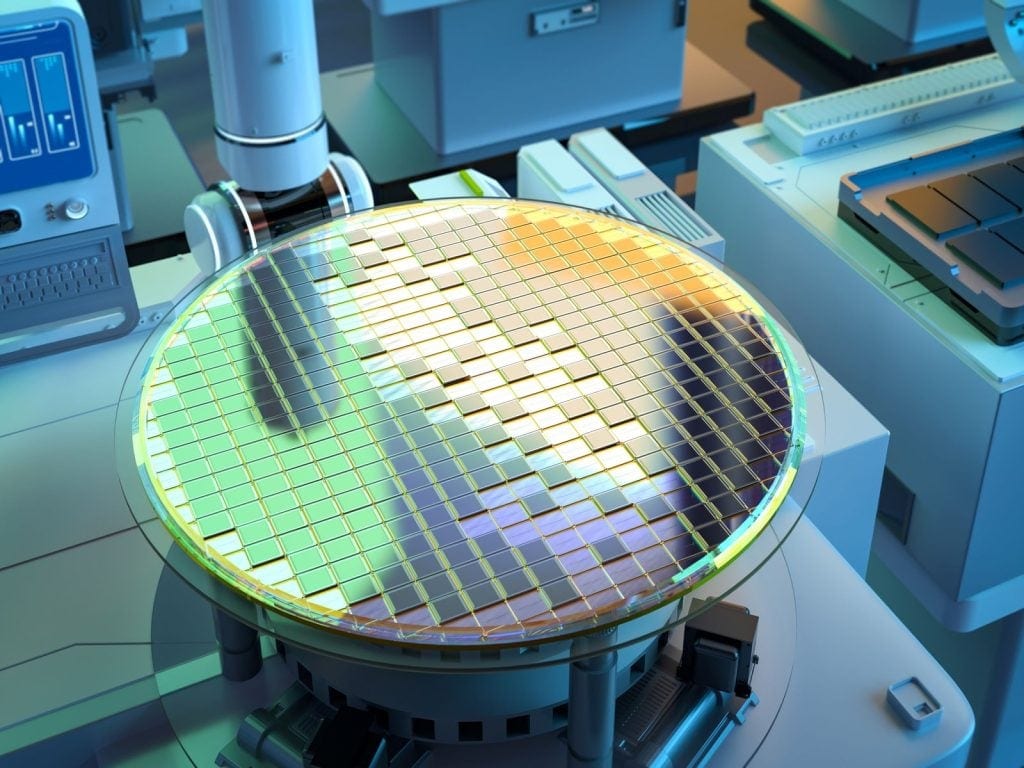
Image source: Getty Images.
Three giants and lots of chips
The fund owned 318 stocks as of Sept. 30, but a few of them do most of the work. Nvidia (NASDAQ:NVDA) made up around 18% of its assets, Apple (NASDAQ:AAPL) about 16%, and Microsoft (NASDAQ:MSFT) about 11%, according to Vanguard. Together, the three were about 45% of the fund.
It also leans hard on one industry. Semiconductor companies were around 38% of its stock holdings, and chip-equipment makers were another 5.5%. All told, over 40 cents of every dollar in the fund is in the chip business.
This matters because chip profits can swing wildly. Showing just how quickly things can shift, Micron Technology, the fund’s fourth-largest holding, had net income of $778 million in its fiscal 2024. In fiscal 2025, it made $8.5 billion. And in fiscal 2026 (ended Sept. 3, 2026), it made almost $85 billion.
Profits that rise that fast can shrink fast, too, when memory prices turn.
Why not 23% a year?
I don’t expect the last decade to repeat.
Part of the reason is the starting price. Vanguard put the fund’s price-to-earnings ratio at around 33 as of Sept. 30, compared to about 25 for the Vanguard S&P 500 ETF. In other words, a buyer of the tech fund pays around a third more for every dollar of earnings than a buyer of the S&P 500 fund does.
The other part is the chip cycle, which has hit this fund hard before. Its price sank around 35% from its late-2021 high to its bottom in October 2022. And from late 2007 to late 2008, it dropped about 55%.
I’ve cut the fund’s 20-year rate of around 16% a year to about 12%. That leaves room for investors to pay a little less for every dollar of earnings by 2030, and for at least one tough patch along the way. And the fund’s expense ratio of 0.09% takes just a sliver of that return every year.
The biggest holdings are growing faster than 12%
For the fund’s price to climb 12% a year without a higher valuation, the earnings of the companies in it have to grow at around the same rate. Now, the three largest holdings are clearing that bar.
In its fiscal first quarter of 2027 (ended Sept. 30, 2026), Microsoft’s non-GAAP (adjusted) earnings per share grew 18% year over year. Growth in its cloud business sped up to 30%, too.
Apple’s earnings per share rose 29% in its fiscal third quarter of 2026 (ended June 27), or around 22% without a $0.11 lift from tariff refunds. And Nvidia‘s revenue more than doubled year over year to $96.2 billion in its fiscal second quarter of 2027 (ended July 26). That was up 18% from the previous quarter alone.
Of course, growth that fast likely won’t last at companies this large. But my estimate gives the fund’s biggest holdings room to slow down considerably and still do their part.
In the end, I think around $8,000 is a fair estimate for $5,000 put into the fund today. That would still be a great return over a bit more than four years.
Sure, spending on artificial intelligence might keep the fund’s chip stocks booming longer than I expect. But with over 40% of the fund in an industry known for sharp downturns, I wouldn’t count on another decade like the last one. I’d consider owning the fund as one piece of a diversified portfolio, with expectations closer to 12% a year than 23%.
Should you buy stock in Vanguard Information Technology ETF right now?
Before you buy stock in Vanguard Information Technology ETF, consider this:
The Motley Fool Stock Advisor analyst team just identified what they believe are the 10 best stocks for investors to buy now… and Vanguard Information Technology ETF wasn’t one of them. The 10 stocks that made the cut could produce monster returns in the coming years.
Consider when Netflix made this list on December 17, 2004… if you invested $1,000 at the time of our recommendation, you’d have $334,793!* Or when Nvidia made this list on April 15, 2005… if you invested $1,000 at the time of our recommendation, you’d have $1,257,420!*
Now, it’s worth noting Stock Advisor’s total average return is 874% — a market-crushing outperformance compared to 209% for the S&P 500. Don’t miss the latest top 10 list, available with Stock Advisor, and join an investing community built by individual investors for individual investors.
See the 10 stocks »
*Stock Advisor returns as of November 1, 2026.
Daniel Sparks and his clients have positions in Apple. The Motley Fool has positions in and recommends Apple, Micron Technology, Microsoft, Nvidia, and Vanguard S&P 500 ETF. The Motley Fool has a disclosure policy.