Key Points
-
Sandisk has plunged by roughly 60% over the past two months despite better fundamentals and a low valuation.
-
The company has been in a rush to buy back more shares as supply chains for memory products continue to tighten.
-
Sandisk has secured multiyear deals with key customers and will likely win more lucrative deals in 2027 as memory prices soar.
-
Sandisk (NASDAQ:SNDK) completed its 8-for-1 stock split after the market close on Nov. 19. Thanks to that split, the stock now trades below $100 per share. That doesn’t make it a better deal than it was just a few days ago, but Sandisk’s fundamentals still make it look attractive.
The stock split helps with volume
A stock split is just taking the same pie — that is, the company — and cutting it into smaller pieces. It’s the same pie. A disgusting pie will still taste disgusting no matter how much you slice it up, while a delicious pie will retain its taste.
Missed Nvidia in 2009? This Rare Signal Is Flashing Again. In 2009, a “Double Down” signal flashed for a little-known chipmaker called Nvidia. For the first time in years, that same “Total Conviction” signal is flashing for a company 1/100th the size of Nvidia. Continue »
So Sandisk shares will retain the same valuation relative to the business that they had before, but there is one key factor in splits that will boost their volatility. A lower stock price helps with volume and makes options trading more accessible.
More call and put options can make Sandisk’s stock price more volatile by increasing volume. Options contracts are traded in 100-share batches, so by lowering the share price, the split makes it feasible for many more investors to take part in that type of trading. That’s true for any stock split, and it’s worth noting. However, Sandisk’s fundamentals are far more important.
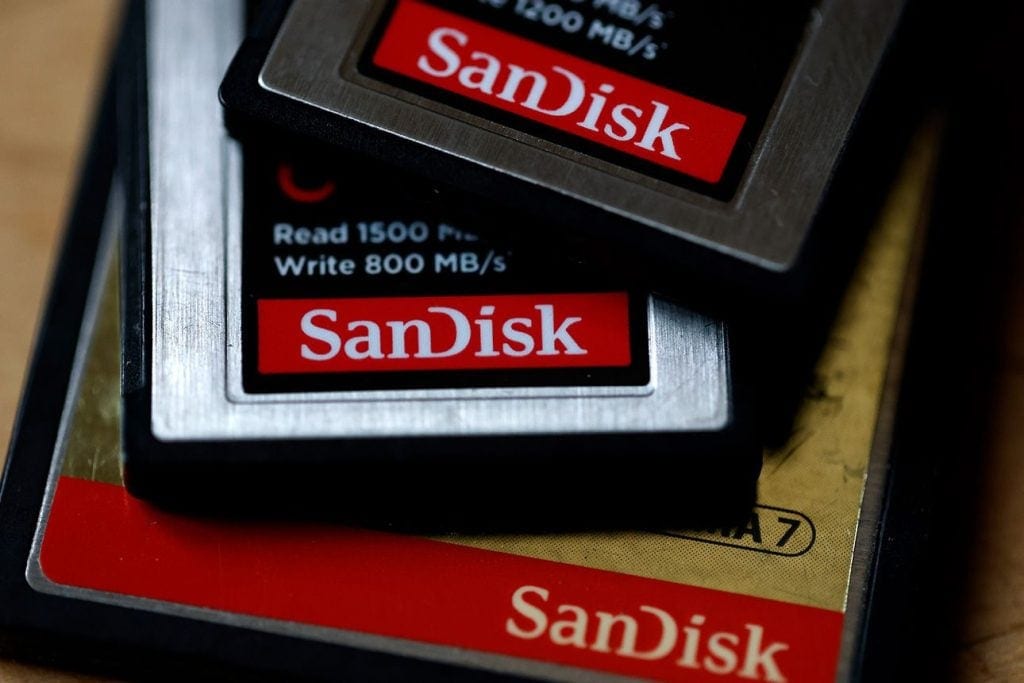
Image source: Getty Images.
Memory demand continues to surge
While AI processor chips such as GPUs have been capturing headlines for years, memory chips have become just as vital for the AI boom. Sandisk has been a major beneficiary of the steep rise in demand for memory; its stock surged by more than 4,000% over a 12-month period before a sharp correction dragged it back down, but it is still up by about 1,800% from where it traded after Western Digital (NASDAQ:WDC) spun it back off in February 2025.
The fundamentals look better than ever, highlighted by $11 billion in revenue in its fiscal 2027 first quarter (which ended Oct. 2). That was a 23% sequential boost and a 378% year-over-year boost. Sandisk also expects $12.6 billion in fiscal Q2 revenue at the high end of its guidance, a 14.5% sequential improvement.
That revenue growth also came with surging profits. Sandisk recorded $8.1 billion in generally accepted accounting principles (GAAP) net income, which was good for a 73.4% net profit margin. Rising profits prompted Sandisk to buy back $5 billion worth of shares in the quarter. Stock buybacks have totaled 4% of shares outstanding over the past two quarters. Sandisk will have plenty of financial flexibility to extend its stock buyback spree, especially if the price remains discounted.
Sandisk only trades at a P/E ratio of roughly 5.5, giving it a lot of upside potential. The valuation gets more lopsided in favor of investors when you consider Sandisk’s $8.1 billion in quarterly revenue against its $97 billion market cap. On an annualized basis, that equates to a P/S ratio of about 3.
The AI tailwinds are far from abating
Artificial intelligence is still evolving. Self-driving vehicles and humanoid robots are still in early development, but are expected to become mainstream products and services. Micron (NASDAQ:MU) Chief Technology Officer Scott DeBoer said that he expects memory chip supply to be tighter in 2027 than it was in 2026.
That news directly impacts Sandisk, which manufactures NAND flash memory and solid-state drives, both of which are critical for AI data centers. That demand prediction also lines up with Grand View Research’s prediction that the artificial intelligence market will grow at a compound annual rate of 37.7% through 2033.
Sandisk’s recent stock price suggests something different. Shares have plunged by about 61% over the past two months. Concerns about a potential AI bubble have been overblown, and Jensen Huang’s return as CEO of Nvidia (NASDAQ:NVDA) may bring forth a return to fundamental analysis over short-term negative sentiment.
To Sandisk’s credit, the company has been securing multiyear sales agreements with key customers, offering revenue visibility across multiple years and longer-than-usual guarantees of premium pricing for its memory. That secures some of Sandisk’s revenue and creates a robust backlog. It simultaneously tightens memory supply, which gives the company flexibility to charge higher prices for future deals.
Should you buy stock in Sandisk right now?
Before you buy stock in Sandisk, consider this:
The Motley Fool Stock Advisor analyst team just identified what they believe are the 10 best stocks for investors to buy now… and Sandisk wasn’t one of them. The 10 stocks that made the cut could produce monster returns in the coming years.
Consider when Netflix made this list on December 17, 2004… if you invested $1,000 at the time of our recommendation, you’d have $328,591!* Or when Nvidia made this list on April 15, 2005… if you invested $1,000 at the time of our recommendation, you’d have $924,693!*
Now, it’s worth noting Stock Advisor’s total average return is 791% — a market-crushing outperformance compared to 201% for the S&P 500. Don’t miss the latest top 10 list, available with Stock Advisor, and join an investing community built by individual investors for individual investors.
See the 10 stocks »
*Stock Advisor returns as of November 29, 2026.
Marc Guberti has no position in any of the stocks mentioned. The Motley Fool has positions in and recommends Micron Technology and Nvidia. The Motley Fool has a disclosure policy.