Key Points
-
The foundry market has been growing at a nice clip, driven by the booming demand for AI chips.
-
Intel can address the foundry supply shortage, and its latest customer win for the 18A process node indicates the company is moving in the right direction.
-
Shares of Intel (NASDAQ:INTC) have fallen off a cliff in the second half of 2026, losing 60% of their value since the beginning of July following a tremendous start to the year.
The broader decline in the semiconductor sector is partially responsible for Intel’s decline. However, it is worth noting that the pullback was exacerbated by the company’s third-quarter results last month. Though Intel’s revenue and earnings exceeded expectations, its Q4 guidance was well below what Wall Street was looking for.
Missed Nvidia in 2009? This Rare Signal Is Flashing Again. In 2009, a “Double Down” signal flashed for a little-known chipmaker called Nvidia. For the first time in years, that same “Total Conviction” signal is flashing for a company 1/100th the size of Nvidia. Continue »
However, Intel stock showed signs of breaking out on Nov. 19 following remarks from CEO Lip-Bu Tan. Let’s see what Tan said and check whether this development can bring Intel out of the rut it is in.
Intel has won its first 18A foundry customer
CNBC reports that Intel’s foundry division has won the first outside customer for chips manufactured on the 18A process node. Speaking at a business summit in Austin, Texas, Tan noted that the company has “just signed the first customer” for 18A. This could be a big deal for Intel, especially considering that the foundry market has been growing at an incredible pace due to artificial intelligence (AI)-fueled demand.
Foundry giant Taiwan Semiconductor Manufacturing (NYSE:TSM) has been winning big in the foundry market, driven by strong demand for its advanced process nodes used by leading chip designers to manufacture AI chips. TSMC has built a strong customer base that includes Nvidia, AMD, Qualcomm, Apple, Broadcom, Marvell Technology, and others.
This explains why TSMC’s revenue has increased by 44% in the first 10 months of 2026. However, TSMC isn’t able to meet the massive demand for AI chips, which explains why the company has been ramping up its capital expenditure. The Taiwan-based foundry giant is on track to spend $60 billion to $64 billion on capex this year, up from $40.9 billion in 2025. What’s more, management notes that TSMC’s capex between 2026 and 2028 will be significantly higher than in the past three years.
TSMC’s forecast suggests a supply gap in the foundry space that needs to be filled. So, Intel’s first external customer for the 18A process node is indeed a big deal, as it indicates the chipmaker can fill that gap. Wall Street analysts estimate that this new customer could be anyone, including Microsoft, Amazon, or Alphabet‘s Google, cloud computing giants that are struggling to secure sufficient chip supply to meet demand.
Tom’s Hardware reported last year that Intel’s 18A could give TSMC’s latest 2-nanometer (nm) process node serious competition. That won’t be surprising, as the 18A process is essentially a 1.8nm node, which explains why it is anticipated to deliver stronger performance and compete with TSMC’s 2nm node.
As such, Intel could gain more customers for 18A in the future, potentially setting the company up for stronger growth.
Why opportunistic investors can consider buying Intel right now
The sharp slide in Intel stock has made it attractive from a valuation perspective. It trades at 30 times forward earnings. Though that’s a premium to the tech-focused Nasdaq-100 index’s forward earnings multiple of 20, investors will do well to note that Intel’s earnings are expected to jump by a whopping 254% in 2026.
Though analysts have reduced their earnings per share (EPS) growth expectations over the next couple of years, they still anticipate a significant acceleration in Intel’s bottom line in 2028.
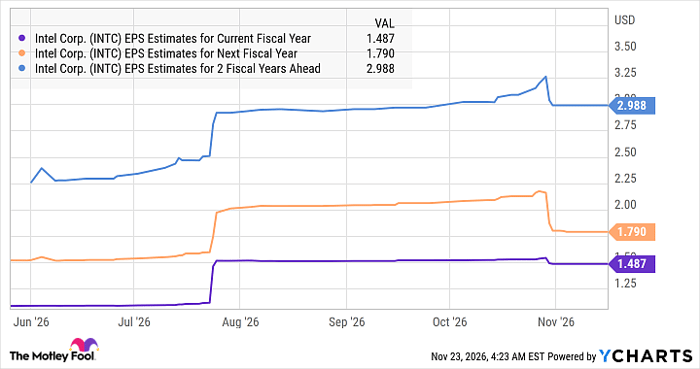
INTC EPS Estimates for Current Fiscal Year data by YCharts
The company’s foray into the foundry market and the potential addition of new external customers should pave the way for Intel to beat analysts’ earnings growth expectations, providing the stock with a much-needed catalyst. But even if Intel’s EPS reaches $2.99 in 2028 and it continues to trade at 30 times earnings, the stock price could jump to $90.
That signifies a potential 76% upside in just over two years, which is why savvy investors looking for a beaten-down growth stock that could go on a bull run may consider buying Intel following its recent slide.
Should you buy stock in Intel right now?
Before you buy stock in Intel, consider this:
The Motley Fool Stock Advisor analyst team just identified what they believe are the 10 best stocks for investors to buy now… and Intel wasn’t one of them. The 10 stocks that made the cut could produce monster returns in the coming years.
Consider when Netflix made this list on December 17, 2004… if you invested $1,000 at the time of our recommendation, you’d have $305,941!* Or when Nvidia made this list on April 15, 2005… if you invested $1,000 at the time of our recommendation, you’d have $771,325!*
Now, it’s worth noting Stock Advisor’s total average return is 719% — a market-crushing outperformance compared to 192% for the S&P 500. Don’t miss the latest top 10 list, available with Stock Advisor, and join an investing community built by individual investors for individual investors.
See the 10 stocks »
*Stock Advisor returns as of November 23, 2026.
Harsh Chauhan has no position in any of the stocks mentioned. The Motley Fool has positions in and recommends Advanced Micro Devices, Alphabet, Amazon, Apple, Broadcom, Intel, Marvell Technology, Microsoft, Nvidia, Qualcomm, and Taiwan Semiconductor Manufacturing. The Motley Fool has a disclosure policy.