Key Points
-
Zepbound and Foundayo currently anchor Eli Lilly’s obesity lead.
-
Retatrutide and EloraTZP outperformed Zepbound in weight-loss trials, though not yet in head-to-head Phase 3 studies.
-
Eli Lilly looks positioned to keep the obesity crown, which supports paying a premium for the stock.
-
The weight loss drug market is one of the hottest areas in the pharmaceutical industry right now, and according to projections, it will continue growing rapidly over the medium term. Eli Lilly (NYSE:LLY) is currently a leader in this space.
Missed AI’s “Act 1”? Act 2 Could Be 15x Bigger. Most investors think they missed the AI boat because they didn’t buy Nvidia in 2005. But according to our analysts, we’re only at the end of “Act 1″—the R&D phase. “Act 2” is the global rollout. Continue »
Its financial results in recent quarters have been excellent, partly thanks to its obesity franchise. Even though some investors worry that increased competition will erode Eli Lilly’s market share, the company’s pipeline appears strong enough to withstand the challenge. Here’s more on why Eli Lilly is well positioned to remain the top player in the anti-obesity space over the next five years.
Image source: Getty Images.
An embarrassment of riches
Eli Lilly’s approved weight loss portfolio currently includes injectable tirzepatide, sold under the brand name Zepbound in this market, and Foundayo, an oral anti-obesity treatment. Zepbound was first approved about three years ago, and it is posting outstanding sales growth. In the third quarter, Zepbound’s revenue increased by 49% year over year to $5.4 billion.
Foundayo earned approval in April, and it has had a fairly strong commercial ramp-up so far. In the third quarter, it generated $184 million in revenue. Competitors might launch treatments that rival — or perhaps even exceed — Zepbound and Foundayo in efficacy. But Eli Lilly will do the same, which may help the company defend, or even improve, its market share. Below are some of Eli Lilly’s most important pipeline candidates.
| Drug |
How it works |
Stage |
Best weight loss |
Trial context |
| Zepbound (tirzepatide) |
Dual GIP and GLP-1 receptor agonist |
Approved |
22.5% |
Adults without diabetes, 72 weeks |
| Retatrutide |
Triple GIP, GLP-1, and glucagon receptor agonist |
Phase 3 complete; FDA filing planned for Q1 2027 |
28.3% |
Adults without diabetes, 80 weeks |
| Eloralintide |
Selective amylin receptor agonist |
Phase 3 |
20.1% |
Phase 2: adults without diabetes, 48 weeks |
| EloraTZP (eloralintide + tirzepatide) |
Amylin agonist combined with a dual GIP and GLP-1 agonist |
Phase 3 starting in Q4 2026 |
23.3% |
Phase 2b: adults with type 2 diabetes, 48 weeks; tirzepatide alone lost 14.8% |
Data from Eli Lilly. Chat by the author.
Note that two of these candidates, retatrutide and EloraTZP, achieved greater weight loss than Zepbound, although head-to-head comparisons remain somewhat limited. This does raise a potential problem, however.
Will these new medicines cannibalize Zepbound sales? Some of that will happen, and for what it’s worth, it’s better if Eli Lilly’s own products capture sales from older ones rather than other pharmaceutical giants taking market share away from the company. However, newer products will also help Eli Lilly expand the market.
First, medicines with greater weight-loss efficacy will help the company attract patients who haven’t lost enough weight on Zepbound alone.
In fact, Lilly has already made retatrutide available to some patients, despite it not yet being approved. Eligible patients must have failed to respond to standard obesity interventions, among other criteria.
Second, eloralintide isn’t a GLP-1 product. It mimics the amylin hormone, a differentiated approach that could yield improved tolerability. Eloralintide demonstrated weight-loss efficacy comparable to GLP-1 products in Phase 2 studies, with strong tolerability.
Further, Eli Lilly’s expanding portfolio could help it maintain strong pricing power, even as more weight-loss options enter the market. Treatments with stronger efficacy than Zepbound could command a premium price. That may allow the company to keep revenue growing fast while also preserving its margins and profits. Here’s the most important point.
While an increasingly competitive weight-loss market is often cited as one reason Eli Lilly isn’t worth investing in right now, the company’s pipeline suggests it could perform just fine despite the challenge.
What this means for Eli Lilly
Eli Lilly’s revenue and earnings have grown at much higher rates than the industry averages in recent years.
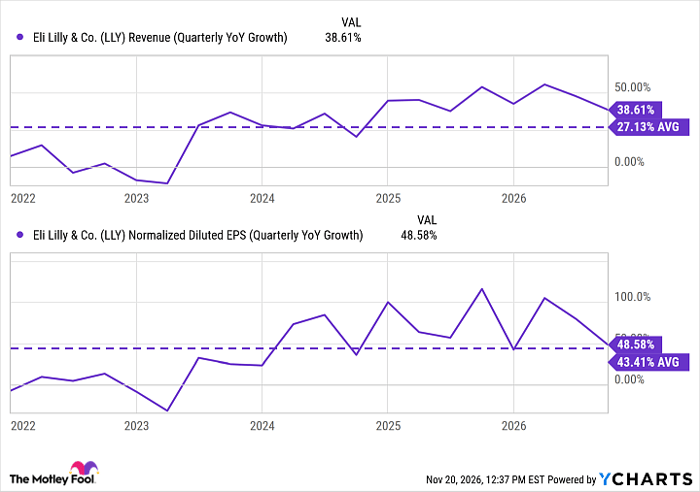
LLY Revenue (Quarterly YoY Growth) data by YCharts
For context, a pharmaceutical leader with a double-digit year-over-year revenue rate is already pretty impressive. Eli Lilly’s growth rate will eventually slow. But given its work in the weight loss market, the drop might not be that dramatic, especially when we also factor in the clinical and commercial progress it is making in other areas, such as diabetes, oncology, immunology, and neuroscience.
An earnings per share (EPS) growth rate of about 20% to 25% over the next five years seems reasonable for the company, and considering the progress it is still making across various areas, the market may continue to price the stock at a premium. Given all that, Eli Lilly’s forward price-to-earnings ratio of 27.2 doesn’t seem unreasonable, even though it’s much higher than the 18.9 average for healthcare stocks. The stock is a buy.
Should you buy stock in Eli Lilly right now?
Before you buy stock in Eli Lilly, consider this:
The Motley Fool Stock Advisor analyst team just identified what they believe are the 10 best stocks for investors to buy now… and Eli Lilly wasn’t one of them. The 10 stocks that made the cut could produce monster returns in the coming years.
Consider when Netflix made this list on December 17, 2004… if you invested $1,000 at the time of our recommendation, you’d have $305,941!* Or when Nvidia made this list on April 15, 2005… if you invested $1,000 at the time of our recommendation, you’d have $771,325!*
Now, it’s worth noting Stock Advisor’s total average return is 719% — a market-crushing outperformance compared to 192% for the S&P 500. Don’t miss the latest top 10 list, available with Stock Advisor, and join an investing community built by individual investors for individual investors.
See the 10 stocks »
*Stock Advisor returns as of November 22, 2026.
Prosper Junior Bakiny has positions in Eli Lilly. The Motley Fool has positions in and recommends Eli Lilly. The Motley Fool has a disclosure policy.