Key Points
-
The crypto market fell significantly over the last couple of months.
-
That makes the burst of market activity in the late summer look like a fluke.
-
It’s best to stick to small, cautious crypto purchases rather than aggressively buying the dip right now.
-
The crypto bear market may not be as completely finished as investors had hoped. After a weak October, between Nov. 5 and Nov. 17, Bitcoin (CRYPTO:BTC) fell about 19%, putting its price near $65,000 — not too far from the $58,000 level it hit during the depths of the summer’s doldrums. Other crypto market leaders like Ethereum (CRYPTO:ETH), Hyperliquid (CRYPTO:HYPE), Solana (CRYPTO:SOL), and Zcash (CRYPTO:ZEC) have been falling quickly too.
This pullback wasn’t something I expected, but here’s how I’m planning to make the most of it.
Missed Nvidia in 2009? This Rare Signal Is Flashing Again. In 2009, a “Double Down” signal flashed for a little-known chipmaker called Nvidia. For the first time in years, that same “Total Conviction” signal is flashing for a company 1/100th the size of Nvidia. Continue »
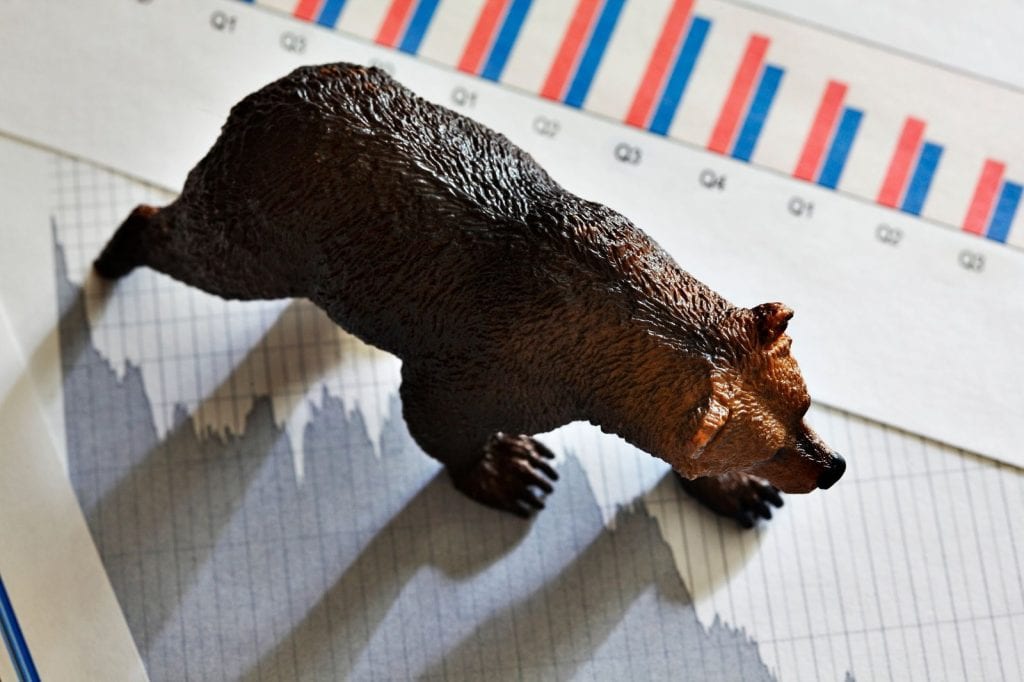
Image source: Getty Images.
Worries are stacking up quickly
First, let’s unpack a few headwinds blowing strongly at the moment.
October’s hot inflation readout increased the odds of the Federal Reserve hiking interest rates at its December meeting, making bonds more tempting and assets that pay no interest, like most of crypto, less appealing to investors. Separately, the Democrats’ incoming takeover of Congress is making the market more volatile due to a widespread (and not entirely accurate) expectation that Democrats are bad for asset prices.
As if that weren’t enough, there’s an ongoing sell-off in artificial intelligence (AI) stocks, which is depressing marketwide sentiment and has just gone into overdrive as a result of the Nvidia drama.
Then there’s the collection of crypto-specific problems, most of which would be digested by the market as fairly routine if they weren’t happening at the same time as the above.
Hackers stole $6.3 billion in funds from Binance in October. Then, as part of the ongoing sell-off, investors withdrew $1.3 billion from U.S. Bitcoin exchange-traded funds (ETFs) in the week ending Nov. 6, with additional withdrawals in the subsequent week.
On Nov. 8, Ethereum co-founder Vitalik Buterin attempted to offer a new vision for how the market should assign value to the chain. He argued the coin should be valued as a store of value, backed by its chain’s decentralization and privacy, rather than by the fees it generates — a step away from a popular reason to buy it. That prompted a lot of soul-searching among the coin’s longtime holders, and it was likely another blow to the market’s fragile sentiment.
Finally, as marketwide selling accelerated on Nov. 15, about $2 billion in leveraged crypto positions were liquidated, sending the market lower.
Why isn’t good news lifting Hyperliquid?
One particularly concerning aspect of the ongoing downtrend is that positive news and good financial performance are not leading to consistent increases in the prices of leading assets.
For example, Hyperliquid runs a blockchain exchange for perpetual futures (perps), price-tracking contracts that never expire, and on Oct. 29, the New York Stock Exchange’s parent company, Intercontinental Exchange, inked a deal to run new U.S. perps markets designed by TradeXYZ and built on Hyperliquid’s technology, pending regulatory approval. As far as upside catalysts go, it’s hard to imagine a better one for Hyperliquid than that.
Hyperliquid brought in $71.7 million in revenue in the 30-day period ending on Nov. 17. Yet the coin is now 29.2% below its all-time high set earlier this year. And the three Hyperliquid ETFs have had six straight weeks of net capital outflows through Nov. 13.
When investors sell a project that’s making money and teeing up future income, it signals very low confidence, suggesting the crypto bear market never ended despite some excitement in the late summer.
I am taking this signal as an opportunity to reassess my read on the crypto market.
My prior analysis was that the bear market was over, due to the now-erased rebound in Bitcoin’s price, the continued uptrends in Zcash, Hyperliquid, and Solana, and an explosion of new projects hosted on Solana and elsewhere. I calculated that their strong performance, both in their fundamentals and in price, would enable them to muddle through the uncertainty and headwinds I knew they were facing. That could still happen, but it’s now less probable.
Instead, I’m now assessing that I should look for opportunities to slowly buy the dip in these assets with small amounts of capital, with the intention of holding whatever I buy for at least a handful of years. After all, the market could keep falling from here if the bear market really is back.
Even if it doesn’t, the arrival of a new crypto bull market looks a lot further away than it did just a few months ago.
Should you buy stock in Bitcoin right now?
Before you buy stock in Bitcoin, consider this:
The Motley Fool Stock Advisor analyst team just identified what they believe are the 10 best stocks for investors to buy now… and Bitcoin wasn’t one of them. The 10 stocks that made the cut could produce monster returns in the coming years.
Consider when Netflix made this list on December 17, 2004… if you invested $1,000 at the time of our recommendation, you’d have $322,605!* Or when Nvidia made this list on April 15, 2005… if you invested $1,000 at the time of our recommendation, you’d have $927,581!*
Now, it’s worth noting Stock Advisor’s total average return is 790% — a market-crushing outperformance compared to 202% for the S&P 500. Don’t miss the latest top 10 list, available with Stock Advisor, and join an investing community built by individual investors for individual investors.
See the 10 stocks »
*Stock Advisor returns as of November 19, 2026.
Alex Carchidi has positions in Bitcoin, Ethereum, Hyperliquid, Nvidia, Solana, and Zcash. The Motley Fool has positions in and recommends Bitcoin, Ethereum, Hyperliquid, Nvidia, and Solana. The Motley Fool recommends Intercontinental Exchange. The Motley Fool has a disclosure policy.