Key Points
-
Prominent Wall Street bears warn that excessive AI spending and historically high valuations could trigger a devastating market crash.
-
The S&P 500’s forward price-to-earnings ratio has fallen to its lowest level in three years as corporate earnings growth has accelerated.
-
AI adoption is outpacing previous technological revolutions, and measurable productivity gains suggest the boom has genuine economic benefits.
-
The artificial intelligence (AI) boom began in earnest when OpenAI introduced ChatGPT in November 2022. Since then, the S&P 500 (SNPINDEX:^GSPC) and Nasdaq Composite (NASDAQINDEX:^IXIC) have advanced 90% and 122%, respectively, as investors have poured money into companies developing AI chips, infrastructure, and software.
However, the enthusiasm has been accompanied by a growing chorus of warnings that AI stocks are in a speculative bubble. And several prominent financial experts think the boom will end with a devastating stock market crash, potentially dragging the U.S. economy into a recession.
Missed AI’s “Act 1”? Act 2 Could Be 15x Bigger. Most investors think they missed the AI boat because they didn’t buy Nvidia in 2005. But according to our analysts, we’re only at the end of “Act 1″—the R&D phase. “Act 2” is the global rollout. Continue »
Those concerns deserve consideration, and some arguments have merit, but Wall Street’s doomsayers seem to be ignoring crucial facts about the stock market’s valuation and the economic benefits of AI.
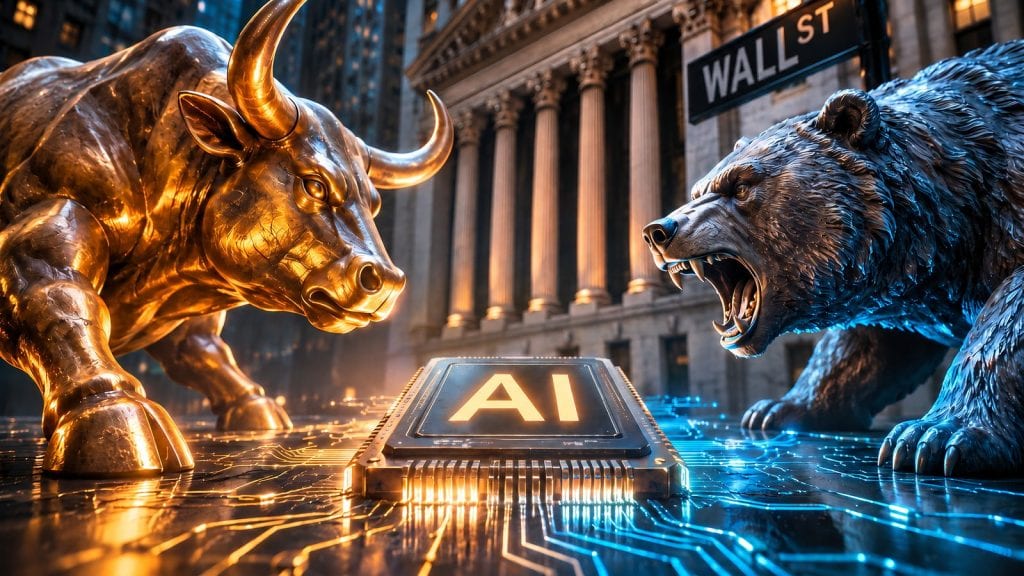
Image source: OpenAI (AI-generated illustration).
Wall Street’s doomsayers are sounding an alarm about an AI bubble
Former SEC Chair Gary Gensler recently warned that artificial intelligence had already formed a stock market bubble that could burst and trigger a recession before the 2028 presidential election. In an interview with CNN, he expressed concern about the massive amount of money being invested in AI infrastructure, particularly the growing reliance on debt and complex financing deals.
Admittedly, Gensler makes good points, and he is not alone. Michael Burry, the investor who famously predicted the collapse of the U.S. housing market in 2008, has also warned that technology companies are spending too much relative to profits they are likely to earn. “It is just an asset bubble, plain and simple,” he wrote earlier this year. “This, all of it, is the scene of the bloody car crash, minutes before it happens.”
Meanwhile, Jeremy Grantham, co-founder of investment management firm GMO, had this to say in a research paper published earlier this year: “The rule from history is that great technological innovations lead to great bubbles.” And investment manager John Hussman believes the S&P 500 could eventually fall between 50% and 75% when the bubble bursts.
These warnings share several common themes. Technology companies are spending an unprecedented amount of money on AI infrastructure, often without a clear timeline for generating returns. Circular financing deals create additional risk, and investors may be overestimating the long-term profitability of AI.
Additionally, many analysts believe stocks are too expensive, and they are quick to point out a particular valuation metric has reached levels last seen during the dot-com bubble.
One metric frequently cited by market bears is the S&P 500’s cyclically adjusted price-to-earnings (CAPE) ratio, which divides stock prices by average inflation-adjusted earnings over the past decade. The S&P 500’s CAPE ratio topped 40 in six consecutive months this year, a level last seen when the dot-com bubble burst in 2000.
However, CAPE is a backward-looking valuation metric. That means it does not account for future earnings growth, which is particularly important when evaluating a transformative technology like AI. Indeed, forward-looking valuation metrics tell a very different story.
The S&P 500’s forward price-to-earnings (PE) ratio rocketed by 20 and eventually topped 25 as the dot-com bubble built momentum in the late 1990s. That happened because stock prices were appreciating much faster than corporate profits were increasing. The S&P 500’s forward PE ratio stayed above 22 until early 2001.
The opposite is happening today. The S&P 500’s forward PE ratio topped 23 last year, but the valuation has gradually moderated as earnings growth has accelerated. Today, the S&P 500 trades at 17.7 times forward earnings, according to FactSet Research. That is the cheapest valuation in more than three years, and it’s a discount to the 10-year average of 18.9.
That doesn’t sound like a bubble. Of course, that argument depends on companies meeting Wall Street’s earnings estimates. But investors have several reasons to believe corporate profits can continue to grow rapidly.
First, AI adoption is happening at an extraordinary pace. The Federal Reserve Bank of St. Louis found that generative AI reached 55% of U.S. adults ages 18 to 64 approximately three years after ChatGPT launched. At comparable stages, personal computers and the internet had adoption rates of just 20% and 30%, respectively.
Second, AI is already generating measurable economic benefits, despite being relatively early in its adoption cycle.
- Financial technology company Klarna estimates that its AI assistant does the work of 853 full-time agents, delivering $58 million in annual cost savings.
- Randomized workplace experiments at Microsoft, Accenture, and an anonymous Fortune 100 company found that AI coding assistants increased completed tasks by 26%.
- Federal Reserve researchers estimate that generative AI may have increased aggregate labor productivity by as much as 1.3% since ChatGPT’s introduction.
There are many other examples. Businesses are already using the technology to reduce costs, boost productivity, and create true value. As adoption broadens and applications improve, those benefits could translate into sustained corporate earnings growth.
Of course, none of this means every AI stock is cheap, nor does it guarantee that the stock market will continue rising. Whether a stock is reasonably valued today ultimately depends on how quickly earnings grow tomorrow. But I do not believe there is decisive evidence that AI stocks are in an epic bubble destined to burst with catastrophic consequences. That is certainly possible, but it is not a foregone conclusion.
Should you buy stock in S&P 500 Index right now?
Before you buy stock in S&P 500 Index, consider this:
The Motley Fool Stock Advisor analyst team just identified what they believe are the 10 best stocks for investors to buy now… and S&P 500 Index wasn’t one of them. The 10 stocks that made the cut could produce monster returns in the coming years.
Consider when Netflix made this list on December 17, 2004… if you invested $1,000 at the time of our recommendation, you’d have $327,620!* Or when Nvidia made this list on April 15, 2005… if you invested $1,000 at the time of our recommendation, you’d have $959,410!*
Now, it’s worth noting Stock Advisor’s total average return is 802% — a market-crushing outperformance compared to 205% for the S&P 500. Don’t miss the latest top 10 list, available with Stock Advisor, and join an investing community built by individual investors for individual investors.
See the 10 stocks »
*Stock Advisor returns as of November 18, 2026.
Trevor Jennewine has no position in any of the stocks mentioned. The Motley Fool has positions in and recommends Accenture Plc, FactSet Research Systems, Klarna Group, and Microsoft. The Motley Fool recommends the following options: long January 2028 $260 calls on Accenture Plc and short January 2028 $280 calls on Accenture Plc. The Motley Fool has a disclosure policy.