When it raises interest rates to fight inflation, the Federal Reserve typically moves very gradually, hiking its target rate by a quarter of a percentage point at a time.
But December may be different. That’s because, after raising the federal funds rate by a quarter of a percentage point at its September meeting, the Fed’s monetary policy committee paused in October to see if inflation was beginning to cool.
Missed AI’s “Act 1”? Act 2 Could Be 15x Bigger. Most investors think they missed the AI boat because they didn’t buy Nvidia in 2005. But according to our analysts, we’re only at the end of “Act 1″—the R&D phase. “Act 2” is the global rollout. Continue »
Suddenly, it looks like that was a poor decision. The Consumer Price Index (CPI), the main measure of inflation in the U.S., was just published and showed that inflation was higher than expected in October. The overall price level rose 0.4% month over month, higher than the 0.3% expected and well above the 0.2% level the Fed would like to see.
Higher energy prices, related to the ongoing conflict with Iran, continued to add to overall inflation. But other sectors saw larger-than-expected increases, too, including housing.
The Fed may have to play catch-up in December
As a result, the Fed may have to play catch-up at its last meeting of the year, on Dec. 8-9. That means it could move from its typical quarter-point hike to a half-point hike, which could be jarring for financial markets unused to larger rate increases.
In fact, one Fed official said it out loud. Fed Governor Christopher Waller said on Nov. 10 in a speech in London that a 50-basis-point (bp) hike — equivalent to half of a percentage point — is merited. If October’s core CPI rate (the rate that excludes volatile food and fuel costs) came in at 0.3% or higher, he said, “I believe a 50-basis-point hike in the policy rate should be considered at the December meeting.” And indeed, core CPI in October was 0.3%.
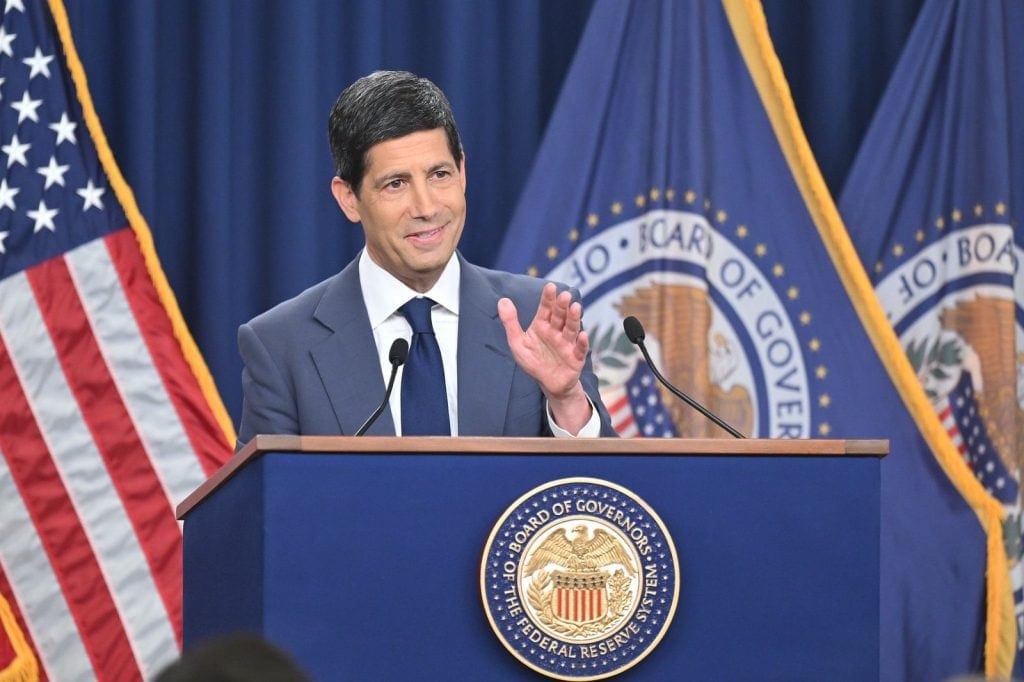
Image source: Official Federal Reserve Photo.
It’s not yet clear that Fed Chair Kevin Warsh is on board with a 50 bp hike in December, and we may get little indication of how he’s leaning before that meeting, as he has come out against giving markets hints of what he’s thinking.
But I think he’ll be won over to a larger hike. Despite not hiking the federal funds rate in October, Warsh sounded very hawkish at his press conference after the October meeting, and with the economy and the labor market appearing very healthy at the moment, he may reason that a larger rate hike won’t harm them much.
Right now, futures traders are pricing in an 87% chance of a quarter-point hike and a 13% chance of a half-point hike. But I believe that will change in the coming weeks. The next key data point to watch is the Personal Consumption Expenditures price index, which will be published on Nov. 25.
If that index, like the CPI, comes in hotter than expected, I expect a half-point hike in December.
Missed Nvidia in 2009? This Rare Signal Is Flashing Again
In 2009, a “Double Down” signal flashed for a little-known chipmaker called Nvidia. If you’d invested $5,000 then, you’d be sitting on $2,116,882 today.*
Now, for the first time in years, that same “Total Conviction” signal is flashing for a company 1/100th the size of Nvidia. It’s a key player in the $1.8 trillion space race, and with the stock recently sitting 20% off its highs, the window to get in early is closing fast.
Continue »
*Stock Advisor returns as of November 14, 2026.
The Motley Fool has a disclosure policy.