Key Points
-
Social Security’s financial outlook has been deteriorating for decades, with the Board of Trustees estimating that sweeping benefit cuts are only six years away.
-
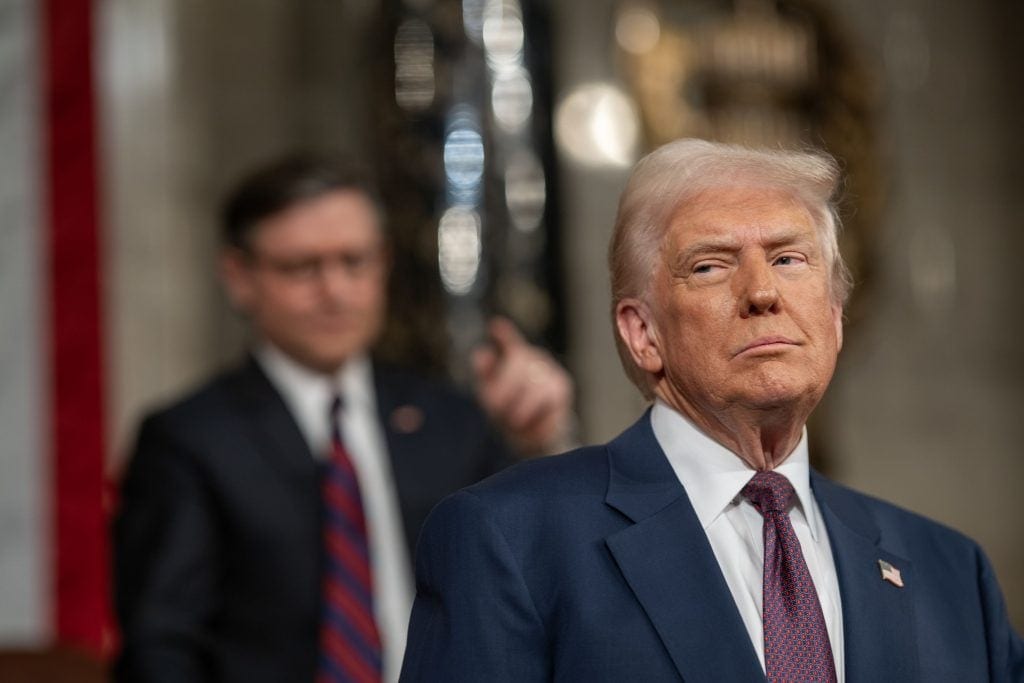
President Trump claimed that “Seniors should not pay tax on Social Security,” but failed to deliver on that promise with the “Big, Beautiful Bill.”
-
While the president’s flagship tax and spending law is helping some Americans retain more of their income, it’s making Social Security’s outlook even more precarious.
-
For most retirees, Social Security provides more than just a check. A quarter-century of annual Gallup surveys show that this Social Security income is relied on by 80% to 90% of retirees, in some capacity, to make ends meet.
But this storied program isn’t on the best financial footing. According to the 2026 Social Security Board of Trustees Report, America’s leading retirement program is staring down a $29.3 trillion funding shortfall through the year 2100. The Trustees Report has cautioned about an unfunded long-term obligation every year since 1985.
Missed AI’s “Act 1”? Act 2 Could Be 15x Bigger. Most investors think they missed the AI boat because they didn’t buy Nvidia in 2005. But according to our analysts, we’re only at the end of “Act 1″—the R&D phase. “Act 2” is the global rollout. Continue »
Furthermore, the latest Trustees Report estimates the Old-Age and Survivors Insurance trust fund (OASI) will exhaust its asset reserves — the excess income collected since inception that’s invested in special-issue, interest-bearing government bonds, as required by law — by the fourth quarter of 2032. Although Social Security isn’t going bankrupt, the existing payout schedule, including annual cost-of-living adjustments, appears unsustainable and may require sweeping benefit cuts in six years.
Despite these challenges, President Donald Trump campaigned (for his second nonconsecutive term) on ending the taxation of Social Security benefits. Halting this highly unpopular tax would enable retirees to retain more of their monthly payout.
While the president’s promise sounded great on paper, he ultimately failed to keep his pledge. Worse yet, his flagship tax and spending law, the “Big, Beautiful Bill,” appears to have accelerated the OASI’s path to insolvency.
Donald Trump failed to end the taxation of Social Security benefits
In late July 2024, mere months before the election, then-Republican presidential nominee Donald Trump wrote in all caps on Truth Social, “Seniors should not pay tax on Social Security.”
Though this wasn’t an official policy proposal from candidate Trump, it set an expectation that, if elected, he would end the taxation of benefits.
Back in 1983, Social Security’s trust funds (the OASI and the Disability Insurance trust fund) were running on fumes. Without reforms, the program’s asset reserves would have been exhausted in less than a year. This led to the passage of the Social Security Amendments of 1983, which, among other things, introduced the taxation of benefits.
Beginning in 1984, up to 50% of an individual’s benefits could be exposed to the federal income tax rate if their provisional income — adjusted gross income + tax-free interest + one-half of benefits — exceeded $25,000 (or $32,000 for a couple filing jointly). A second tax tier was added in 1993, exposing up to 85% of benefits to federal taxation when provisional income topped $34,000 for single filers or $44,000 for couples filing jointly.
When introduced, the tax on benefits affected about one in 10 senior households. But since these provisional income thresholds have never been adjusted for inflation, around 50% of all senior households now pay federal tax on some portion of their Social Security income.
President Trump claimed that his flagship tax and spending law, the Big, Beautiful Bill (signed July 4, 2025), ends the tax on Social Security income — but this isn’t the case.
The president’s tax and spending law temporarily increases the annual standard deduction for eligible seniors aged 65 and over by $6,000 (or $12,000 if filing jointly) from calendar years 2025 through 2028. While this has reduced the federal income tax liability for some retirees, it’s not an end to the taxation of benefits.
Even if President Trump wanted to end the taxation of benefits, it would have proved virtually impossible. It would take 60 of 100 votes in the Senate to amend the Social Security Act, and neither party has had a supermajority in the upper house of Congress since the late 1970s. Ending the taxation of benefits isn’t an issue that would garner bipartisan support.
Long story short, President Trump failed to uphold his pledge to end Social Security taxation.

Image source: Getty Images.
Trump’s Big, Beautiful Bill has created an unsightly problem for Social Security
On top of not sticking to his campaign promise of ending the tax on benefits, the president’s Big, Beautiful Bill looks to have dug an even deeper hole for America’s top retirement program.
There’s no question that select groups of taxpayers are benefiting from the Big, Beautiful Bill. It made the personal income tax bracket reduction from the Tax Cuts and Jobs Act permanent and introduced several temporary tax credits and deductions from 2025 through 2028. In addition to the aforementioned senior deduction, which can provide a beefed-up annual deduction, Trump’s tax law introduced the “no tax on tips” and “no tax on overtime” provisions for eligible workers.
But as the Big, Beautiful Bill giveth to taxpayers, it taketh away from Social Security.
Between 2025 and 2028, the temporary deductions associated with this law are reducing the pool of earned income (wages and salaries, but not investment income) subject to the 12.4% payroll tax. Last year, this payroll tax brought in more than 91% of Social Security’s income.
Shortly after President Trump signed the Big, Beautiful Bill into law, Sen. Ron Wyden (D-OR) requested that the Social Security Administration (SSA) provide a 10-year projection of how it would affect the program. In early August 2025, the SSA’s Office of the Actuary (OACT) published its findings.
The OACT estimates that Trump’s tax and spending law will add $168.6 billion in costs to Social Security from 2025 through 2034. Additionally, the OACT predicted that the OASI’s asset reserve insolvency would shift forward by three months, from the first quarter of 2033 to the fourth quarter of 2032. Perhaps unsurprisingly, the OASI’s asset reserve insolvency timeline moved from the first quarter of 2033 to the fourth quarter of 2032 in the 2026 Social Security Board of Trustees Report.
The law that President Trump claimed ended the taxation of benefits (but didn’t) is accelerating the timeline for sweeping benefit cuts for retired workers and survivors of deceased workers.
The $23,760 Social Security bonus most retirees completely overlook
If you’re like most Americans, you’re a few years (or more) behind on your retirement savings. But a handful of little-known “Social Security secrets” could help ensure a boost in your retirement income.
One easy trick could pay you as much as $23,760 more… each year! Once you learn how to maximize your Social Security benefits, we think you could retire confidently with the peace of mind we’re all after. Join Stock Advisor to learn more about these strategies.
View the “Social Security secrets” »
The Motley Fool has a disclosure policy.