Key Points
-
Nvidia stock fell to about $156 shortly after the Nov. 12 open, roughly 35% below its Oct. 6 record close, after CEO Jensen Huang resigned.
-
Management is calling for about 70% revenue growth in its next fiscal year.
-
At the Nov. 11 close, the stock cost about 11 times next fiscal year’s estimated earnings.
-
Nvidia (NASDAQ:NVDA) stock finished at $173.73 on Wednesday, Nov. 11, roughly 27% off its all-time closing high of $239.24 from Oct. 6. And shares slipped further in after-hours trading that evening, to roughly $159, after The Wall Street Journal reported that Nvidia’s board was preparing to oust CEO Jensen Huang. On Thursday morning, Nov. 12, Nvidia announced that Huang had resigned and named finance chief Colette Kress interim CEO, and the stock fell even further, briefly trading below $150 at the open and sitting at about $156 shortly after, roughly 35% below that record.
The company, meanwhile, keeps growing at a remarkable rate. The artificial intelligence (AI) chip giant’s revenue more than doubled from a year earlier in its last reported quarter, and management sees about 70% growth in its next fiscal year.
Missed AI’s “Act 1”? Act 2 Could Be 15x Bigger. Most investors think they missed the AI boat because they didn’t buy Nvidia in 2005. But according to our analysts, we’re only at the end of “Act 1″—the R&D phase. “Act 2” is the global rollout. Continue »
At what price, then, does the stock become worth buying?
Before today, I generally followed one rule for Nvidia stock: I’d pay up to around 14 times next fiscal year’s estimated earnings. For now, that sets my buy price near $220 a share — far above where the stock trades now. With that said, Huang’s resignation does shift things a bit.
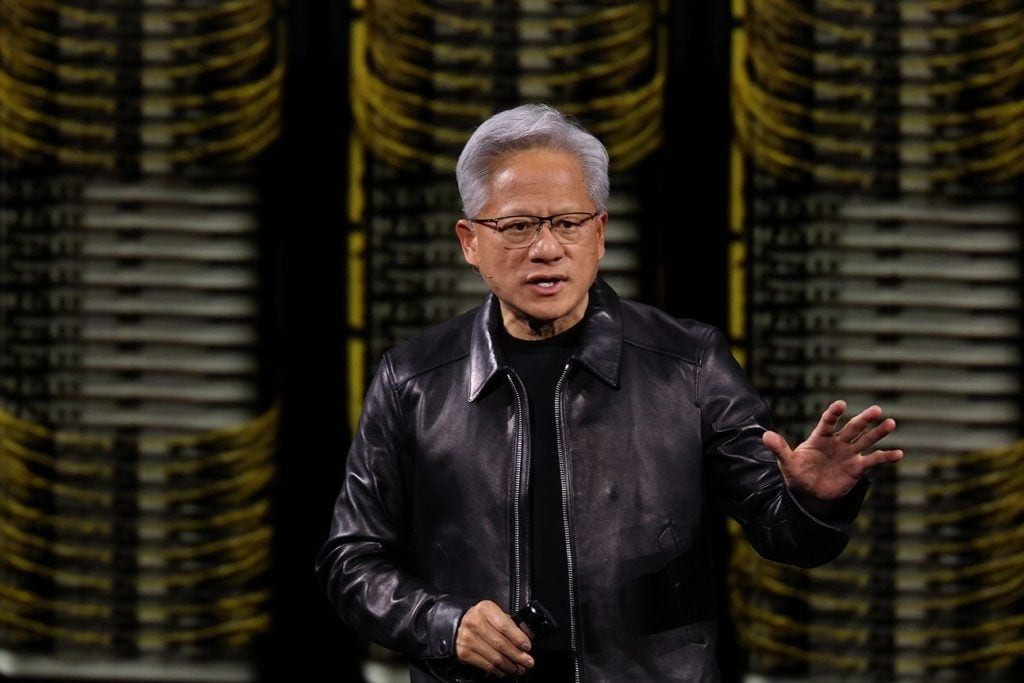
Jensen Huang. Image source: Getty Images.
Valuing Nvidia stock
On average, analysts expect Nvidia to earn about $15.80 per share in fiscal 2028, the 12 months ending January 2028. Multiply it by 14, and you get around $221.
At the Nov. 11 close, the stock traded at around 11 times forecast fiscal 2028 earnings, and at the after-hours price, it was closer to 10 times expected earnings.
Even at the October peak, shares cost only about 15 times today’s earnings estimate for fiscal 2028.
In other words, Nvidia stock is now at least 20% under the price I would have paid before Huang stepped down.
Why 14 times earnings?
A business growing so fast would normally command a premium to the broader market. According to FactSet, the S&P 500 had a forward price-to-earnings ratio of around 18 as of Nov. 5, based on expected earnings for the next 12 months. Nvidia’s fiscal 2028 runs a few months beyond that window, so the comparison flatters Nvidia a bit.
Showing just how much demand the company is seeing, Nvidia’s revenue in the second quarter of fiscal 2027 (the period ending July 26, 2026) grew 106% year over year to $96.2 billion. Data center revenue, around 93% of the total, grew 117% year over year to $89.0 billion. Adjusted (non-GAAP) earnings per share increased 120%, so profits kept up with sales. And on a GAAP basis, earnings per share jumped 128%.
“We expect to grow revenue by approximately 70% in fiscal 2028. This is a supply-constrained outlook,” chief financial officer Colette Kress said on the company’s August earnings call. She added that customers’ forecasts indicate Nvidia’s growth will double next year.
But I want a discount to the market price-to-earnings ratio rather than a premium. After all, Nvidia’s earnings can swing much more than the average company’s. For fiscal 2023, which ended in January 2023, Nvidia’s revenue was flat at $26.97 billion, but its GAAP earnings per share dropped 55% (25% on an adjusted basis).
Now, most of Nvidia’s sales go to companies investing heavily in building AI data centers. If those buyers slow down, the chipmaker’s profits might take a hit fast. Paying 14 times next year’s earnings arguably still rewards the growth while leaving room for a tough year.
The $15.80 estimate still needs to hold
Of course, my buy price is only as good as that estimate, and if expected earnings drop, so does the price I’d pay.
And growth from quarter to quarter has been slowing. Revenue climbed 20% over the previous quarter in the fiscal first quarter of 2027, then 18% in fiscal Q2. Nvidia’s guidance for fiscal Q3 revenue of $108.0 billion points to around 12%.
Kress said she expects growth from hyperscale customers (the huge cloud providers) to accelerate again in the fiscal fourth quarter and into fiscal 2028 as supply of its new Vera Rubin systems increases. If that happens, a $15.80-per-share year looks achievable, and the fiscal third-quarter report on Nov. 17 is the next test.
But I think a lot of disappointment is already priced in. If fiscal 2028 earnings came in a quarter under the estimate, the stock would still trade around 15 times those lower earnings at the Nov. 11 close.
So, is Nvidia stock a buy here?
I think so.
It’s a risky business, and the shares might keep sliding in the short term. But at around 11 times expected fiscal 2028 earnings, the stock closed Nov. 11 far below the roughly $220 I’d pay. I’d consider buying at that closing price. Over about $220, I’d want to see the estimate climb before paying more.
Huang’s resignation, of course, adds real risk. Indeed, I do think the stock is worth less without him, maybe around $30 a share less. But even at roughly $190, my fair value estimate is still above the stock’s current price.
Should you buy stock in Nvidia right now?
Before you buy stock in Nvidia, consider this:
The Motley Fool Stock Advisor analyst team just identified what they believe are the 10 best stocks for investors to buy now… and Nvidia wasn’t one of them. The 10 stocks that made the cut could produce monster returns in the coming years.
Consider when Netflix made this list on December 17, 2004… if you invested $1,000 at the time of our recommendation, you’d have $348,060!* Or when Nvidia made this list on April 15, 2005… if you invested $1,000 at the time of our recommendation, you’d have $1,067,492!*
Now, it’s worth noting Stock Advisor’s total average return is 849% — a market-crushing outperformance compared to 210% for the S&P 500. Don’t miss the latest top 10 list, available with Stock Advisor, and join an investing community built by individual investors for individual investors.
See the 10 stocks »
*Stock Advisor returns as of November 12, 2026.
Daniel Sparks and his clients do not have positions in any of the stocks mentioned. The Motley Fool has positions in and recommends Nvidia. The Motley Fool has a disclosure policy.