Key Points
-
Shares of AMD and Nvidia have retreated significantly over the past month.
-
Both companies have been clocking solid growth, and their momentum is poised to continue in 2027.
-
However, one of these stocks is trading at a really attractive valuation right now, making it a no-brainer buy.
-
Artificial intelligence (AI) chip stocks have witnessed a brutal sell-off lately, as evidenced by the 20% dip in the PHLX Semiconductor Sector index over the past month.
Not surprisingly, semiconductor stalwarts Nvidia (NASDAQ:NVDA) and Advanced Micro Devices (NASDAQ:AMD) have also been under pressure. While AMD has retreated 15% over the past month, Nvidia has dropped 26%, relinquishing its status as the world’s largest company in the process.
Missed AI’s “Act 1”? Act 2 Could Be 15x Bigger. Most investors think they missed the AI boat because they didn’t buy Nvidia in 2005. But according to our analysts, we’re only at the end of “Act 1″—the R&D phase. “Act 2” is the global rollout. Continue »
However, the solid financial performance of both these companies doesn’t justify their recent slide. Both Nvidia and AMD have been clocking robust growth, and they are poised to continue their momentum into the New Year. That’s why I will take a closer look at the prospects and valuations of both companies to determine which one is the better semiconductor stock to buy for 2027.
Image source: Getty Images.
The case for Nvidia
Nvidia remains the dominant player in AI chips despite intensifying competition. Semiconductor supply chain data provider Silicon Analysts estimates that Nvidia will control 75% of the AI chip market by the end of 2026.
The company has been pulling the right strings to maintain its status as the top AI chip player. It is now designing server systems aimed at enhancing inference performance while reducing costs simultaneously. Nvidia claims that its latest Vera Rubin chip systems consume twice as much power as the previous-generation Blackwell processors but deliver 10x higher performance-per-watt.
Nvidia has begun shipping its Vera Rubin systems in volume to customers. It expects the platform to account for 20% of its data center revenue in the third quarter of fiscal 2027. The company should see a significant ramp in Vera Rubin sales in 2027, which will be a tailwind for its revenue and earnings growth, given the significantly higher revenue it expects from its latest systems.
It is worth noting that Nvidia has already guided for a 70% increase in its fiscal 2028 revenue (which will end in January 2028 and coincide with the majority of calendar 2027). Analysts are forecasting a 71% increase in Nvidia’s earnings per share (EPS) in fiscal 2028, following an impressive 95% jump that’s projected for the current fiscal year.
So, there is a solid chance of Nvidia stock stepping on the gas once again in the New Year.
The case for AMD
Silicon Analysts notes that AMD controlled 6%-8% of the AI chip market last year. However, the company’s latest quarterly results indicate that it is gaining ground in this market. AMD’s data center revenue surged 97% year over year in Q3 to $8.5 billion, driven by the growing adoption of its server processors, graphics cards, and rack-scale systems.
For some perspective, Nvidia’s data center revenue surged by 106% year over year in the last reported quarter to $96.2 billion. So, while Nvidia remains the significantly larger player in this segment, AMD’s accelerating growth rate suggests that it is gradually catching up. Importantly, AMD expects its data center growth to accelerate.
The Q4 revenue guidance of $17 billion implies a year-over-year jump of 66%, higher than the 45% growth it reported in Q2. The data center business produced 64% of AMD’s revenue last quarter, and it expects the segment to account for more than 80% of its top line in 2027. Also, AMD expects total revenue to increase by more than 80% next year, an acceleration over the 50% top-line growth it is expected to deliver in 2026.
What’s more, AMD’s EPS growth rate is projected to accelerate from 93% this year to 108% in 2027, according to Yahoo! Finance consensus estimates. Given that the data center segment will account for the majority of AMD’s top line next year, it is evident that the company will gain more share in AI chips. So, is AMD a better AI semiconductor stock to buy compared to Nvidia?
The verdict
We have seen that both Nvidia and AMD are on track to deliver impressive earnings growth in 2027. However, AMD’s EPS growth is poised to be higher than Nvidia’s, suggesting that it may be the better growth stock to buy.
But the valuation tilts the balance in Nvidia’s favor, as evident from the following chart.
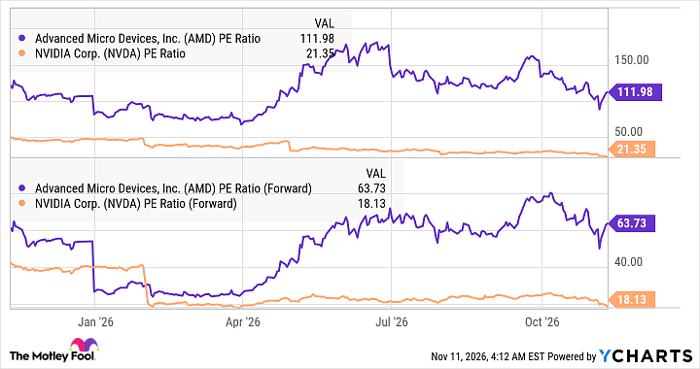
AMD PE Ratio data by YCharts
Nvidia is significantly cheaper than AMD, suggesting it may have greater upside potential once the market rewards it with a premium valuation. This is probably why Nvidia’s median 12-month price target of $318 implies a potential jump of 88%, higher than AMD’s projected 12-month gains of 26%.
So, Nvidia looks like an ideal investment for investors seeking a chip stock trading at attractive levels. However, they won’t go wrong with AMD either, as its accelerating growth will help it justify the valuation and send the stock higher in 2027 and beyond.
Should you buy stock in Nvidia right now?
Before you buy stock in Nvidia, consider this:
The Motley Fool Stock Advisor analyst team just identified what they believe are the 10 best stocks for investors to buy now… and Nvidia wasn’t one of them. The 10 stocks that made the cut could produce monster returns in the coming years.
Consider when Netflix made this list on December 17, 2004… if you invested $1,000 at the time of our recommendation, you’d have $348,060!* Or when Nvidia made this list on April 15, 2005… if you invested $1,000 at the time of our recommendation, you’d have $1,067,492!*
Now, it’s worth noting Stock Advisor’s total average return is 849% — a market-crushing outperformance compared to 210% for the S&P 500. Don’t miss the latest top 10 list, available with Stock Advisor, and join an investing community built by individual investors for individual investors.
See the 10 stocks »
*Stock Advisor returns as of November 12, 2026.
Harsh Chauhan has no position in any of the stocks mentioned. The Motley Fool has positions in and recommends Advanced Micro Devices and Nvidia. The Motley Fool has a disclosure policy.