Key Points
-
High-yield dividend stocks tend to perform better during stock market crashes and recessions, when investors make a “flight to safety.”
-
The SPDR S&P Dividend ETF (SDY) holds 154 high-yield dividend stocks with a 30-day SEC yield of 2.35%.
-
Although SDY has underperformed the S&P 500 in recent years, it could be a good choice for investors who want to hedge against the risks of a bear market in tech stocks.
-
When growth stocks start to feel too risky, some investors find a relative sense of safety (and steady income) from high-yield dividend stocks. The SPDR S&P Dividend ETF (NYSEMKT: SDY) reached a new record high on Nov. 4. As of this writing, the SDY dividend index fund has gained about 8.8% in the past month.
Let’s look at what’s driving the growth of this dividend ETF and why investors like you might want to consider it.
Missed Nvidia in 2009? This Rare Signal Is Flashing Again. In 2009, a “Double Down” signal flashed for a little-known chipmaker called Nvidia. For the first time in years, that same “Total Conviction” signal is flashing for a company 1/100th the size of Nvidia. Continue »
Why buy dividend stocks
For some investors, the artificial intelligence (AI) boom has started to feel like a bursting bubble. The tech-heavy Nasdaq-100 index has entered a correction, with a decline of about 11.2% since reaching a record high on Oct. 6. If you’re worried about the risk of AI stocks going through a prolonged downturn, high-yield dividend stocks could be a good way to diversify against the risk of a tech stock crash.
The stocks held by the SPDR S&P Dividend ETF are big, well-established, financially strong companies that have a long-term track record of paying high dividends. In case of an AI stock crash, this fund might perform better than the broader S&P 500 index (SNPINDEX: ^GSPC).
Here’s what happened in 2022, the last time there was a year-long bear market. SDY strongly outperformed the Nasdaq-100 and the S&P 500 that year.
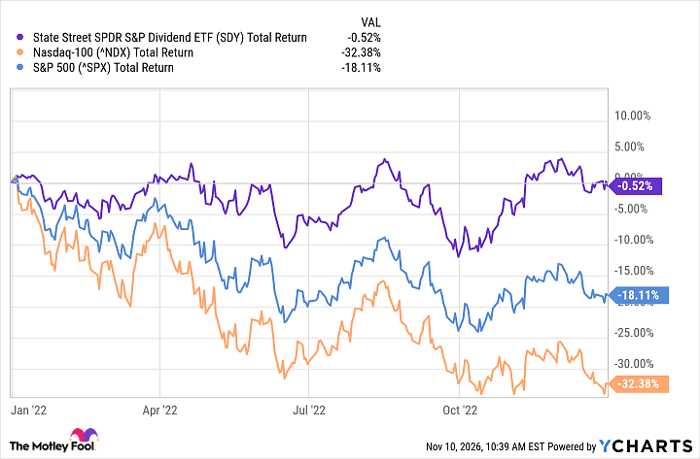
Data by YCharts.
There’s no guarantee that any stock, ETF, or sector of the economy will be “safe” from the next bear market or recession. But during tough times, dividend stocks tend to do better than tech stocks. That’s because investors often make a “flight to safety” during a stock market crash or recession. Growth stocks and less profitable companies tend to fall out of favor when investors have less appetite for risk. Instead, investors seek bonds and relatively safe stocks in defensive sectors like consumer staples and utilities.
Why buy SDY: Stocks with a 20-year track record of increasing dividends
What stocks are in SDY? This fund holds 154 stocks and tracks the S&P High Yield Dividend Aristocrats® Index. (The term “Dividend Aristocrats™” is a registered trademark of Standard & Poor’s Financial Services LLC.) That’s a select group of companies that have raised their dividend for at least 20 consecutive years. There’s no such thing as a totally “safe” stock. But the stocks held by SDY tend to be high-quality companies with financially strong balance sheets and time-tested business models, not volatile stocks that might take a big hit in the short to medium term.
Some of the top holdings in SDY include household-name brands like Verizon (NYSE: VZ) (2.8% of the fund), PepsiCo (NASDAQ: PEP) (2.1%), and McDonald’s (NYSE: MCD) (1.65%). Unlike many other exchange-traded funds (ETFs) that are weighted by market cap, SDY uses a unique approach: This fund weights its holdings by yield. And this fund delivers excellent dividends. Its 30-day SEC Yield is 2.35% as of Nov. 6. That’s competitive with some of the best dividend index funds.
Why buy SDY… or not
The SPDR S&P Dividend ETF has a long track record. Since the fund’s inception in November 2005, it’s delivered annualized returns of about 8.7%. That’s lower than the long-run average annual return of 9.98% for the S&P 500. For example, in the past five years, SDY has delivered annualized returns of about 7.3%, underperforming the S&P 500.
But buying stocks isn’t about the past; it’s about what you think will happen in the future. If you’re worried about tech stock volatility and want to put some of your money into an ETF that earns steady dividend income — and that might avoid the worst effects of a possible AI-related stock market crash — SDY could be a good choice.
Should you buy stock in SPDR Series Trust – State Street SPDR S&P Dividend ETF right now?
Before you buy stock in SPDR Series Trust – State Street SPDR S&P Dividend ETF, consider this:
The Motley Fool Stock Advisor analyst team just identified what they believe are the 10 best stocks for investors to buy now… and SPDR Series Trust – State Street SPDR S&P Dividend ETF wasn’t one of them. The 10 stocks that made the cut could produce monster returns in the coming years.
Consider when Netflix made this list on December 17, 2004… if you invested $1,000 at the time of our recommendation, you’d have $341,157!* Or when Nvidia made this list on April 15, 2005… if you invested $1,000 at the time of our recommendation, you’d have $1,037,753!*
Now, it’s worth noting Stock Advisor’s total average return is 834% — a market-crushing outperformance compared to 207% for the S&P 500. Don’t miss the latest top 10 list, available with Stock Advisor, and join an investing community built by individual investors for individual investors.
See the 10 stocks »
*Stock Advisor returns as of November 12, 2026.
Ben Gran has no position in any of the stocks mentioned. The Motley Fool recommends Verizon Communications and recommends the following options: long January 2028 $320 calls on McDonald’s and short January 2028 $340 calls on McDonald’s. The Motley Fool has a disclosure policy.