Key Points
-
Wall Street volatility is picking up, with the Nasdaq Composite logging its largest-ever single-day point decline and the Nasdaq-100 losing roughly 15% in one month.
-
A healthcare stock with a sustained double-digit growth rate and a wide moat is begging to be bought.
-
Meanwhile, a specialty retailer with one of Wall Street’s premier share repurchase programs is an ideal buy as stock market turbulence picks up.
-
Although the artificial intelligence (AI)-driven bull market over the last four years has sent Wall Street’s major stock indexes to several record highs, the last few weeks have served as a reminder that stocks can, indeed, go down. Last week, on Nov. 5, the Nasdaq Composite (NASDAQINDEX:^IXIC) logged the largest single-session point decline in its storied history (1,422 points), while the Nasdaq-100 reached a nearly 15% correction in a month.
While a retracement has arguably been long overdue for high-flying tech stocks, several bargains abound within the Nasdaq-100 for patient investors. Two proven winners from outside the tech sector, Intuitive Surgical (NASDAQ:ISRG) and O’Reilly Automotive (NASDAQ:ORLY), can buck this historic volatility.
Missed AI’s “Act 1”? Act 2 Could Be 15x Bigger. Most investors think they missed the AI boat because they didn’t buy Nvidia in 2005. But according to our analysts, we’re only at the end of “Act 1″—the R&D phase. “Act 2” is the global rollout. Continue »
Image source: Getty Images.
Intuitive Surgical
Though you can certainly find cheaper healthcare stocks, based on the price-to-earnings ratio, you’d struggle mightily to find a healthcare company with a sustained double-digit growth rate or with as large a moat as robotic-assisted surgical systems developer Intuitive Surgical.
Intuitive holds a veritable monopoly in robotic-assisted surgical systems, with more than 12,000 of its da Vinci systems installed worldwide. The relatively high cost of these systems, coupled with a lack of competition, often locks hospitals and surgical centers in as long-term customers.
What’s arguably even more important than its virtual monopoly status is its revenue mix. In the early 2000s, Intuitive generated the bulk of its revenue from selling its high-priced, but mediocre-margin systems. As time has passed, higher-margin sales channels, including accessories sold with each procedure and system servicing, have grown into a majority of net sales. In short, this is a recipe for Intuitive’s profits to grow even faster than its sales.
Innovation matters, too. In addition to developing new generations of the da Vinci surgical system, Intuitive debuted its minimally invasive lung biopsy system (Ion endoluminal system) in 2019. Ion procedures jumped by 31% in the latest quarter.
Intuitive Surgical stock may not be cheap, but there are several reasons it can maintain a healthy premium.

Image source: Getty Images.
O’Reilly Automotive
Another proven winner within the Nasdaq-100 that can buck this recent volatility is auto parts retailer O’Reilly Automotive.
Macro trends certainly favor O’Reilly. According to a May 2025 report from S&P Global Mobility (now Mobility Global (NYSE:MBGL)), the average age of vehicles in the U.S. rose to a record 12.8 years, up from an average of 11.1 years in 2012. Though newer vehicles are built to last longer, the aging of America’s vehicles suggests drivers and mechanics will be relying on companies like O’Reilly Automotive to keep them in tip-top shape.
O’Reilly’s success is also a function of its hub-and-spoke distribution model. The company’s 32 distribution centers provide overnight access to more than 156,000 stock-keeping units (SKUs). Nearly 400 larger hub stores can also provide up to 115,000 SKUs on a same-day basis.
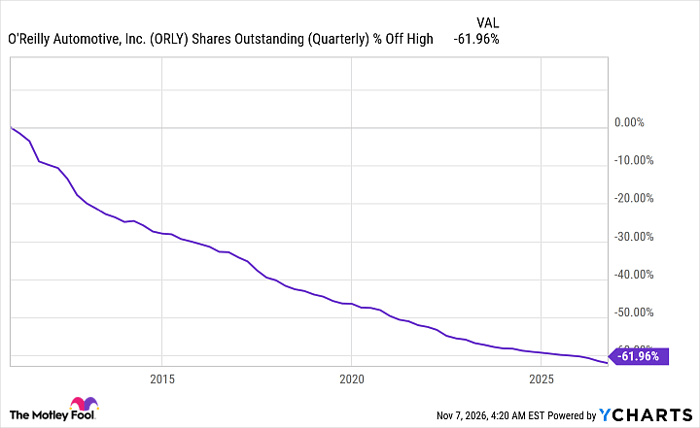
ORLY Shares Outstanding (Quarterly) data by YCharts.
But the one factor that’s really set O’Reilly Automotive apart, at least from an investment standpoint, is its top-notch share repurchase program. Since the inception of its buyback program in January 2011, O’Reilly has spent just over $31 billion to retire 1.5 billion outstanding shares (OS). The company has reduced its OS by 62% in less than 16 years, meaningfully boosting its earnings per share in the process.
Tech-driven volatility doesn’t change the investment thesis for O’Reilly Automotive one bit.
Should you buy stock in O’Reilly Automotive right now?
Before you buy stock in O’Reilly Automotive, consider this:
The Motley Fool Stock Advisor analyst team just identified what they believe are the 10 best stocks for investors to buy now… and O’Reilly Automotive wasn’t one of them. The 10 stocks that made the cut could produce monster returns in the coming years.
Consider when Netflix made this list on December 17, 2004… if you invested $1,000 at the time of our recommendation, you’d have $341,966!* Or when Nvidia made this list on April 15, 2005… if you invested $1,000 at the time of our recommendation, you’d have $1,146,819!*
Now, it’s worth noting Stock Advisor’s total average return is 852% — a market-crushing outperformance compared to 203% for the S&P 500. Don’t miss the latest top 10 list, available with Stock Advisor, and join an investing community built by individual investors for individual investors.
See the 10 stocks »
*Stock Advisor returns as of November 10, 2026.
Sean Williams has no position in any of the stocks mentioned. The Motley Fool has positions in and recommends Intuitive Surgical and Mobility Global. The Motley Fool recommends the following options: long January 2028 $520 calls on Intuitive Surgical and short January 2028 $530 calls on Intuitive Surgical. The Motley Fool has a disclosure policy.