Key Points
-
Musk said SpaceX’s annual recurring revenue will probably pass $500 billion in December 2027, and he called that his best guess.
-
SpaceX says it’s headed for $100 billion in annual recurring revenue this December.
-
Musk expects around 13 gigawatts of computing capacity by year-end 2027, up from 1.7 gigawatts in September.
-
On SpaceX’s (NASDAQ:SPCX) Oct. 20 earnings call, CEO Elon Musk said its annual recurring revenue by year-end 2027 would be “somewhere between $500 billion and $1 trillion.”
At the Baron Investment Conference on Nov. 6, he said which end he meant. Musk said it “seems quite likely” that annual recurring revenue (a yearly pace based on December) will top $500 billion in December 2027. He called that his “best guess” and “not a promise.”
Missed AI’s “Act 1”? Act 2 Could Be 15x Bigger. Most investors think they missed the AI boat because they didn’t buy Nvidia in 2005. But according to our analysts, we’re only at the end of “Act 1″—the R&D phase. “Act 2” is the global rollout. Continue »
As for $1 trillion, he said it’s “not out of the question” and put the odds at about 2%.
Even the low end is five times the $100 billion yearly pace SpaceX expects to hit this December. But at around $140 as I write, the stock trades a few percent over its $135 initial public offering (IPO) price and about 38% under its 52-week high of $225.64.
It’s tempting to think investors are ignoring Musk’s forecast. I don’t think they are.
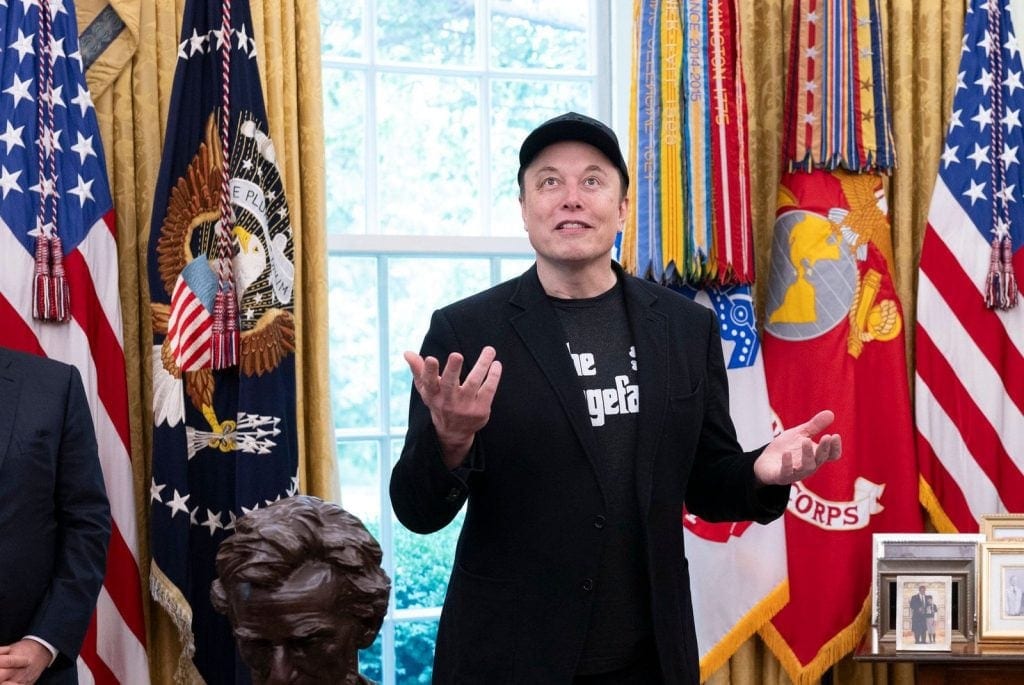
Elon Musk. Image source: The White House.
Can SpaceX grow that fast?
SpaceX’s revenue climbed 87% sequentially to $14.6 billion in the third quarter, after a 66% gain in the second. Musk said at the conference that fourth-quarter revenue will likely grow about 70% from there, which comes to roughly $25 billion.
But CFO Bret Johnsen guided for $33 billion to $37 billion in the first quarter of 2027, about 41% over that number at the midpoint. (Musk floated about 70% again, which would top that range.)
Hitting a $500 billion pace by next December from that midpoint would take about 45% to 50% revenue growth in every quarter left in 2027. Put another way, growth would need to stop slowing almost right away, on a far bigger base.
It boils down to computing power
The forecast relies mainly on computing capacity, which SpaceX rents to other businesses and uses for its own artificial intelligence (AI) products. SpaceX had 1.7 gigawatts on Sept. 30. On the October call, Musk said he’s “highly confident” of adding 10 gigawatts next year, bringing the total to around 13.
Even if it all came from computing power, $500 billion split across 13 gigawatts would be about $38 per watt. Musk guessed on the second-quarter call that computing power could pull in $30 to $50 per watt, and Johnsen said in October that pricing is running a bit over the high end of that range.
So I don’t think $500 billion is far-fetched.
Of course, the superintelligence segment, where this business sits, generated only about $30 billion annualized last quarter. That comes to roughly $18 for every watt SpaceX had at quarter-end.
Musk also wants to keep about half the capacity for SpaceX’s own products. If the rented half made $50 per watt, it would pull in about $325 billion. Starlink and launches run at only around $28 billion a year combined, so most of the other $175 billion would need to come from products like Grok, whose Grok Bot assistant had 800,000 paying weekly users in October.
Pricing might not hold, either. SpaceX’s cloud contracts can usually be canceled by either side with 90 days’ notice. At $30 a watt, 13 gigawatts would bring in around $390 billion.
SpaceX stock already prices in much of this
At $140 a share, SpaceX is worth around $1.9 trillion.
Now let’s say SpaceX gets to $500 billion and earns the 19% operating margin it reported last quarter. That’s around $96 billion in annual operating income, or about $76 billion after a 21% tax rate. The stock would then trade at about 25 times earnings. The S&P 500 (SNPINDEX:^GSPC), in comparison, trades at around 18 times its expected earnings over the next 12 months.
Twenty-five times earnings looks fair for a company that size still growing fast. But it’s no bargain, even if Musk’s best guess is right. And it ignores the cost of getting there. Management expects $35 billion to $40 billion in capital spending in the fourth quarter alone, even as capacity is expected to grow by only about 1 gigawatt.
I’ve covered Tesla for over 10 years, and Musk’s big numbers tend to describe what might happen if most things go well. This time, he told investors it’s not a promise.
In the end, I think SpaceX could come close to the $500 billion floor. But at around $140, investors are already paying for a good chunk of it. The metric I’d most want in the next report is revenue per watt.
For now, I wouldn’t sell the stock at this price, and I wouldn’t be in a rush to buy it.
Should you buy stock in Space Exploration Technologies right now?
Before you buy stock in Space Exploration Technologies, consider this:
The Motley Fool Stock Advisor analyst team just identified what they believe are the 10 best stocks for investors to buy now… and Space Exploration Technologies wasn’t one of them. The 10 stocks that made the cut could produce monster returns in the coming years.
Consider when Netflix made this list on December 17, 2004… if you invested $1,000 at the time of our recommendation, you’d have $341,966!* Or when Nvidia made this list on April 15, 2005… if you invested $1,000 at the time of our recommendation, you’d have $1,146,819!*
Now, it’s worth noting Stock Advisor’s total average return is 852% — a market-crushing outperformance compared to 203% for the S&P 500. Don’t miss the latest top 10 list, available with Stock Advisor, and join an investing community built by individual investors for individual investors.
See the 10 stocks »
*Stock Advisor returns as of November 9, 2026.
Daniel Sparks has clients with positions in Tesla. The Motley Fool has positions in and recommends Space Exploration Technologies and Tesla. The Motley Fool has a disclosure policy.