Key Points
-
Berkshire spent $9.6 billion on buybacks in Q3, more than double the $4.5 billion it spent in Q2.
-
The company can repurchase shares only when its CEO believes the price is below conservatively determined intrinsic value, so what Abel paid is a clue to where management sees value.
-
Class A shares are currently trading nearly 14% above September’s average purchase price, which gives investors a reference point to watch.
-
One of Warren Buffett’s investing lessons has been that the price you pay for a stock matters as much as the company you’re buying. Greg Abel, his successor at Berkshire Hathaway (NYSE:BRKA) (NYSE:BRKB), looks to be following the same philosophy.
Berkshire posted its quarterly filing with the Securities and Exchange Commission over the weekend. In it, the company disclosed that it spent $9.6 billion repurchasing its own shares during the third quarter of 2026, more than double the $4.5 billion it spent in the second quarter. That’s an eye-opening amount of money, even for a company with Berkshire’s incredible financial resources.
Missed AI’s “Act 1”? Act 2 Could Be 15x Bigger. Most investors think they missed the AI boat because they didn’t buy Nvidia in 2005. But according to our analysts, we’re only at the end of “Act 1″—the R&D phase. “Act 2” is the global rollout. Continue »
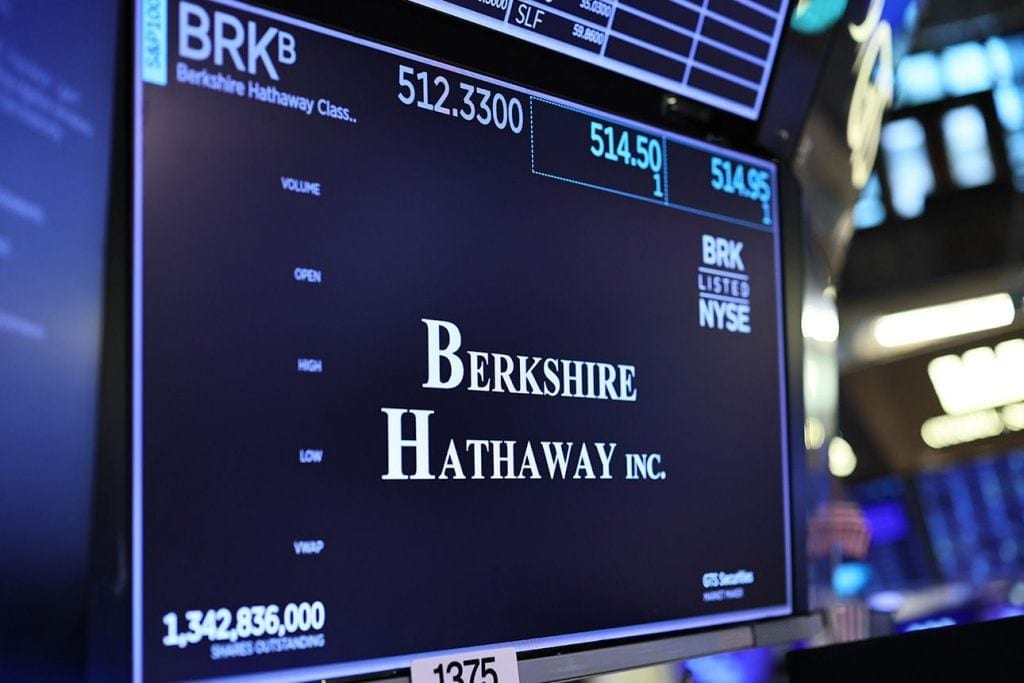
Image source: Getty Images.
But the amount isn’t the most interesting part of the story.
Berkshire has strict rules about when it can repurchase shares. And by examining what Abel was willing to pay, investors can get an idea of where management sees value in the stock.
Berkshire’s unusual approach to stock buybacks
Most large companies regularly repurchase shares, sometimes spending billions of dollars regardless of whether their stocks are trading at attractive valuations.
Berkshire operates differently. Its third-quarter regulatory filing states that repurchases are permitted when the CEO, after consulting with the chairman, believes the purchase price is “below Berkshire’s intrinsic value, conservatively determined.” Intrinsic value is simply an estimate of what a business is actually worth, based on its assets and ability to generate cash over time.
So, Berkshire isn’t buying shares because it has money available or because it wants to support its stock price. Management must believe the company is worth more than the price it’s paying.
There are other restrictions. Berkshire won’t repurchase shares if doing so would reduce its combined cash, cash equivalents, and Treasury bill holdings below $30 billion. But there’s no maximum amount Berkshire can spend, and it isn’t obligated to buy anything.
Abel has considerable flexibility to repurchase shares. When Berkshire spends billions buying its own shares, investors have good reason to pay attention.
What Berkshire paid during the third quarter
The company’s latest filing provides a monthly breakdown of its repurchases of Berkshire stock, including the average price paid for each class.
In July, Berkshire purchased approximately 3.1 million Class B shares at an average price of $496.24, along with about $1.84 billion in Class A shares. The average purchase price for Class B shares increased to $503.99 in August, when the company bought another 1.5 million shares, in addition to $66 million in Class A shares.
September was particularly interesting. Berkshire purchased approximately 7.7 million Class B shares at an average price of $506.64. It also acquired 1,983 Class A shares at an average price of $758,332.88.
Remember that one Class A share represents the same economic ownership as 1,500 Class B shares. September’s average Class B purchase price was therefore equivalent to $759,960 per Class A share. Altogether, Berkshire spent about $9.6 billion on purchases in the quarter.
Those figures don’t establish Berkshire’s intrinsic value. Management presumably believes the business is worth more than the prices it paid, but it hasn’t disclosed by how much. But it tells us that Abel was comfortable committing billions of dollars to Berkshire stock at those valuations.
And the company wasn’t exactly running short of money. Berkshire’s insurance and other businesses held approximately $352.3 billion in cash, cash equivalents, and Treasury bills, net of related payables, at the end of September.
Why the price matters now
Berkshire’s stock continued climbing after the third quarter, with Class A shares eventually surpassing $863,000. That’s nearly 14% above the average price Berkshire paid for its Class A shares in September.
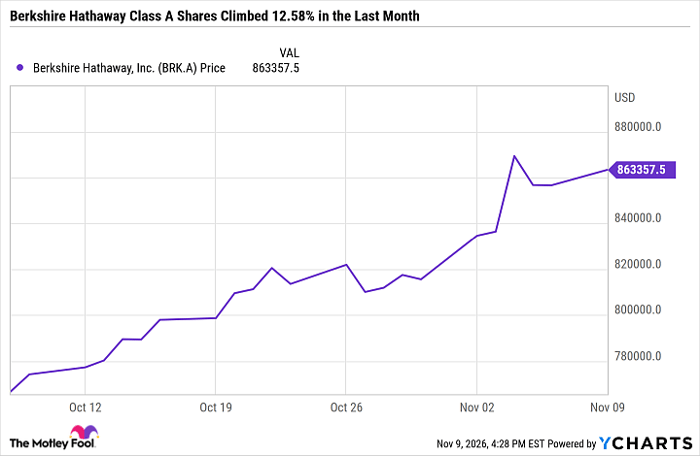
BRK.A data by YCharts
The Associated Press reported that the rally may have prompted Berkshire to halt share repurchases. The company hasn’t confirmed that, and its latest filing only covers purchases through September. But the possibility makes sense given Berkshire’s repurchase policy.
A stock that looks attractive at $758,000 doesn’t necessarily offer the same value now, particularly when management insists on a conservative estimate of intrinsic value.
But investors shouldn’t assume Berkshire has established a firm ceiling for its stock price, either. Intrinsic value changes as the underlying business grows, and management’s assessment can change along with it. Nor would a pause in repurchases automatically mean Abel believes Berkshire is overvalued. It might simply mean the discount isn’t large enough to justify spending shareholders’ money. Or the company chose to pause buybacks as Buffett announced his retirement as chairman in September.
So, Berkshire’s third-quarter purchases don’t provide an official price target or guarantee future returns. They do, however, establish a useful reference point for evaluating the stock.
If shares retreat toward the levels where Berkshire was aggressively buying, investors will have evidence that management recently found those valuations attractive.
And that’s considerably more informative than simply knowing the stock has fallen from its highs.
Should you buy stock in Berkshire Hathaway right now?
Before you buy stock in Berkshire Hathaway, consider this:
The Motley Fool Stock Advisor analyst team just identified what they believe are the 10 best stocks for investors to buy now… and Berkshire Hathaway wasn’t one of them. The 10 stocks that made the cut could produce monster returns in the coming years.
Consider when Netflix made this list on December 17, 2004… if you invested $1,000 at the time of our recommendation, you’d have $341,966!* Or when Nvidia made this list on April 15, 2005… if you invested $1,000 at the time of our recommendation, you’d have $1,146,819!*
Now, it’s worth noting Stock Advisor’s total average return is 852% — a market-crushing outperformance compared to 203% for the S&P 500. Don’t miss the latest top 10 list, available with Stock Advisor, and join an investing community built by individual investors for individual investors.
See the 10 stocks »
*Stock Advisor returns as of November 9, 2026.
Patrick Sanders has no position in any of the stocks mentioned. The Motley Fool has positions in and recommends Berkshire Hathaway. The Motley Fool has a disclosure policy.