Key Points
-
Statistically, the Dow Jones Industrial Average, S&P 500, and Nasdaq Composite have excelled under Donald Trump.
-
The president has repeatedly called on the central bank to slash interest rates.
-
A recent study by New York Fed economists found that Trump’s tariffs have increased goods prices.
-
Persistently elevated inflation presents challenges for a historically expensive, artificial intelligence (AI)-driven bull market that can ill afford any hiccups.
-
From a purely statistical standpoint, Wall Street has relished having Donald Trump in the White House. The average annual return of the timeless Dow Jones Industrial Average (DJINDICES:^DJI), benchmark S&P 500 (SNPINDEX:^GSPC), and tech-driven Nasdaq Composite (NASDAQINDEX:^IXIC) is decisively higher under Trump than under most other presidents over the last 130 years.
There’s little question that the evolution of artificial intelligence (AI) and the ongoing AI infrastructure build-out have been paramount to this outperformance in President Trump’s nonconsecutive second term. The president’s favorable tax policy — the Tax Cuts and Jobs Act permanently lowered the peak marginal corporate income tax rate from 35% to 21% — has played an important role, too.
Missed Nvidia in 2009? This Rare Signal Is Flashing Again. In 2009, a “Double Down” signal flashed for a little-known chipmaker called Nvidia. For the first time in years, that same “Total Conviction” signal is flashing for a company 1/100th the size of Nvidia. Continue »

President Trump’s policies are contributing factors to elevated inflation. Image source: Official White House Photo by Daniel Torok.
But things may not be as picture-perfect for Wall Street as the Dow, S&P 500, and Nasdaq Composite suggest. Though the stock market has made a habit of climbing the proverbial wall of worry for years, eventually stocks will stumble.
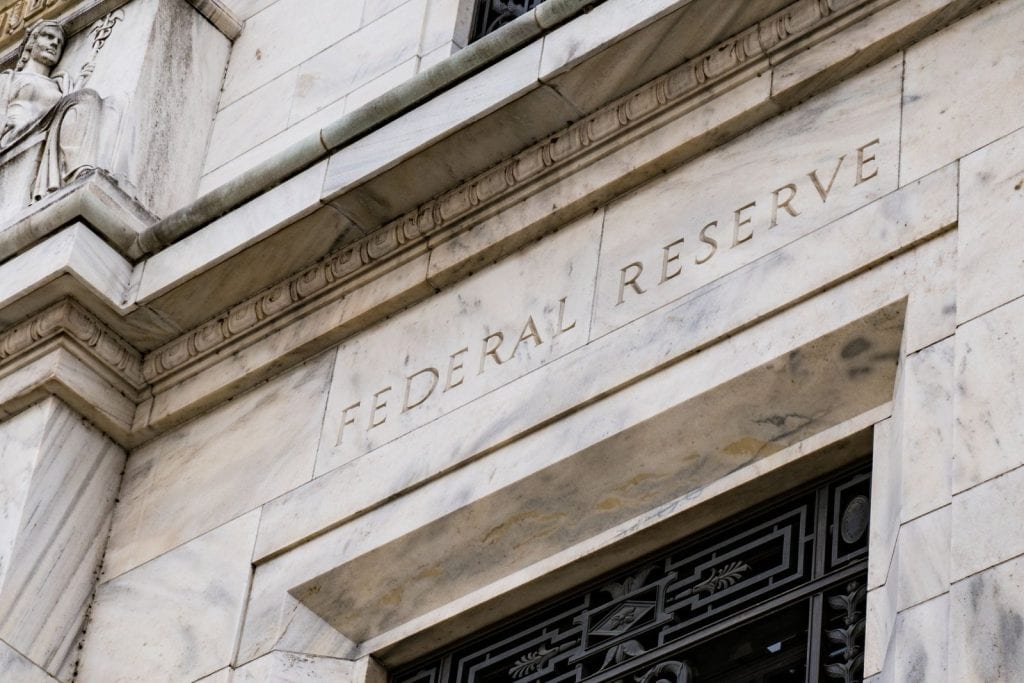
Perhaps no stock market headwind is greater at the moment than persistently elevated inflation. While President Trump has been adamant that “inflation is way down” under his administration, Federal Reserve economists have a different take.
President Trump has repeatedly criticized the Fed for not lowering interest rates
Despite the Consumer Price Index reaching a three-year high of 4.2% in May, Trump has been firm in his stance that prices are rising at a much tamer pace under his administration than under his predecessor.
In particular, the president has latched onto the strength of the job market — the unemployment rate remains near historic lows — and the stated temporary nature of the Iran war as reasons not to be concerned with inflation. Donald Trump has opined on several occasions that oil prices and, therefore, fuel prices, would plunge once the Iran war ends. This would, in his view, quickly remedy energy-commodity-driven inflation.
Modest inflation, or even the perception of moderating inflation, is foundational to President Trump’s repeated calls for the Federal Reserve to lower interest rates.
Since the start of his second term on Jan. 20, 2025, Trump has been feuding almost nonstop with the central bank over interest rates. He criticized now-former Fed Chair Jerome Powell for the Fed’s slow-stepped rate-easing cycle. While the Federal Open Market Committee (FOMC) lowered the federal funds target rate six times between September 2024 and December 2025 to 3.50%-3.75%, the president believes lending rates should be slashed to 1% (or lower).
Although the new Fed Chair, Kevin Warsh, has largely avoided these criticisms, the same can’t be said about the other voting members of the FOMC.
President Trump wants to see interest rates head lower, because reduced borrowing costs would spur hiring and fuel the AI infrastructure build-out. Furthermore, interest rate cuts would make it considerably easier for the U.S. to service its more than $40 trillion in total debt.
Image source: Getty Images.
Federal Reserve economists have bad news for Trump (and Wall Street): inflation is rising
However, inflation isn’t “way down,” as Donald Trump has proclaimed. Though annualized inflation is well below its four-decade high of 9.1% in June 2022, the reported annualized rate of 3.7% for September is nearly double the FOMC’s long-term target of 2%.
Keep in mind that consumer prices are expected to rise when the U.S. economy is expanding. If businesses are firing on all cylinders, they should possess some degree of pricing power over their goods and services.
The issue is that annualized inflation has moved well above what Warsh and the FOMC would consider “modest,” and two of the president’s policies are mostly to blame.
Despite Trump’s recent claim that tariffs don’t cause inflation, three New York Federal Reserve economists writing for Liberty Street Economics examined the inflationary effects of the president’s 2025 tariffs on consumer prices. In their report (“How Fast Do Tariffs Pass Through into Consumer Prices?”), the authors estimated that Trump’s tariffs raised goods price inflation by 2.9 percentage points by February 2026. Conversely, goods prices would have declined had Trump not imposed tariffs!
This isn’t the first time that NY Fed economists at Liberty Street Economics have linked Trump’s tariffs to higher prices, either. A December 2024 report (“Do Input Tariffs Protect U.S. Firms?”) found that the president’s 2018 China tariffs raised prices for select imported goods.
In addition to tariffs, the Trump-led Iran war has created the largest modern-day energy supply disruption. Even if a peace deal were hypothetically signed today, it would take months to restore energy production to normal in the region, and even longer to rebuild storage. The inflationary effects of the Iran war are here to stay for quite some time.
The AI infrastructure build-out is also sparking inflation. The insatiable demand for AI data center hardware, coupled with persistent hardware supply shortages, has lifted prices all the way down to the consumer level. While President Trump’s policies aren’t responsible for AI-driven inflation, this is another data point that shows inflation isn’t “way down.”
Persistently elevated inflation is particularly worrisome for Wall Street. While banks and insurers can thrive amid a rate-hiking cycle, the same can’t be said for high-growth tech stocks.
The AI build-out has been financed in part with debt. If borrowing costs continue to climb due to a confluence of factors, including the president’s own policies, it threatens to slow this expansion. A historically expensive stock market can ill afford any hiccups. But with inflation remaining elevated and still climbing (as of September), the odds are growing of an aggressive rate-hiking cycle that ultimately wallops Wall Street.
Should you buy stock in S&P 500 Index right now?
Before you buy stock in S&P 500 Index, consider this:
The Motley Fool Stock Advisor analyst team just identified what they believe are the 10 best stocks for investors to buy now… and S&P 500 Index wasn’t one of them. The 10 stocks that made the cut could produce monster returns in the coming years.
Consider when Netflix made this list on December 17, 2004… if you invested $1,000 at the time of our recommendation, you’d have $353,560!* Or when Nvidia made this list on April 15, 2005… if you invested $1,000 at the time of our recommendation, you’d have $1,115,850!*
Now, it’s worth noting Stock Advisor’s total average return is 852% — a market-crushing outperformance compared to 203% for the S&P 500. Don’t miss the latest top 10 list, available with Stock Advisor, and join an investing community built by individual investors for individual investors.
See the 10 stocks »
*Stock Advisor returns as of November 7, 2026.
Sean Williams has no position in any of the stocks mentioned. The Motley Fool has no position in any of the stocks mentioned. The Motley Fool has a disclosure policy.