Key Points
-
Since becoming chair of the Federal Reserve’s Board of Governors, Kevin Warsh has sought to make the Fed less influential in the stock market.
-
Warsh has not given forward guidance and shortened policy statements from the Federal Open Market Committee.
-
But his next planned move is unlike anything investors have ever seen.
-
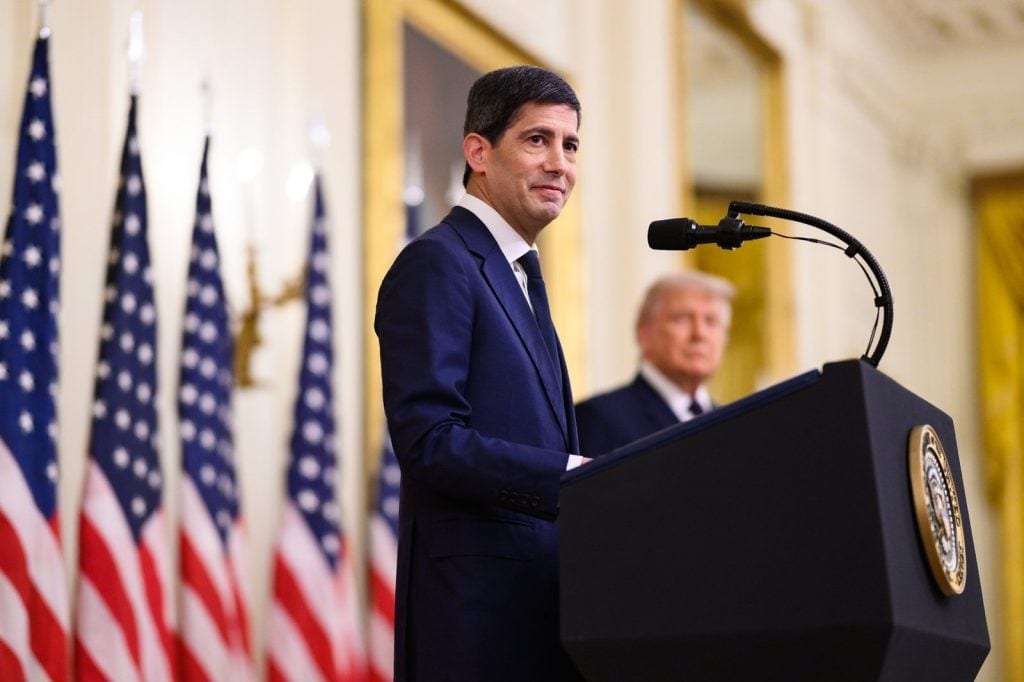
When Kevin Warsh became the new chair of the Federal Reserve Board of Governors earlier this year, he made it clear he wanted to reform the agency, which he has criticized in recent years.
Warsh believes the Federal Open Market Committee (FOMC), which sets monetary policy, including interest rate decisions, has become too influential in the stock market.
Missed AI’s “Act 1”? Act 2 Could Be 15x Bigger. Most investors think they missed the AI boat because they didn’t buy Nvidia in 2005. But according to our analysts, we’re only at the end of “Act 1″—the R&D phase. “Act 2” is the global rollout. Continue »
Warsh doesn’t want the Fed to serve as a backstop for the market when things go awry. He also believes investors spend too much time trying to figure out how the Fed will react rather than reacting to economic data themselves.
At the FOMC’s recent meeting, Warsh said he plans to break a 45-year precedent with a stunning change to monetary policy — and it could rattle Wall Street for years to come.
Warsh proposes fewer Fed meetings
Since 1981, the FOMC has met eight times a year to determine monetary policy.
Decisions made by the FOMC include changes to the Federal Reserve’s overnight benchmark lending rate, the federal funds rate, and, more recently, to the size of the Fed’s balance sheet and the overall U.S. money supply through open market operations.
At the FOMC’s recent October meeting, Warsh stunned investors by announcing that there would be fewer meetings at which the committee would make interest rate decisions or issue an FOMC policy statement.
Warsh said there will still be eight FOMC meetings per year. However, next year, one meeting will focus exclusively on monetary policy strategy, with no vote on the federal funds rate or a policy statement. In 2028, Warsh said he expects two meetings exclusively for strategy with no rate vote or policy statement.
“Now, what’s the reasoning behind this change? To me, it’s quite straightforward. Getting policy right involves assessing near-term developments at timely, regular, and information-rich intervals,” Warsh said in his prepared remarks. “But it’s equally important we reserve time and space, as an intellectually diverse group, for strategic deliberations — for thinking anew about big questions, looking out over longer time horizons, focusing, as I say, on the left side of the decimal point.”
The move follows earlier actions by Warsh during his brief tenure as chair to push the Fed into more of a back seat role. Warsh has not submitted his projections to the Fed’s Summary of Economic Projections, which shows how each of the 19 FOMC members views several important economic data points.
Warsh has also shortened the FOMC policy statement. With inflation remaining elevated, Warsh’s actions have partly contributed to greater market uncertainty ahead of some FOMC meetings.
Why this may rattle markets
The biggest immediate impact in 2027 and 2028 is increased market volatility. Interest rates impact the entire stock market. For some sectors, such as housing, they can directly impact a company’s revenue and profits. But bond yields, which are influenced by the federal funds rate, also determine valuations in a discounted cash flow model, the standard on Wall Street for valuing most companies where free cash flow is relevant.
So when it’s harder to predict where rates go, that’s going to make everything more volatile, not to mention that rates determine borrowing costs for consumers and businesses. Warsh wants investors to react to data on their own without factoring in what the Fed will do. In reality, it will likely be difficult to remove this instinct entirely. But another big question is how strict the FOMC will be on its new meeting schedule.
“Does it imply arbitrarily refusing to adjust policy even if economic conditions warrant it? Does it imply that tactical policy decisions and broader strategy discussions cannot be held in parallel?” EY Parthenon’s Chief Economist Gregory Daco wondered, according to reporting from Barron’s.
These are all good questions that I’m guessing Warsh will provide more clarity on in the near future.
Some FOMC meetings are only about 1.5 months apart, but given how the market has relied on the Fed since the Great Recession, even this minor adjustment is likely to rattle Wall Street for years to come, especially heading into FOMC meetings when the market is divided about how the FOMC will proceed.
A surprise rate decision could move the market in a big, unexpected way.
Missed AI’s “Act 1”? Act 2 Could Be 14x Bigger
Most investors think they missed the AI boat because they didn’t buy Nvidia in 2005.
But according to our analysts, we’re only at the end of “Act 1″—the R&D phase. “Act 2” is the global rollout, a massive technology build-out that Google’s CEO says could be more profound than fire or electricity.
While everyone watches the chip designers, one “backbone” company provides the critical technology that Nvidia and AMD literally cannot function without. We’ve detailed this under-the-radar player in our new AI Playbook.
Continue »
The Motley Fool has a disclosure policy.