Key Points
-
Neither AMD nor Palantir have any obvious upcoming catalysts that could drive rapid margin expansions.
-
In the third quarter, Palantir’s revenues grew by 96%, while AMD’s rose by 45%.
-
Chipmaker AMD (NASDAQ: AMD) and data analytics giant Palantir (NASDAQ: PLTR) each reported their third-quarter earnings results earlier this week. In the aftermath of those reports, Palantir’s stock declined slightly while AMD’s rose. While both companies’ numbers showed that their businesses are growing rapidly, I think investors need to focus on something else: the valuations of their stocks.
These companies are trading at sky-high valuation levels, and history is not on their side.
Missed AI’s “Act 1”? Act 2 Could Be 15x Bigger. Most investors think they missed the AI boat because they didn’t buy Nvidia in 2005. But according to our analysts, we’re only at the end of “Act 1″—the R&D phase. “Act 2” is the global rollout. Continue »
AMD and Palantir have a ton of future growth baked into their stocks
Finding businesses that are doing well to invest in is just one part of the equation for investors. Their stocks also have to be purchasable at a reasonable price. How best to determine what a reasonable price would be for any given stock is a widely debated topic, as there are a host of factors that can affect that calculation, from the industry it operates in to its track record to overall sector sentiment. However, there are some broadly acceptable valuation ranges that most stocks tend to trade within.
Both AMD and Palantir are mature businesses, and their profit margins are not expected to expand rapidly over the next few years, so the price-to-earnings (P/E) ratio is a great metric to use to gauge their valuations. However, both of them are also growing fast. During Q3, Palantir’s growth rate rose to 96%. AMD’s top line rose at a slower 45% pace, but that’s still quite impressive. In light of those growth rates, I don’t think the trailing P/E ratio is the best valuation measure here, as it looks at where companies have been, not where they’re going.
Instead, I think valuing these companies relative to their projected earnings makes far more sense. With 2026 almost over, using 2027 estimates is a good idea. And by that measure, it’s easy to see how expensive Palantir and AMD are.
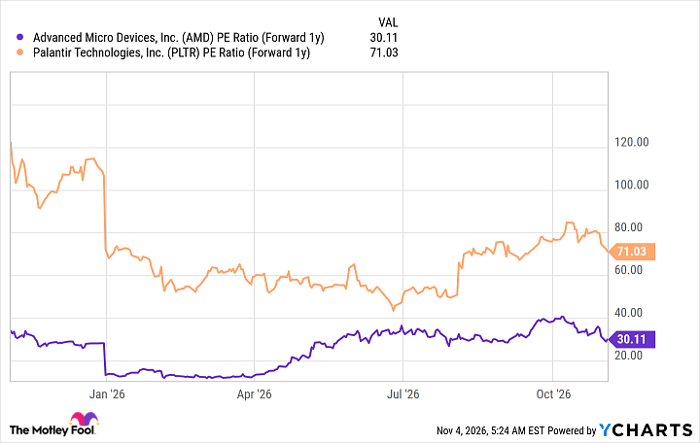
AMD PE Ratio (Forward 1y) data by YCharts.
Palantir clearly takes the cake for being very pricey, as 71 times forward earnings is way more than most stocks trade for. Its forward P/E ratio is more than double AMD’s — a huge red flag. And while the chipmaker looks relatively more reasonable at 30 times next year’s earnings, it’s worth noting that AMD’s top competitor, Nvidia (NASDAQ: NVDA), trades for just 13 times forward earnings and is posting better results.
While stocks can temporarily become expensive, over the long term, they tend to revert to normal valuation levels. That could be a problem for both Palantir and AMD. While I’m not saying that a crash is imminent for either or both of them, their high valuations could indicate that a period of stock price underperformance is coming as their valuations normalize.
As a result, I think investors should steer clear of these two, as there are far better options available.
Should you buy stock in Advanced Micro Devices right now?
Before you buy stock in Advanced Micro Devices, consider this:
The Motley Fool Stock Advisor analyst team just identified what they believe are the 10 best stocks for investors to buy now… and Advanced Micro Devices wasn’t one of them. The 10 stocks that made the cut could produce monster returns in the coming years.
Consider when Netflix made this list on December 17, 2004… if you invested $1,000 at the time of our recommendation, you’d have $358,037!* Or when Nvidia made this list on April 15, 2005… if you invested $1,000 at the time of our recommendation, you’d have $1,229,708!*
Now, it’s worth noting Stock Advisor’s total average return is 897% — a market-crushing outperformance compared to 211% for the S&P 500. Don’t miss the latest top 10 list, available with Stock Advisor, and join an investing community built by individual investors for individual investors.
See the 10 stocks »
*Stock Advisor returns as of November 6, 2026.
Keithen Drury has positions in Nvidia. The Motley Fool has positions in and recommends Advanced Micro Devices, Nvidia, and Palantir Technologies. The Motley Fool has a disclosure policy.