Key Points
-
Chinese DRAM company CXMT says it has pre-sold $1 billion worth of DRAM.
-
Sandisk doesn’t produce DRAM. It produces NAND.
-
CXMT is struggling to transition from DRAM to HBM memory for data centers.
-
For investors, it’s not as much fun owning Sandisk (NASDAQ:SNDK) as it once was.
Shares of Sandisk, one of the world’s leading producers of NAND flash memory for PCs, mobile devices, and — increasingly — artificial intelligence data centers, are still up 400% over the past 52 weeks. That’s great for investors who got in on the ground floor. More recent Sandisk investors, however, have suffered terribly as Sandisk shares shed 36% of their value over just the last six trading days.
Missed Nvidia in 2009? This Rare Signal Is Flashing Again. In 2009, a “Double Down” signal flashed for a little-known chipmaker called Nvidia. For the first time in years, that same “Total Conviction” signal is flashing for a company 1/100th the size of Nvidia. Continue »
And as of 10 a.m. ET Thursday, Sandisk stock is down another 14.5%.
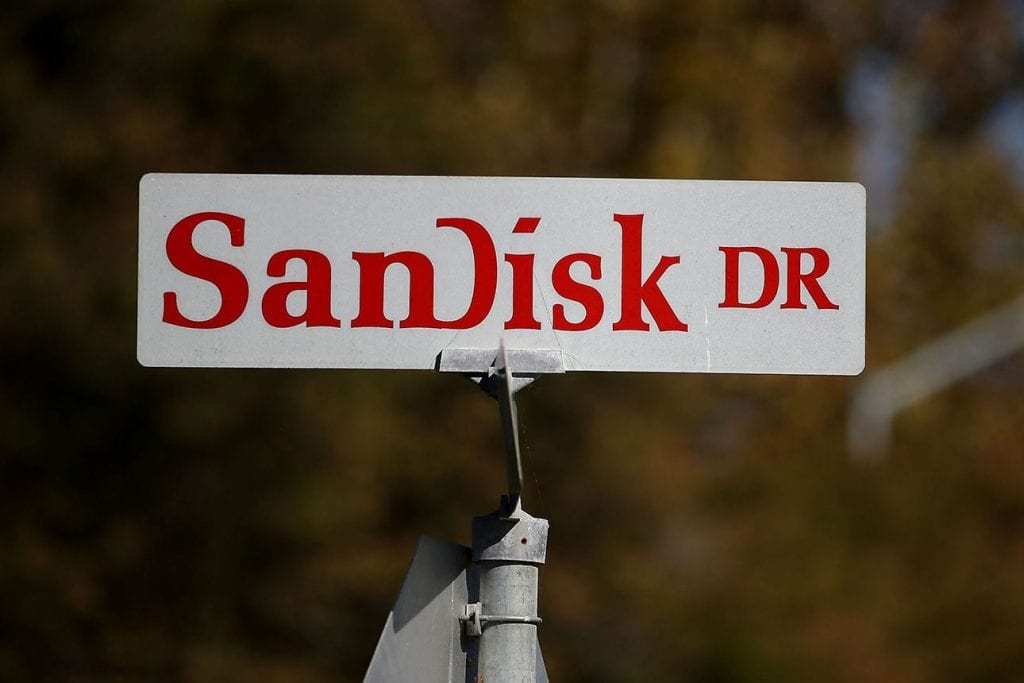
Image source: Getty Images.
China looms large
Why is Sandisk stock still going down? Some blame Chinese memory chipmaker CXMT, which has been in the news a lot lately for boasting it invented a new “4F square” memory chip and plans to market it as high-bandwidth memory (HBM) for data centers.
Earlier today, CXMT announced it’s received $1 billion in customer prepayments for its DRAM chips through the end of September, “a 15.7-fold increase from … the end of 2025,” according to DigiTimes.
What it means for Sandisk
Should this worry Sandisk investors? Not necessarily.
Firstly, investors need to remember that although both CXMT and Sandisk make computer memory, CXMT focuses on DRAM, while Sandisk produces NAND flash memory exclusively. While competing tangentially in the “memory market,” CXMT is not a direct competitor to Sandisk.
One area where the companies may compete in future is if Sandisk’s invention of high-bandwidth flash (HBF) memory takes off as an alternative to HBM and CXMT succeeds in producing DRAM chips capable of being used as HBM. As DigiTimes reports, however, CXMT is struggling to transition its DRAM to HBM, and yield rates for its “next-generation HBM3E products” are only 20% to 30%.
If that’s the best CXMT can do, Sandisk investors may have even less to worry about.
Should you buy stock in Sandisk right now?
Before you buy stock in Sandisk, consider this:
The Motley Fool Stock Advisor analyst team just identified what they believe are the 10 best stocks for investors to buy now… and Sandisk wasn’t one of them. The 10 stocks that made the cut could produce monster returns in the coming years.
Consider when Netflix made this list on December 17, 2004… if you invested $1,000 at the time of our recommendation, you’d have $358,037!* Or when Nvidia made this list on April 15, 2005… if you invested $1,000 at the time of our recommendation, you’d have $1,229,708!*
Now, it’s worth noting Stock Advisor’s total average return is 897% — a market-crushing outperformance compared to 212% for the S&P 500. Don’t miss the latest top 10 list, available with Stock Advisor, and join an investing community built by individual investors for individual investors.
See the 10 stocks »
*Stock Advisor returns as of November 5, 2026.
Rich Smith has no position in any of the stocks mentioned. The Motley Fool has no position in any of the stocks mentioned. The Motley Fool has a disclosure policy.