Key Points
-
The demand for Intel’s server CPUs is increasing at a brisk pace, and its deal with Oracle suggests that the semiconductor specialist’s DCAI revenue growth could continue to accelerate.
-
Intel expects demand for its server CPUs to exceed supply for the next couple of years.
-
Intel can sustain healthy earnings growth thanks to the short supply of server CPUs, which will allow it to command higher prices.
-
Intel (NASDAQ:INTC) witnessed a brutal sell-off last week after releasing its third-quarter results on Oct. 29, primarily due to weaker-than-expected guidance that led investors to press the panic button.
Intel’s personal computer (PC)-focused client business is not in the best shape now due to a steep drop in PC sales. Of course, Intel needed to live up to Wall Street’s expectations to justify the impressive surge the stock has witnessed since the beginning of 2025. However, the weakness in the PC market is beyond Intel’s control.
Missed Nvidia in 2009? This Rare Signal Is Flashing Again. In 2009, a “Double Down” signal flashed for a little-known chipmaker called Nvidia. For the first time in years, that same “Total Conviction” signal is flashing for a company 1/100th the size of Nvidia. Continue »
Moreover, Intel is doing well in data centers, with its artificial intelligence (AI)-focused server chips in solid demand from hyperscalers and AI companies. Oracle (NYSE:ORCL) is one such company that will deploy Intel’s server central processing units (CPUs) in large numbers. Let’s look at the reasons why the Oracle contract could be a big one for Intel.
Image source: Getty Images.
Intel is poised to win big from Oracle’s AI data center build-out
Just a couple of days ahead of Intel’s quarterly report, the semiconductor giant announced a multiyear collaboration with Oracle to deploy its Xeon server CPUs. Oracle will deploy Intel’s current and future generations of Xeon server CPUs to handle agentic AI workloads on Oracle Cloud Infrastructure (OCI).
This bodes well for Intel, given that OCI revenue has been growing at a brisk pace. Oracle reported a 121% year-over-year increase in OCI revenue in the previous quarter to $7.4 billion. This segment can sustain its terrific momentum over the long run owing to Oracle’s $664 billion in remaining performance obligation (RPO), the total value of contracts the company has yet to fulfill.
Oracle expects to accelerate the conversion of its RPO into revenue going forward, driven by the company’s significant investments to bring additional data center capacity online. Intel will provide Oracle with “additional capacity and planned processor capabilities as customers extend existing enterprise systems with AI.”
This should ensure strong growth in Intel’s server CPU business. Notably, Intel estimates that the total addressable market (TAM) for server CPUs could increase 5x over the next five years, reaching $400 billion. Chipzilla’s ability to land a major customer like Oracle should allow it to capture a significant share of this massive opportunity.
As a result, I won’t be surprised to see Intel’s data center and AI (DCAI) segment sustain the healthy growth that it has been clocking.
Intel’s data center growth is accelerating
Intel’s DCAI segment revenue increased by 78% year over year in Q3 to $7.3 billion. For comparison, the company’s DCAI revenue increased by 22% year over year in Q1 and by 59% in Q2.
Importantly, Intel management’s comments on the latest earnings call indicate that its DCAI revenue will continue to grow at a solid pace, which isn’t surprising, given the interest in its server CPUs from a hyperscaler such as Oracle. Specifically, Intel notes that demand signals from its data center customers are strengthening, primarily due to the growing adoption of agentic AI, which is driving increased server CPU demand.
As a result, Intel expects demand for its data center CPUs to outstrip supply in 2027 and 2028. This should allow Intel to implement more price hikes given its position as the dominant player in the x86 server CPU market. Though Intel has been losing ground to Advanced Micro Devices in this niche, it still holds an impressive market share of 65.5%, according to Mercury Research.
The Oracle partnership should help Intel maintain its dominance in server CPUs, paving the way for further growth in revenue and earnings. After all, Intel is expected to increase CPU prices by 10% next year, which could positively impact the company’s bottom-line performance.
What’s worth noting is that there has been a substantial improvement in Intel’s long-term earnings per share (EPS) growth expectations this year.
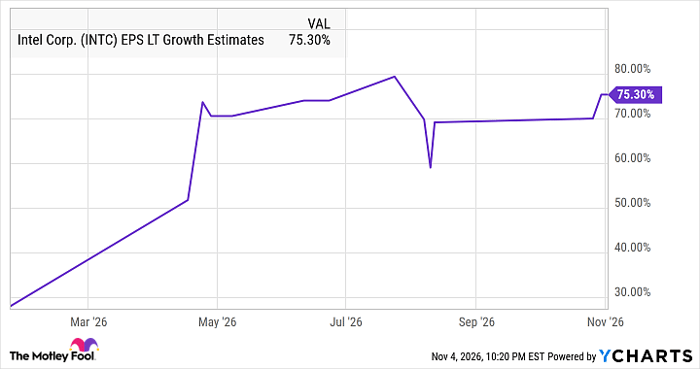
INTC EPS LT Growth Estimates data by YCharts
So, while Intel stock has taken a big beating after its latest quarterly report, the long-term prospects still appear to be sound. Throw in the fact that Intel is trading at an attractive 34 times forward earnings, a discount to the Nasdaq Composite index’s average earnings multiple of 39, and it is easy to see why the stock is worth buying following its recent pullback.
So, savvy investors would do well to look at the bigger picture and consider using this semiconductor stock’s drop to buy more shares, as its accelerating data center business could eventually help it step on the gas once again.
Should you buy stock in Intel right now?
Before you buy stock in Intel, consider this:
The Motley Fool Stock Advisor analyst team just identified what they believe are the 10 best stocks for investors to buy now… and Intel wasn’t one of them. The 10 stocks that made the cut could produce monster returns in the coming years.
Consider when Netflix made this list on December 17, 2004… if you invested $1,000 at the time of our recommendation, you’d have $358,037!* Or when Nvidia made this list on April 15, 2005… if you invested $1,000 at the time of our recommendation, you’d have $1,229,708!*
Now, it’s worth noting Stock Advisor’s total average return is 897% — a market-crushing outperformance compared to 212% for the S&P 500. Don’t miss the latest top 10 list, available with Stock Advisor, and join an investing community built by individual investors for individual investors.
See the 10 stocks »
*Stock Advisor returns as of November 5, 2026.
Harsh Chauhan has no position in any of the stocks mentioned. The Motley Fool has positions in and recommends Advanced Micro Devices, Intel, and Oracle. The Motley Fool has a disclosure policy.