Key Points
-
Intuit acquired Sequence, an AI-native revenue management platform.
-
The company also introduced new features for its intelligence platform.
-
Shares of Intuit (NASDAQ:INTU) were moving higher last month as investors rotated out of AI stocks and into beaten-down stocks in other sectors, including Intuit, which has underperformed due in part to the perception that it would be disrupted by AI.
The biggest piece of news out on Intuit was the company’s acquisition of Sequence, a revenue management company that automates the end-to-end quote-to-revenue process, which it expects to complement QuickBooks and Enterprise Suite, and give it more exposure to AI-based software.
Missed Nvidia in 2009? This Rare Signal Is Flashing Again. In 2009, a “Double Down” signal flashed for a little-known chipmaker called Nvidia. For the first time in years, that same “Total Conviction” signal is flashing for a company 1/100th the size of Nvidia. Continue »
The company also introduced upgrades to the Intuit Intelligence platform, including embedding AI in QuickBooks, Enterprise Suite, and other products across its platform.
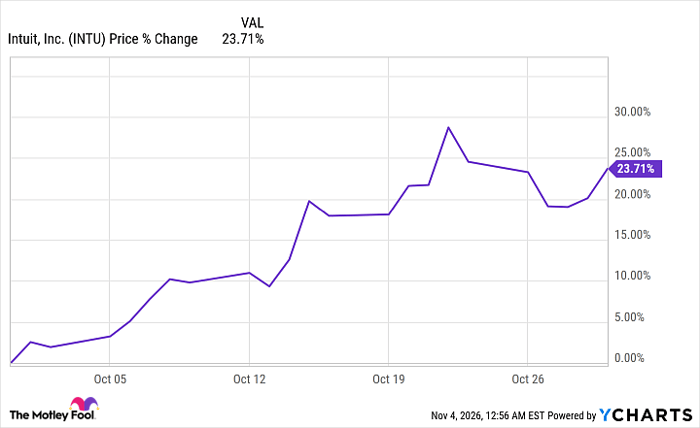
By the end of the month, the stock was up 24% on the news, according to S&P Global Market Intelligence.
As you can see from the chart below, the stock climbed steadily over the course of the month, as investors gave the stock a second look in the AI era.
INTU data by YCharts
What happened with Intuit
Intuit rallied in the first half of the month, trending with a number of beaten-down stocks, but the big news out on the company came on Oct. 15 when the stock jumped 6.4% after it announced its acquisition of Sequence, which brings an AI-native platform into its fold.
Investors seem to think the move will boost Intuit’s overall platform and offer a good example of how the company can bounce back in the AI era. Intuit’s management said, “Sequence will let us deliver mature revenue management to customers, further extending Intuit Enterprise Suite directly into industries that increasingly leverage AI consumption models like B2B software and professional services.”
Later in the month, the company announced a new wave of Intuit Intelligence features, including industry-specific editions of its Intuit Enterprise Suite.
Both moves seemed to reassure investors that the company was focused on its AI development.
Image source: Getty Images.
What’s next for Intuit
Despite the recovery in October, Intuit stock is still down 48% this year, showing the broader worries about it being disrupted by AI-native competitors for programs like TurboTax, for example.
Intuit’s valuation has fallen to a price-to-earnings ratio of just 21, but its growth has slowed, and earnings per share are expected to fall in the new fiscal year.
In light of those challenges, the acquisition of Sequence and the release of new intelligence tools make sense. If Intuit can use those to gain traction and start growing profit again, then the stock looks like a good bet to continue rising from here.
Should you buy stock in Intuit right now?
Before you buy stock in Intuit, consider this:
The Motley Fool Stock Advisor analyst team just identified what they believe are the 10 best stocks for investors to buy now… and Intuit wasn’t one of them. The 10 stocks that made the cut could produce monster returns in the coming years.
Consider when Netflix made this list on December 17, 2004… if you invested $1,000 at the time of our recommendation, you’d have $342,020!* Or when Nvidia made this list on April 15, 2005… if you invested $1,000 at the time of our recommendation, you’d have $1,270,017!*
Now, it’s worth noting Stock Advisor’s total average return is 885% — a market-crushing outperformance compared to 208% for the S&P 500. Don’t miss the latest top 10 list, available with Stock Advisor, and join an investing community built by individual investors for individual investors.
See the 10 stocks »
*Stock Advisor returns as of November 4, 2026.
Ashok Srivastava, Senior Vice President and Chief AI Officer at Intuit, is a member of The Motley Fool’s board of directors. Jeremy Bowman has no position in any of the stocks mentioned. The Motley Fool has positions in and recommends Intuit. The Motley Fool has a disclosure policy.