Key Points
-
Intel’s third-quarter financial results were a massive disappointment for artificial intelligence (AI) investors.
-
While Intel’s data center business is accelerating, demand in its PC and Foundry segments was softer than expected.
-
Intel stock is in free fall, but that does not necessarily mean now is a good time to buy the dip.
-
In the late 1990s, Intel (NASDAQ: INTC) was one of the most important companies in the technology industry. Its processors powered millions of personal computers, and its dominance in semiconductor manufacturing made it a compelling choice for investors looking to capitalize on the internet revolution.
On Aug. 31, 2000, Intel stock closed at a then-record $74.88. More than 26 years later, that optimism has delivered surprisingly disappointing results. As of the closing bell on Nov. 2, Intel shares traded at $59.97. This means a $10,000 investment made at its peak during the dot-com boom would be worth approximately $8,009 today, excluding dividends.
Missed AI’s “Act 1”? Act 2 Could Be 15x Bigger. Most investors think they missed the AI boat because they didn’t buy Nvidia in 2005. But according to our analysts, we’re only at the end of “Act 1″—the R&D phase. “Act 2” is the global rollout. Continue »
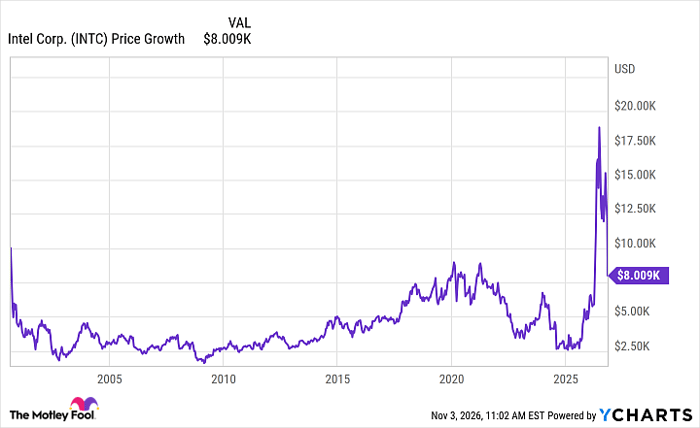
INTC data by YCharts
Intel’s struggles have become apparent throughout the artificial intelligence (AI) revolution. Recently, shares collapsed nearly 29% on Oct. 30 following the company’s third-quarter earnings report.
What went wrong with this former semiconductor powerhouse, and could its latest sell-off represent a lucrative opportunity for investors?
Intel’s earnings reveal a complicated turnaround
Intel’s third-quarter earnings report initially looked encouraging. Revenue increased 21% year over year to $16.5 billion, while adjusted earnings per share (EPS) reached $0.52, more than doubling from the prior-year period.
Its Data Center and AI (DCAI) segment was particularly impressive, growing 78% year over year to $7.3 billion in revenue. Demand for Intel’s Xeon server processors has strengthened as AI developers expand computing infrastructure to support more sophisticated applications across agentic AI workloads.
However, the company’s PC business is facing challenges. Revenue from its Client Computing and Physical AI (CCPG) segment declined 5% to $8.1 billion. Even more concerning was management’s outlook. Intel expects fourth-quarter revenue between $15 billion and $16 billion, below the $17 billion target Wall Street had anticipated. Adjusted earnings guidance of $0.25 also disappointed investors.
Intel’s sharp sell-off shows that investors are reassessing how quickly the company’s turnaround can realistically translate into sustainable growth across the entire business.
Why is Intel struggling?
For decades, Intel enjoyed competitive advantages in processor design and manufacturing. However, several strategic missteps gradually weakened its position.
Intel struggled to capitalize on the smartphone revolution. This allowed competitors to develop processors using alternative chip architectures. Meanwhile, manufacturing delays enabled Taiwan Semiconductor Manufacturing to establish itself as the industry’s leading foundry for advanced chips.
These setbacks have become particularly noticeable as demand for AI infrastructure accelerates. Unlike Nvidia, whose graphics processing units are essential for training and deploying AI models, Intel remains heavily dependent on traditional central processing units (CPUs).
Indeed, CPUs remain critical components of accelerated computing systems, and Intel’s latest data center results underscore that AI is driving meaningful demand for its products. With that said, the company hasn’t captured the same economic opportunity as Nvidia, which stitches together accelerators with networking technology, CUDA software, and a developer ecosystem through an extensive roster of open-source models.
Intel’s manufacturing strategy introduces another headache. The company is investing heavily in its foundry business in hopes of manufacturing advanced semiconductors for outside customers. Unfortunately, this transformation remains costly.
Intel Foundry generated $6.7 billion in revenue during the third quarter but posted an operating loss of $1.9 billion. In addition, most of the company’s foundry revenue comes from internal products rather than external customers.
Is Intel stock a bargain or a value trap?
Intel isn’t necessarily a lost cause. The company’s latest financial performance indicates strong demand for server processors. Intel also benefits from the strategic importance of domestic semiconductor manufacturing, which has attracted government support.
Nevertheless, the company’s long-term performance offers an important warning. The distinction between a cheap stock and an attractive investment is particularly relevant today in the AI era. Following its latest sell-off, Intel might look inexpensive relative to recent trading levels, but its valuation needs to be considered alongside manufacturing losses, ongoing capital expenditures (capex), the competitive landscape, and uncertain earnings growth.
For now, I see Intel as a speculative turnaround rather than a dependable long-term compounder. While its data center business is encouraging, the company still needs to prove its foundry investments will generate sustainable profitability.
Investors seeking exposure to semiconductor stocks have several alternatives with greater durability. Overall, Intel’s disappointing performance since 2000 shows why investors should regularly reassess their investment theses. The company has opportunities to recover, but buying shares simply because they’ve fallen sharply risks confusing a potential bargain with a value trap.
Should you buy stock in Intel right now?
Before you buy stock in Intel, consider this:
The Motley Fool Stock Advisor analyst team just identified what they believe are the 10 best stocks for investors to buy now… and Intel wasn’t one of them. The 10 stocks that made the cut could produce monster returns in the coming years.
Consider when Netflix made this list on December 17, 2004… if you invested $1,000 at the time of our recommendation, you’d have $336,195!* Or when Nvidia made this list on April 15, 2005… if you invested $1,000 at the time of our recommendation, you’d have $1,241,567!*
Now, it’s worth noting Stock Advisor’s total average return is 875% — a market-crushing outperformance compared to 208% for the S&P 500. Don’t miss the latest top 10 list, available with Stock Advisor, and join an investing community built by individual investors for individual investors.
See the 10 stocks »
*Stock Advisor returns as of November 4, 2026.
Adam Spatacco has positions in Nvidia. The Motley Fool has positions in and recommends Intel, Nvidia, and Taiwan Semiconductor Manufacturing. The Motley Fool has a disclosure policy.