Key Points
-
Johnson & Johnson is a large medical device and pharmaceutical company.
-
Third-quarter 2026 earnings fell nearly 96% year over year.
-
Big one-time charges in the quarter won’t derail this business over the long term.
-
Johnson & Johnson (NYSE: JNJ) is a member of the highly elite club of companies known as Dividend Kings. It has increased its dividend annually for a huge 64 years. As you consider the $7 billion charge the company took in the third quarter of 2026, which pummeled its earnings, keep in mind its incredible dividend track record. This is a business that knows how to survive and thrive.
In fact, despite the weak quarterly earnings, J&J upped its full-year guidance. Here’s a deep dive into what happened and what it means for conservative long-term dividend investors.
Missed AI’s “Act 1”? Act 2 Could Be 15x Bigger. Most investors think they missed the AI boat because they didn’t buy Nvidia in 2005. But according to our analysts, we’re only at the end of “Act 1″—the R&D phase. “Act 2” is the global rollout. Continue »
What’s up with J&J’s $7 billion charge?
To quote the company, “Results in the quarter were impacted by the proposed talc litigation resolution as well as expenses associated with the Firefly Bio transaction and Sail Biomedicines’ collaboration amounting to approximately $7 billion.” There are two pieces to consider here, one not so good and one that’s much better.
The negative is the litigation expense. J&J spun off the business that used to make talcum powder, but it still faces exposure to the class action lawsuit alleging the company’s talcum powder caused cancer. It has a potential settlement that will largely end the litigation, but it comes at a high cost. An initial payment of $3 billion is due in 2027, with the remainder of the proposed $5.5 billion settlement set to be paid in future years. That’s a lot of money, but at least it could help bring to a close a legal headwind that has dogged the company for years.
Meanwhile, the remainder of the quarterly charge was for items that will help J&J grow over the long term: an acquisition and a partnership. Simply put, despite the legal distractions this healthcare giant faces, it remains focused on long-term growth.
The big-picture story is still good for J&J
What’s interesting is that J&J increased its full-year revenue and earnings guidance even as it took that big quarterly charge. It highlights something that the company’s status as a Dividend King hints at: J&J knows how to thrive through good times and bad.
Even the best-run businesses eventually go through difficult periods. Surviving those periods while continuing to reward investors with regular dividend increases is a distinction that sets J&J apart. In fact, it has the longest dividend streak of any healthcare company.
The truth is, you could actually view the talc settlement as a net positive as well, despite the huge cost. Removing that issue will make it easier for J&J to focus on the long-term growth of its business. And that growth could continue for decades, given the importance of healthcare in an aging society. It’s also important to keep in mind that the company’s revenues grew nearly 6% in the quarter, signaling that the core business remains strong despite the roughly 96% decline in GAAP earnings per share.
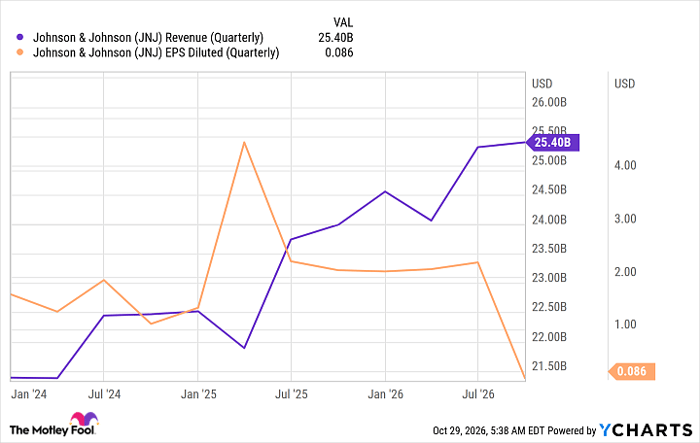
JNJ Revenue (Quarterly) data by YCharts
Notably, healthcare spending tends to be resilient to recessions, since it isn’t usually optional. Getting the talc issue out of the way now, while the economy is still growing, spares the company from taking a huge charge when investors are worried about other issues, like a bear market. Don’t underestimate the importance of the timing. In a bull market, investors are willing to overlook bad news; in a bear market, investors often pay extra attention to it.
J&J remains a fundamentally strong business
You don’t need to dig too deeply into the one-time charge to understand that Johnson & Johnson is still a good company. The quarter was ugly, but the outlook remains bright. And if you are a conservative long-term dividend investor, this Dividend King remains as resilient as ever.
Should you buy stock in Johnson & Johnson right now?
Before you buy stock in Johnson & Johnson, consider this:
The Motley Fool Stock Advisor analyst team just identified what they believe are the 10 best stocks for investors to buy now… and Johnson & Johnson wasn’t one of them. The 10 stocks that made the cut could produce monster returns in the coming years.
Consider when Netflix made this list on December 17, 2004… if you invested $1,000 at the time of our recommendation, you’d have $334,631!* Or when Nvidia made this list on April 15, 2005… if you invested $1,000 at the time of our recommendation, you’d have $1,312,844!*
Now, it’s worth noting Stock Advisor’s total average return is 893% — a market-crushing outperformance compared to 213% for the S&P 500. Don’t miss the latest top 10 list, available with Stock Advisor, and join an investing community built by individual investors for individual investors.
See the 10 stocks »
*Stock Advisor returns as of October 30, 2026.
Reuben Gregg Brewer has no position in any of the stocks mentioned. The Motley Fool recommends Johnson & Johnson. The Motley Fool has a disclosure policy.