Key Points
-
The market is underestimating Micron’s growth potential, as a significant surge in demand for high-bandwidth memory should help sustain its phenomenal growth.
-
The persistent shortage of memory chips will enable Micron to sustain its solid growth rate by 2030.
-
The stock can multiply substantially from current levels even if it trades at a dirt cheap valuation in 2030.
-
Micron Technology (NASDAQ:MU) stock has surged by an incredible 937% since the beginning of 2025, meaning that a $10,000 investment in the memory specialist’s shares at the beginning of last year is worth more than $103,000, as of this writing.
Investors may be wondering if it is worth investing $10,000 in Micron stock right now following its stunning rally in recent months. Moreover, investors have been booking profits in semiconductor stocks lately due to the rising inflation and concerns about whether the aggressive artificial intelligence (AI) build-out is sustainable owing to high borrowing costs.
Missed Nvidia in 2009? This Rare Signal Is Flashing Again. In 2009, a “Double Down” signal flashed for a little-known chipmaker called Nvidia. For the first time in years, that same “Total Conviction” signal is flashing for a company 1/100th the size of Nvidia. Continue »
However, a closer look at the prospects of the memory market and Micron’s solid position in this space suggests that the stock still has incredible upside potential. Let’s look at the reasons why it may be a good idea to put $10,000 into this stock even after the solid gains it has clocked since the beginning of 2025.
Image source: Getty Images.
The favorable memory market dynamic powering Micron’s growth is sustainable
Micron has benefited substantially from the booming demand for memory chips used in AI data centers. The high-bandwidth memory (HBM) that goes into AI accelerator chips plays a critical role in feeding huge amounts of data quickly to graphics processing units (GPUs), central processing units (CPUs), and custom AI processors.
HBM ensures that these chips don’t remain idle waiting for data, facilitating the quick computation needed for running training and inference workloads. Not surprisingly, HBM is in terrific demand. Bloomberg Intelligence estimates that the global HBM market could be worth a whopping $641 billion in 2030, well above the earlier forecast of $260 billion.
The firm also notes that the HBM market’s phenomenal growth will be driven by an increase in prices. According to Bloomberg Research, the average price of HBM in 2030 could be 2.25x compared to 2026 levels. Micron is the third-largest player in the HBM market with an 18% market share, according to Counterpoint Research.
So, Micron’s HBM revenue alone could reach $115 billion in 2030, assuming it maintains its share and the end market jumps to $641 billion. Micron doesn’t state how much revenue it gets from HBM, but the company does point out that it sees HBM growing at a faster pace than dynamic random-access memory (DRAM) shipments through 2028. Also, the company has significantly increased its HBM pricing for 2027, suggesting that the price increases that Bloomberg Intelligence notes are indeed happening.
Moreover, the boom in HBM demand will ensure that the tight supply conditions in the memory market persist. That’s because HBM is manufactured by stacking multiple DRAM chips. As a result, HBM production requires 3-4x the capacity of traditional DRAM, according to Bank of America. What’s worth noting is that the new memory fabrication plants coming online in 2027 are purpose-built for HBM production.
As a result, the memory shortage that’s hurting the smartphone and personal computer (PC) markets is unlikely to go away. So, the new memory capacity poised to come online over the next three years will be quickly absorbed by AI data centers, smartphones, and PCs. This should ensure that Micron continues to enjoy strong revenue and earnings growth over the next four years, which is why I think that the stock could turn a $10,000 investment into a much bigger sum.
Here’s how much upside Micron could deliver by 2030
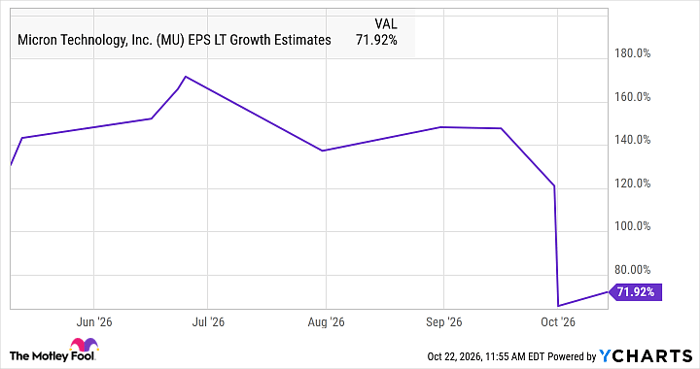
Micron’s non-GAAP earnings per share (EPS) in the recently concluded fiscal 2026 (which ended Sept. 3) stood at $75.52 per share, jumping from $8.29 per share in the prior year. Analysts expect Micron’s non-GAAP EPS to jump to $176.50 in fiscal 2027. Importantly, Micron is expected to clock healthy EPS growth over the long run, even after the exponential jump in the company’s earnings in fiscal 2026.
MU EPS LT Growth Estimates data by YCharts
Of course, analysts have lowered their EPS growth expectation lately, but that’s not surprising given how fast Micron’s earnings have grown lately. Moreover, a 70%-plus long-term earnings growth rate is quite impressive. Assuming Micron’s earnings increase by even 50% a year in fiscal years 2028, 2029, and 2030, its EPS could reach $595.86 after four years (using fiscal 2027’s projected EPS of $176.50 as the base).
If Micron trades at even 10 times earnings in 2030 (in line with its five-year average forward earnings multiple), its stock price could reach $5,958. That’s 6.8x Micron’s current stock price, suggesting that this AI stock could turn a $10,000 investment into more than $68,000 by 2030. So, Micron still has multibagger potential, and the fact that it trades at just 13 times earnings makes it a no-brainer buy.
Should you buy stock in Micron Technology right now?
Before you buy stock in Micron Technology, consider this:
The Motley Fool Stock Advisor analyst team just identified what they believe are the 10 best stocks for investors to buy now… and Micron Technology wasn’t one of them. The 10 stocks that made the cut could produce monster returns in the coming years.
Consider when Netflix made this list on December 17, 2004… if you invested $1,000 at the time of our recommendation, you’d have $355,124!* Or when Nvidia made this list on April 15, 2005… if you invested $1,000 at the time of our recommendation, you’d have $1,296,254!*
Now, it’s worth noting Stock Advisor’s total average return is 901% — a market-crushing outperformance compared to 210% for the S&P 500. Don’t miss the latest top 10 list, available with Stock Advisor, and join an investing community built by individual investors for individual investors.
See the 10 stocks »
*Stock Advisor returns as of October 26, 2026.
Bank of America is an advertising partner of Motley Fool Money. Harsh Chauhan has no position in any of the stocks mentioned. The Motley Fool has positions in and recommends Micron Technology. The Motley Fool has a disclosure policy.