Key Points
-
Despite some exciting advances, electric vertical takeoff and landing (eVTOL) aircraft still face big challenges.
-
The industry is still working toward FAA certification and might not compete soon against traditional helicopters.
-
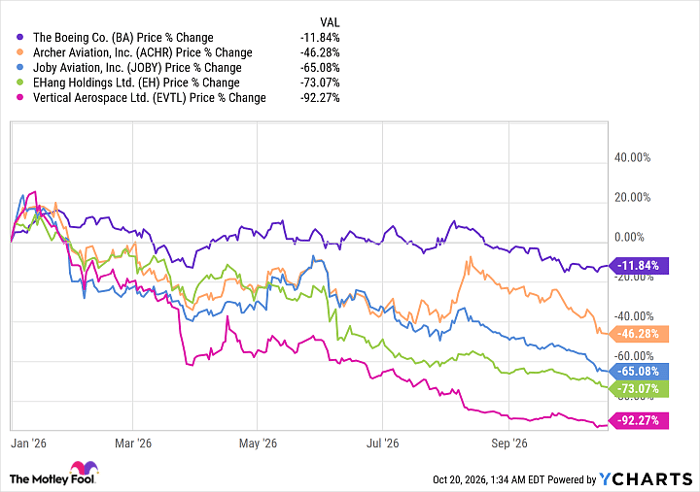
Major eVTOL stocks have been on a roller-coaster ride, losing between 46% and 92% of their value so far in 2026.
-
An occasional joke that people make on the internet when they’re complaining about some annoying or disappointing aspect of modern life in the 21st century is: “We were promised flying cars by now!”
This fascination with flying cars is part of why the electric vertical takeoff and landing (eVTOL) industry has been so intriguing for investors. What if, someday soon, we could all commute to work in the sky — without getting stuck in traffic, car exhaust and fender benders, or the time-wasting, humdrum frustrations of land-based vehicles?
Missed Nvidia in 2009? This Rare Signal Is Flashing Again. In 2009, a “Double Down” signal flashed for a little-known chipmaker called Nvidia. For the first time in years, that same “Total Conviction” signal is flashing for a company 1/100th the size of Nvidia. Continue »
I wish it were possible, but I’m not betting money on it. Don’t get me wrong: I’m rooting for eVTOL technology. The designs look cool. I love the idea of everyday transportation powered by clean energy. I love flying in planes. And I wish we could all experience the futuristic thrills of getting around in everyday life with flying cars or air taxis.
But unfortunately, I believe the eVTOL industry might be stuck in a holding pattern for a long time. There are a few big reasons why I’m bearish on eVTOL stocks.
1. Batteries are expensive
To be lighter than air, eVTOL aircraft need lightweight batteries. The past few years have seen significant improvements in the capacity, energy density, and lightness of lithium-ion batteries used in electric vehicles on land. But eVTOL batteries are expensive. As of April 2025, aviation-grade battery costs were about 10 times higher than electric car batteries. An eVTOL industry website (eVTOL.Travel) estimates that eVTOL aircraft purchase prices range from $410,000 to $4 million per aircraft, and battery and energy costs make up about 25% to 30% of manufacturing costs.
eVTOLs have special challenges with batteries — they need enough power to provide lift and enough battery life to keep an aircraft in the sky. Batteries are much less energy-dense than traditional hydrocarbon aircraft fuel, and making multiple vertical takeoffs and landings (like would be required for everyday round-trips with passengers) causes batteries to drain faster.
This puts extra engineering challenges on eVTOLs. They have to take off and land and operate in a more battery-intensive way compared to conventional aircraft like airline planes. These engineering problems could be solvable, and aviation battery costs might come down. The price of eVTOLs is also expected to decline if and when the industry can ramp up production. But this challenge of more expensive batteries driving up prices is one big area of uncertainty that the eVTOL industry faces.
2. FAA regulations are complicated
The Federal Aviation Administration (FAA) has the final say on what kinds of vehicles are allowed to fly and where. New aircraft are required to go through a seven-phase FAA certification process. As of May, Archer Aviation (NYSE: ACHR) and Joby Aviation (NYSE: JOBY) had made progress into Phase 4 of this FAA process, according to CNBC.
Several eVTOL companies have completed test flights and are exploring the start of passenger service. But as of this writing in October, no eVTOL company has completed full FAA certification. According to reporting from Gulf News in the United Arab Emirates (where eVTOL companies are also exploring air taxi service), eVTOLs might not achieve U.S. certification with the FAA until mid-2027 at the earliest.
Delays in FAA certification might be the biggest risk to the eVTOL industry. Developing these aircraft is expensive. For example, Joby is burning over $200 million per quarter as of September 2026. Not every company will have enough cash to stay in business until they reach commercialization.
3. Aircraft need lots of infrastructure
Even if eVTOL aircraft were fully approved and certified by the FAA tomorrow, many questions remain unanswered:
- Where would they fly — would there be a dedicated low-altitude airspace where these special aircraft could operate?
- Who would oversee air traffic control for eVTOLs? Companies like Joby have been collaborating with the FAA on airspace integration and proof-of-concept programs to include eVTOLs in the existing air traffic control system. But this is another regulatory issue that needs to be addressed.
- Where would they land — would there be dedicated helipads or vertiports for these helicopter-like vehicles to take off, or could they truly take off from any location and land on any parking lot or residential street?
America’s airports rely on complex systems for air traffic control. Commercial airlines have high standards for safety and maintenance. All this involves a lot of government bureaucracy, friction, and expense. None of this can be easily bypassed or waved away with a magic wand. By the time some of these regulatory issues and infrastructure questions get sorted out, many eVTOL companies might run out of cash.
4. What’s the business model?
eVTOL vehicles might be a case of “good product, bad business.” There might not be a large-enough viable market for air taxi services. How many people can currently afford to hire helicopters instead of taking a taxi, rideshare, or bus?
According to Fortune Business Insights, the global helicopter market size was about $47.9 billion in 2025. But according to a helicopter market report from Rotortrade, eVTOL aircraft are likely to have a “limited” impact on demand for traditional helicopters until 2030, and might not replace light helicopters for urban air mobility until 2030 to 2035.
Even if there is enough room in the sky for helicopters and eVTOL aircraft, there might not be enough room in the market for both. So far in 2026, the share prices of the top five best eVTOL stocks have plummeted. Boeing is down less than the rest, but it’s a well-established aerospace company that sells more than just eVTOL aircraft.
BA data by YCharts
It feels like there are still too many unknowns about the business model for eVTOL transportation. Even if battery technology improves, manufacturing scales up, prices come down, the FAA regulations are resolved, and the right infrastructure is organized, I’m skeptical about investing in eVTOL companies.
I don’t know if these companies can make enough money by selling flights to commercial passengers (like an airline or rideshare company), or if there is enough demand from the kinds of buyers who already buy helicopters to buy these vehicles directly. No doubt, eVTOL companies are building something futuristic and exciting, but it’s also financially risky. I wouldn’t rate any pure-play eVTOL stock as a buy right now.
Should you buy stock in Joby Aviation right now?
Before you buy stock in Joby Aviation, consider this:
The Motley Fool Stock Advisor analyst team just identified what they believe are the 10 best stocks for investors to buy now… and Joby Aviation wasn’t one of them. The 10 stocks that made the cut could produce monster returns in the coming years.
Consider when Netflix made this list on December 17, 2004… if you invested $1,000 at the time of our recommendation, you’d have $361,596!* Or when Nvidia made this list on April 15, 2005… if you invested $1,000 at the time of our recommendation, you’d have $1,303,935!*
Now, it’s worth noting Stock Advisor’s total average return is 910% — a market-crushing outperformance compared to 211% for the S&P 500. Don’t miss the latest top 10 list, available with Stock Advisor, and join an investing community built by individual investors for individual investors.
See the 10 stocks »
*Stock Advisor returns as of October 23, 2026.
Ben Gran has no position in any of the stocks mentioned. The Motley Fool has positions in and recommends Boeing. The Motley Fool has a disclosure policy.