Key Points
-
Rivian recently renegotiated its DoE loan down to $4.5 billion.
-
Rivian’s July capital raise was done in part to fund its DoE loan conditions and commitment.
-
The DoE loan will be instrumental in Rivian constructing its second factory, setting the stage for growth towards the end of this decade.
-
Rivian (NASDAQ: RIVN) is on the cusp of becoming the next legitimate electric vehicle (EV) investment on the market. There are many things investors don’t understand about such a young company, especially about Rivian’s $4.5 billion Department of Energy (DoE) loan and what it means — and what it doesn’t mean — for its future. Let’s dig right in.
This doesn’t dilute, does it?
Missed Nvidia in 2009? This Rare Signal Is Flashing Again. In 2009, a “Double Down” signal flashed for a little-known chipmaker called Nvidia. For the first time in years, that same “Total Conviction” signal is flashing for a company 1/100th the size of Nvidia. Continue »
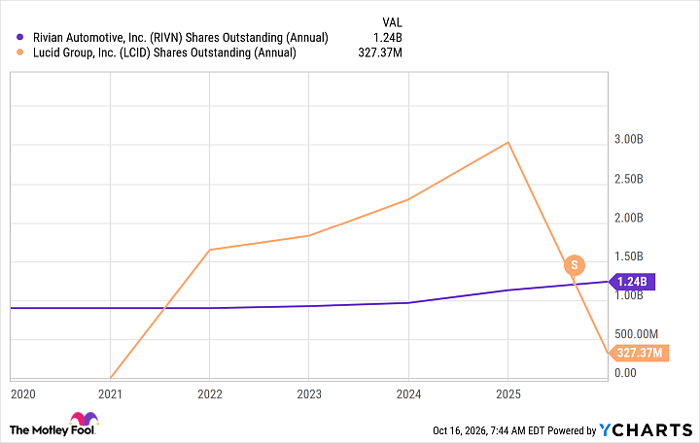
RIVN Shares Outstanding (Annual) data by YCharts.
One argument in favor of Rivian as an investment that too many investors overlook is that the young EV maker has done an admirable job avoiding diluting its shareholders. That may not seem important, but as you can see in the graph above, rival Lucid (NASDAQ: LCID) hasn’t been able to tame its need to tap capital markets and has consistently released new shares, making existing shares less valuable for long-term shareholders. (Please note: The late change in Lucid’s outstanding shares was due to a 1-for-10 reverse stock split.)
The answer to this question, technically, is no. The DoE loan itself is not dilutive; however, indirectly it is. Borrowing money from the DoE commits Rivian to contributing its own capital toward the end goal, which in this case is the company’s second factory being constructed in Georgia. Here’s my napkin math example: If the Georgia factory cost $100, the DoE loan — which should probably be reframed as a financing strategy — could finance up to $80 of that, while Rivian needs to pony up the remaining $20.
This commitment, and condition, is precisely why Rivian exercised a rare capital raise by issuing over 86 million new shares in July, raising roughly $1.3 billion. That capital raise was diluting, and it was in part to fund the DoE loan conditions.
Is this loan even helpful?
To put it bluntly: yes. Rivian’s DoE loan carries the baggage of an interest rate based on the U.S. Treasury yield curve, with a 0% credit spread. Let’s define that because it doesn’t mean 0% interest as if buying a vehicle. Let’s use Rivian’s $1.25 billion secured green notes that carry a 10% annual interest rate as a benchmark and use more napkin math.
Annual interest on a 10% note the size of Rivian’s DoE loan would be about $400 million. While we don’t have exact rates, because those aren’t defined until Rivian makes a withdrawal on the loan (expected in 2027), it should save the company hundreds of millions of dollars annually — hugely valuable for a cash-burning young EV maker.
Another advantage the DoE loan provides Rivian is more breathing room before repayment. Let’s look at the first of two notes: Note A ($3.355 billion maximum principal) requires interest payments to begin on June 15, 2030, with principal repayments beginning in 2031 and final maturity on March 15, 2045.
This is a low-interest, multibillion-dollar loan with repayments beginning two to three years after its Georgia plant opens and ramps up production. This is just savvy business by Rivian.
The BIG point
The biggest question for investors is how does Rivian’s DoE loan to fund construction of its Georgia plant impact profitability? Great question, you!
Here’s the truth: Rivian’s upcoming Georgia plant could make the company far more efficient at scale, but reaching that scale will take time and could make its financial results a bit worse. Early on, each vehicle rolling out of Georgia is likely to be less profitable compared to one rolling out of a more maxed-out Illinois factory. It’s not guaranteed due to many variables involved, but it is likely.
As Rivian grows and potentially builds more factories, it will have more flexibility, but this is the scenario for a young EV maker with one factory opening and now a second factory. Rivian almost certainly can’t immediatly start selling vehicles at a rate that will require the Georgia facility to run at full capacity.
What it all means
Investors can misinterpret Rivian’s DoE loan because investors see a big dollar sign and hope for the best. The truth is much more business-like. The loan is certainly beneficial with favorable terms and conditions, and it gives a young company much needed breathing room before repayments begin. If all goes to plan, the EV maker should moderately fill production capacity at its Georgia plant by the time it begins favorable loan-term repayments.
If that holds true, this would be one big benefit any similar-sized rival to Rivian would envy.
Should you buy stock in Rivian Automotive right now?
Before you buy stock in Rivian Automotive, consider this:
The Motley Fool Stock Advisor analyst team just identified what they believe are the 10 best stocks for investors to buy now… and Rivian Automotive wasn’t one of them. The 10 stocks that made the cut could produce monster returns in the coming years.
Consider when Netflix made this list on December 17, 2004… if you invested $1,000 at the time of our recommendation, you’d have $350,756!* Or when Nvidia made this list on April 15, 2005… if you invested $1,000 at the time of our recommendation, you’d have $1,363,905!*
Now, it’s worth noting Stock Advisor’s total average return is 922% — a market-crushing outperformance compared to 213% for the S&P 500. Don’t miss the latest top 10 list, available with Stock Advisor, and join an investing community built by individual investors for individual investors.
See the 10 stocks »
*Stock Advisor returns as of October 23, 2026.
Daniel Miller has no position in any of the stocks mentioned. The Motley Fool has no position in any of the stocks mentioned. The Motley Fool has a disclosure policy.