Key Points
-
Social Security’s cost-of-living adjustment (COLA) will be announced at 08:30 a.m. ET on Oct. 14.
-
For a second consecutive year, Trumpflation should lead to an outsize Social Security raise.
-
However, abnormally large Social Security COLAs come at a steep cost to America’s leading retirement program.
-
Social Security’s big day is right around the corner. In just three days, on Oct. 14 at 08:30 a.m. ET, the U.S. Bureau of Labor Statistics will release the September inflation report, providing the final data point needed to calculate Social Security’s 2027 cost-of-living adjustment (COLA).
Social Security’s COLA is essentially a “raise” given to beneficiaries to offset inflation (rising prices) over the last year. If benefits didn’t grow annually on par with inflation, retired workers, workers with disabilities, and survivors of deceased workers would see their Social Security income purchasing power decline over time.
Missed Nvidia in 2009? This Rare Signal Is Flashing Again. In 2009, a “Double Down” signal flashed for a little-known chipmaker called Nvidia. For the first time in years, that same “Total Conviction” signal is flashing for a company 1/100th the size of Nvidia. Continue »
For Social Security’s more than 71 million traditional beneficiaries, the program’s 2027 COLA should be one of the largest of the last 35 years, thanks in part to a second consecutive year with a “Trump bump.” But while larger monthly Social Security checks, courtesy of President Donald Trump, may bring smiles, outsize COLAs come with a grim reality for America’s leading retirement program.

An outsize Trump bump may lead to mammoth problems for Social Security. Image source: Official White House Photo by Molly Riley. Image source: The White House.
Trumpflation should yield one of the largest Social Security raises since 1993
Rising prices are perfectly normal when the U.S. economy is growing. Since 1975, Social Security beneficiaries have received a COLA in all but three years (2010, 2011, 2016), indicating that inflation and Social Security raises are near-annual occurrences.
However, two of President Trump’s policies are directly lifting consumer prices and boosting inflation.
For starters, Trump’s tariff and trade policy has been increasing consumer goods prices since mid- 2025. The president’s “Liberation Day” tariffs, which were struck down by the U.S. Supreme Court in February 2026, lifted consumer prices and gave a modest boost to Social Security’s 2.8% COLA in 2026.
The cumulative effects of tariffs on consumer goods prices should continue, given that the Trump administration implemented sweeping tariffs of 10% to 12.5% on more than 80 countries in late July. Adding duties to imported goods can raise manufacturing costs, which producers pass on to consumers.
The Iran war is the second of Trump’s policies that has caused inflation to jump. Shortly after the president green-lit attacks against Iran on Feb. 28, the latter shut down the Strait of Hormuz to most commercial vessels, thereby stymying the flow of a fifth of the world’s crude oil. Energy markets reacted quickly to the largest energy supply disruption in modern history, sending gas prices soaring and diesel to a record high.
With Trumpflation (inflation directly traced back to Trump’s policies) boosting the prevailing inflation rate, independent estimates call for one of the largest Social Security raises in 35 years. Both The Senior Citizens League (TSCL), a nonpartisan senior advocacy group, and Mary Johnson, a Social Security and Medicare policy analyst, are projecting a 3.5% COLA for 2027.
If TSCL and Johnson are correct, a 3.5% increase in monthly benefits would tie for the sixth-largest COLA since 1993 and add $73 per month to the average retired worker’s payout. It would also represent the sixth consecutive year with a Social Security raise of at least 2.5%, which hasn’t happened in 30 years!

Image source: Getty Images.
Social Security’s Trump bump may hasten the need for sweeping benefit cuts
While most traditional beneficiaries will appreciate a larger-than-normal COLA next year, Social Security’s Trump bump also has a dark side.
Every year since 1985, the Social Security Board of Trustees has warned of a long-term (75-year) unfunded obligation. In simpler terms, the Trustees project that income collected in the 75 years after the release of a report will be insufficient to cover outlays (primarily benefits, but also administrative expenses to oversee Social Security). As of 2026, this unfunded obligation reached $29.3 trillion.
Although $29.3 trillion is a daunting figure, the more frightening forecast concerns the Old-Age and Survivors Insurance trust fund’s (OASI) asset reserves. This excess income that’s been collected since inception and is invested in special-issue, interest-bearing government bonds, as required by law, is forecast to be exhausted by the fourth quarter of 2032.
One of the few positives about Social Security forecasts is that America’s leading retirement program can’t go bankrupt or halt benefits. More than 91% of the income collected comes from the 12.4% payroll tax on earned income. As long as Americans keep working, there will always be income to disburse to eligible beneficiaries.
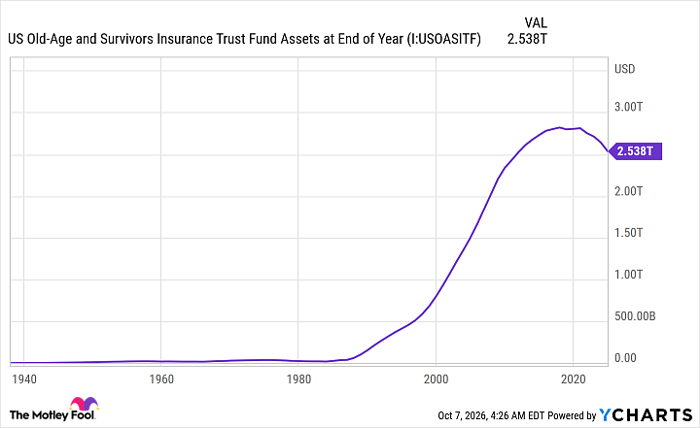
US Old-Age and Survivors Insurance Trust Fund Assets at End of Year data by YCharts
The problem is that if the OASI’s asset reserves are exhausted, it would create the need for sweeping benefit cuts, currently estimated at 22%.
The annual Trustees Report models a long list of variables when crafting its forecasts, including birth rates, net migration, death rates, and even annual COLAs. The Trustees assume relatively modest annual raises in developing their short- and long-range models.
However, Social Security’s Trump bump-driven 2027 COLA is anything but modest. A 3.5% COLA risks draining the OASI’s asset reserves much faster than the Trustees have forecast. What’s more, there’s no quick resolution to Trumpflation, implying that the consumer price pressures from tariffs and the Iran war will persist into 2027 and potentially boost Social Security’s 2028 COLA as well.
The grim reality is that persistently elevated inflation, leading to outsize COLAs, may hasten the need for sweeping benefit cuts or potentially increase the size of the cut needed in the coming years.
The $23,760 Social Security bonus most retirees completely overlook
If you’re like most Americans, you’re a few years (or more) behind on your retirement savings. But a handful of little-known “Social Security secrets” could help ensure a boost in your retirement income.
One easy trick could pay you as much as $23,760 more… each year! Once you learn how to maximize your Social Security benefits, we think you could retire confidently with the peace of mind we’re all after. Join Stock Advisor to learn more about these strategies.
View the “Social Security secrets” »
The Motley Fool has a disclosure policy.