
Key Points
-
The annual cost-of-living adjustment (COLA) is determined by inflation data.
-
Inflation has swung wildly this year, due to the Iran conflict.
-
The most important inflation data for the COLA comes in July, August, and September.
While investors were eagerly awaiting July inflation data for clues about how the Federal Reserve might proceed regarding interest rates at its September meeting, Social Security beneficiaries were watching for a different reason.
Inflation data plays a key role in determining the next year’s cost-of-living adjustment (COLA), which typically increases benefits for tens of millions of Americans.
Missed Nvidia in 2009? This Rare Signal Is Flashing Again. In 2009, a “Double Down” signal flashed for a little-known chipmaker called Nvidia. For the first time in years, that same “Total Conviction” signal is flashing for a company 1/100th the size of Nvidia. Continue »
The first of three critical economic data points that will help determine next year’s COLA is now out — and it’s bad news for retirees.
Image source: Getty Images.
Inflation continues to show signs of easing
The purpose of the COLA is to help retirees maintain their purchasing power, which is why it is benchmarked to inflation.
The COLA is determined by the Consumer Price Index for Urban Wage Earners and Clerical Workers (CPI-W). This index looks at a basket of consumer prices and services that are intended to be more representative of what older Americans spend their money on, although there’s wide disagreement on how reflective this index actually is of that.
The COLA is determined by the CPI-W increase in the third quarter of the year, which includes July, August, and September.
The average CPI-W for these three months is compared with the average CPI-W for the same three months in the prior year, and the percentage difference is the following year’s COLA. COLAs can’t be negative.
On Aug. 12, the Consumer Price Index for All Urban Consumers (CPI-U) showed that prices in July rose 0.1% from the prior month and were up 3.4% year over year, in line with economists’ estimates.
The CPI-W, which determines the COLA, had not been released for July as of this writing, but it’s a subset of the CPI-U, and the two are highly correlated.
If the COLA ends up being 3.4% next year, that would be higher than the COLAs over the past three years.
Still, heading into the July inflation report, the non-partisan The Senior Citizens League (TSCL), which tracks many matters related to Social Security, predicted a 2027 COLA of 3.8%. So this is not a good start for achieving that level.
There have now been two consecutive reports in which inflation has risen more slowly than expected or only modestly. Prices actually declined in June. There was also a weak July jobs report. This can influence inflation because a healthy labor market leads to more spending, which can drive inflation.
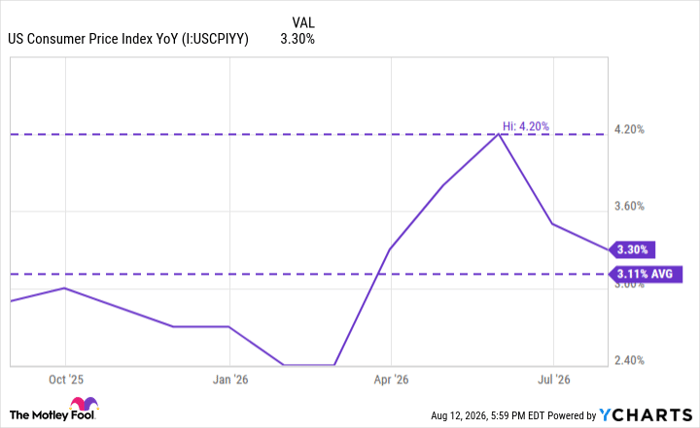
U.S. Consumer Price Index YoY data by YCharts.
Trying to gauge future inflation is no easy task right now because the Iran conflict remains fluid, which has led to energy prices swinging drastically.
The Federal Reserve Bank of Cleveland’s Inflation Nowcasting tool projects the August CPI will rise 0.35% during the month — a solid increase — and for annual inflation to rise 3.36%, similar to July.
So, the bad news is that, based on current data, the 2027 COLA may end up being less than TSCL expected.
The good news
Like many other economic data points, there is usually both good and bad news.
Although the 2027 COLA may not be as high as expected, that also likely means consumer prices and services won’t rise as much as anticipated, allowing retirees to spend less next year and thus giving them more purchasing power.
There’s still a long way to go, of course. August inflation data will come out next month. September inflation data, the final data point needed for the 2027 COLA, will be released in October, at which point the 2027 COLA will be determined.
If retirees are currently mapping out budgets for next year, the best approach is to assume a lower-than-expected COLA of 3.4%, or even lower.
That way, if the COLA comes in higher, it will turn into a nice surprise, whereas if it comes in lower than retirees expect, they may have to revise their spending plans for 2027.
The $23,760 Social Security bonus most retirees completely overlook
If you’re like most Americans, you’re a few years (or more) behind on your retirement savings. But a handful of little-known “Social Security secrets” could help ensure a boost in your retirement income.
One easy trick could pay you as much as $23,760 more… each year! Once you learn how to maximize your Social Security benefits, we think you could retire confidently with the peace of mind we’re all after. Join Stock Advisor to learn more about these strategies.
View the “Social Security secrets” »
The Motley Fool has a disclosure policy.