Key Points
-
The artificial intelligence (AI) infrastructure build-out has helped catapult the Dow Jones Industrial Average, S&P 500, and Nasdaq Composite to new heights.
-
The CME Group’s FedWatch Tool indicates a series of inflation-fighting interest rate hikes may be coming.
-
Higher borrowing costs can pull the rug out from beneath a pricey, AI-fueled stock market.
-
For the better part of the last four years, the stock market has been virtually unstoppable. Aside from a few brief corrections, the Dow Jones Industrial Average (DJINDICES:^DJI), S&P 500 (SNPINDEX:^GSPC), and Nasdaq Composite (NASDAQINDEX:^IXIC) have rattled off several record highs, thanks in large part to the artificial intelligence (AI) infrastructure build-out.
But things may not be as perfect for the stock market as its major indexes make them appear. Though several headwinds are waiting in the wings to knock equities off their pedestal, including historically pricey valuations and sky-high outstanding margin debt, it’s the Federal Reserve’s monetary policy that could be the stock market’s undoing.
Missed AI’s “Act 1”? Act 2 Could Be 15x Bigger. Most investors think they missed the AI boat because they didn’t buy Nvidia in 2005. But according to our analysts, we’re only at the end of “Act 1″—the R&D phase. “Act 2” is the global rollout. Continue »
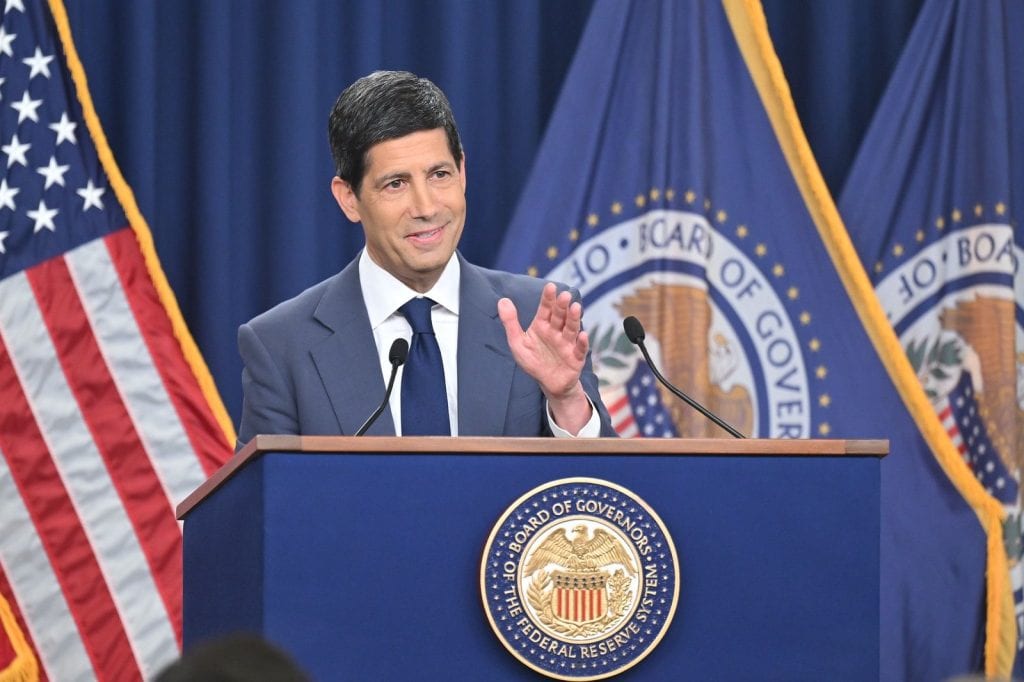
Fed Chair Kevin Warsh and the FOMC may ramp up their rate-hiking cycle. Image source: Official Federal Reserve Photo.
The latest interest rate forecast suggests the Fed will get more aggressive
To preface this discussion, there isn’t a predictive tool that can guarantee what Fed Chair Kevin Warsh and the Federal Open Market Committee (FOMC) will do next with interest rates. Nevertheless, the CME Group‘s (NASDAQ:CME) FedWatch Tool (commonly known as CME FedWatch) has an impressive track record of accurately forecasting the Fed’s policy actions.
CME FedWatch uses 30-day Fed Funds futures prices to track the probability of changes to the federal funds rate at upcoming FOMC meetings. For the Dec. 9 meeting, there’s a 100% chance of a rate hike. These odds have been pinned at 100% for about two weeks.
What has recently updated is the probability of a rate hike looking beyond December. There’s now a 64% chance that the federal funds target rate will jump at least 50 basis points to 4.25%-4.50% by the Jan. 27, 2027 FOMC meeting. In other words, the odds appear to favor 25-basis-point hikes at the December and January FOMC meetings.
Additionally, the odds are just above 58% that the fed funds rate will reach at least 4.50%-4.75% by the June 9, 2027 meeting. This implies at least 75 basis points in hikes will be undertaken over the next five FOMC meetings.

Image source: Getty Images.
Fed Chair Warsh and the FOMC may pull the rug out from beneath Wall Street
Although Fed Chair Warsh and his colleagues recognize how important the AI infrastructure build-out has been for equity markets, they’ve been adamant about returning annualized inflation, as measured by the Personal Consumption Expenditures Price Index, to the 2% long-term target. Doing so will require the central bank to get tough on inflation.
While some AI companies have financed their data center build-outs with cash on hand and ongoing operating cash flow, many have turned to debt offerings to raise capital. If the FOMC continues to raise interest rates, it’ll be progressively costlier for businesses to finance the AI build-out.
What complicates matters is that the stock market entered the year at its second-highest valuation in history, according to the S&P 500’s Shiller Price-to-Earnings (P/E) Ratio, also known as the Cyclically Adjusted P/E Ratio (CAPE Ratio). Premium stock valuations offer little to no room for error. If this build-out slows down, even slightly, due to higher borrowing costs, it may be enough to end the AI-driven bull market’s four-year run.
Though nothing is set in stone, the latest interest rate forecast is undeniably worrisome for an expensive stock market.
Should you buy stock in S&P 500 Index right now?
Before you buy stock in S&P 500 Index, consider this:
The Motley Fool Stock Advisor analyst team just identified what they believe are the 10 best stocks for investors to buy now… and S&P 500 Index wasn’t one of them. The 10 stocks that made the cut could produce monster returns in the coming years.
Consider when Netflix made this list on December 17, 2004… if you invested $1,000 at the time of our recommendation, you’d have $320,394!* Or when Nvidia made this list on April 15, 2005… if you invested $1,000 at the time of our recommendation, you’d have $917,381!*
Now, it’s worth noting Stock Advisor’s total average return is 776% — a market-crushing outperformance compared to 199% for the S&P 500. Don’t miss the latest top 10 list, available with Stock Advisor, and join an investing community built by individual investors for individual investors.
See the 10 stocks »
*Stock Advisor returns as of November 27, 2026.
Sean Williams has no position in any of the stocks mentioned. The Motley Fool has positions in and recommends CME Group. The Motley Fool has a disclosure policy.