Key Points
-
Berkshire has spent roughly $92 billion on buybacks since 2018.
-
At the company’s current valuation, the strategy still makes sense.
-
Berkshire looks like a great stock pick in the current environment.
-
Greg Abel became the CEO of Berkshire Hathaway (NYSE:BRKA) (NYSE:BRKB) at the beginning of this year after the conglomerate’s longtime leader and legendary investor, Warren Buffett, stepped down. Abel has had a busy first year in charge of the company, and many of his moves have been reminiscent of those his mentor would have made.
That’s not surprising. Abel was quick to reassure investors that Berkshire Hathaway’s values and culture wouldn’t change under his leadership, and we have seen plenty of evidence that he meant those words. For instance, during the third quarter, Berkshire Hathaway spent $9.6 billion buying one of Buffett’s favorite stocks. Here’s what investors need to know.
Missed AI’s “Act 1”? Act 2 Could Be 15x Bigger. Most investors think they missed the AI boat because they didn’t buy Nvidia in 2005. But according to our analysts, we’re only at the end of “Act 1″—the R&D phase. “Act 2” is the global rollout. Continue »
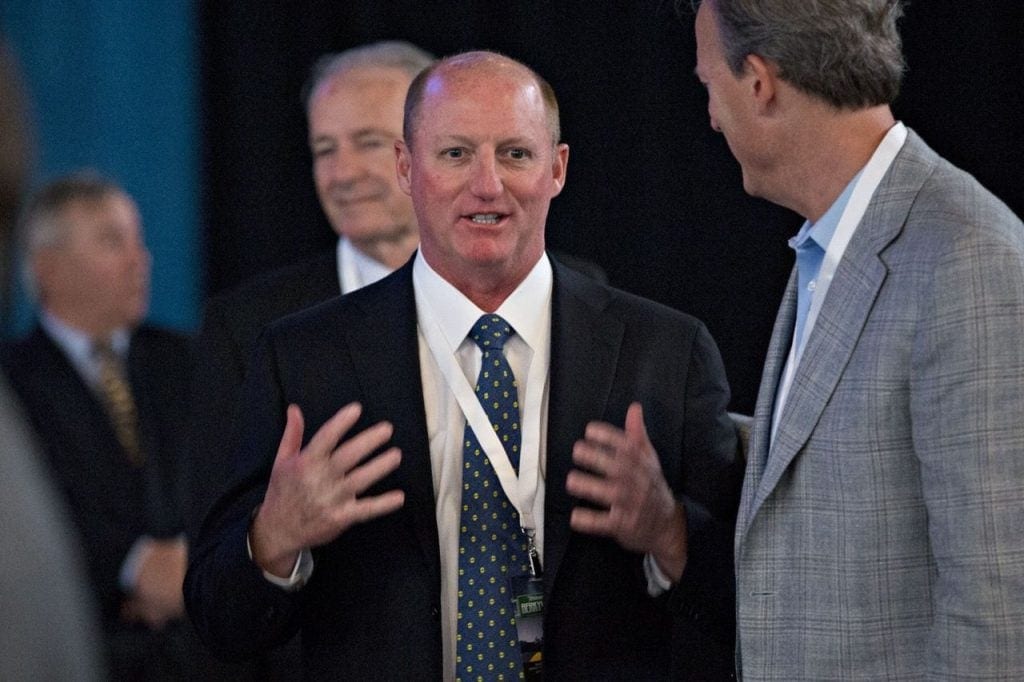
Greg Abel. Image source: Getty Images.
The stock Buffett loves more than Berkshire’s largest holding
When people try to guess Buffett‘s favorite stock, Apple (NASDAQ:AAPL) is usually near the top of the list. That makes sense. Apple has been in Berkshire Hathaway’s public equity portfolio since 2016; it has been the conglomerate’s largest holding for years, and Buffett once said it is probably the best business in the world.
Buffett has also praised Apple’s now-former CEO, Tim Cook, on multiple occasions. However, there is one stock Berkshire Hathaway has spent even more on over the past decade or so: its own stock.
| Purchase |
Total spent |
Period |
| Apple stock |
About $36 billion |
2016 to 2018 |
| Berkshire Hathaway stock (buybacks) |
About $92 billion |
2018 to Q3 2026 |
Yes, Buffett loves Apple. But under his leadership, Berkshire Hathaway spent far more on share buybacks than it did on buying Apple shares over the past 10 years. That policy has continued under Greg Abel, who oversaw the conglomerate’s $9.6 billion in buybacks during the third quarter.
What this means for investors
Like most corporate strategies, share buybacks aren’t inherently good or bad. A lot depends on the details. But they do tend to signal management’s confidence in the company’s outlook. Massive buybacks are a sign that a corporation’s top executives believe shares are undervalued relative to the business’s growth potential.
If that’s really the case, then buybacks, by lowering the total number of outstanding shares, increase intrinsic value per share. Of course, the opposite is true if shares are actually overvalued. Where does Berkshire Hathaway stand right now? We can always trust Buffett and Abel’s judgment. After all, Buffett crushed broader equities in his six-decade tenure as CEO of Berkshire Hathaway.
Few people are more capable than he is at determining whether a company’s shares are trading below their intrinsic value, particularly one he knows as deeply as the corporation he led for a long time. Abel is not Buffett, but he learned under the Oracle of Omaha’s leadership, occupied high-level positions at Berkshire for a long time, and was handpicked to be Buffett’s successor.
However, we don’t have to put our blind faith in Buffett and Abel (although in this case, that faith would hardly be blind). We can look at how the business is doing ourselves. Now, Berkshire Hathaway is a complex conglomerate with multiple moving parts. But Buffett himself gave us a framework to approximate the company’s intrinsic value in a 2018 letter to shareholders.
He argued that Berkshire Hathaway can be separated into five “groves,” each of which can be valued separately. We can then get close to the business’ total value by adding up the individual groves’ values, making the appropriate adjustments (taxes, debt, etc.), and dividing that total by the number of shares outstanding to get the intrinsic value per share. By my calculation, Berkshire Hathaway is currently slightly undervalued, by about 8% to 10%, although the answer can change depending on the earnings multiple we apply to certain parts of the business.
But if my answer is roughly in agreement with that of Abel and Buffett — who know infinitely more about Berkshire Hathaway than I do — then I am fine with that. There is another aspect to consider. Berkshire Hathaway is arguably an outstanding hedge against current market uncertainty. Some are worried about a shaky geopolitical and economic environment.
Others worry that AI stocks are overvalued and will drag broader equities into a bear market. Berkshire Hathaway has a vast and diversified business with multiple parts that will respond differently to whatever troubles lie ahead. The company also has some exposure to AI, though not too much, through its public equity portfolio, especially its stake in Alphabet (NASDAQ:GOOG) (NASDAQ:GOOGL). So, investors have a lot to gain by investing in the stock and holding onto it for a long time.
Should you buy stock in Berkshire Hathaway right now?
Before you buy stock in Berkshire Hathaway, consider this:
The Motley Fool Stock Advisor analyst team just identified what they believe are the 10 best stocks for investors to buy now… and Berkshire Hathaway wasn’t one of them. The 10 stocks that made the cut could produce monster returns in the coming years.
Consider when Netflix made this list on December 17, 2004… if you invested $1,000 at the time of our recommendation, you’d have $320,394!* Or when Nvidia made this list on April 15, 2005… if you invested $1,000 at the time of our recommendation, you’d have $917,381!*
Now, it’s worth noting Stock Advisor’s total average return is 776% — a market-crushing outperformance compared to 199% for the S&P 500. Don’t miss the latest top 10 list, available with Stock Advisor, and join an investing community built by individual investors for individual investors.
See the 10 stocks »
*Stock Advisor returns as of November 27, 2026.
Prosper Junior Bakiny has positions in Alphabet and Berkshire Hathaway. The Motley Fool has positions in and recommends Alphabet, Apple, and Berkshire Hathaway. The Motley Fool has a disclosure policy.