Key Points
-
The S&P 500 entered a correction last week along with the Dow Jones Industrial Average and the Nasdaq Composite.
-
AI stocks, which once drove market gains, have lately been leading declines.
-
The S&P 500 has soared in recent years on optimism about artificial intelligence (AI) stocks — investors rushed to get in on these potentially game-changing players, and that movement boosted the overall index. Today, however, AI stocks are doing just the opposite, leading not only the S&P 500 but also the Dow Jones Industrial Average and the Nasdaq Composite lower — all three indexes finished last week in correction territory. A correction happens when an index falls at least 10% from its most recent peak.
AI stocks have come under pressure amid concerns about the infrastructure build-out. And last week’s massive initial public offering of Anthropic — the first pure-play AI company to go public — though successful, added to the pressure.
Missed Nvidia in 2009? This Rare Signal Is Flashing Again. In 2009, a “Double Down” signal flashed for a little-known chipmaker called Nvidia. For the first time in years, that same “Total Conviction” signal is flashing for a company 1/100th the size of Nvidia. Continue »
So now, many investors may be asking themselves what’s next for the stock market. With the S&P 500 in correction territory, it’s a great idea to consider what history has to say.
Image source: Getty Images.
The S&P 500 reaches records
First, let’s take a closer look at the index’s path in recent times. After gaining 78% over the past three calendar years, the S&P 500 continued to march higher this year, reaching new record highs. At the same time, pressures mounted, led by worries about tech spending on the AI build-out. Tech giants pledged to spend more than $700 billion this year alone, and investors questioned whether the revenue opportunity would justify such spending.
The Democratic Party’s victory in the U.S. midterm elections added a new dimension to this, with the idea that Democrats’ policies might lead to AI regulation and a slowdown in development.
Finally, turmoil at Nvidia, the AI industry bellwether, and the Anthropic IPO added further pressure. Nvidia chief Jensen Huang stepped down following allegations of affairs, leaving investors to question how a new leader would define Nvidia’s future. (Nvidia’s board reinstated Huang 11 days later, and the stock climbed more than 30% in one trading session.)
As for Anthropic, the IPO, the biggest on record, was successful. But it created a liquidity drain as investors sold other stocks in order to buy Anthropic shares. Meanwhile, this also represented an influx of shares of yet another AI giant in an already jittery market.
Past market corrections
As a result, indexes declined last week, led by AI stocks. Now, let’s consider what history says about what could happen next. I took a look three past S&P 500 market corrections, occurring in March 2022, November 2023, and March 2025. The 2022 correction was followed by a rebound, but over the next six months the index resumed its decline.
In 2023 and 2025, however, the S&P 500 went on to rebound and quickly resume its path higher over the six months to follow. In that period, the index rose 15% and more than 8%, respectively. So, recent history shows us that a correction could be brief and more gains might lie ahead.
It’s important to keep in mind, though, that in those past two corrections, the AI boom was in its early stages, and this helped the positive momentum to return. Today, AI is still in its early days, with the actual use of AI just beginning. But AI spending has increased dramatically since just a few years ago. We can see this through the capital spending levels of tech giants.
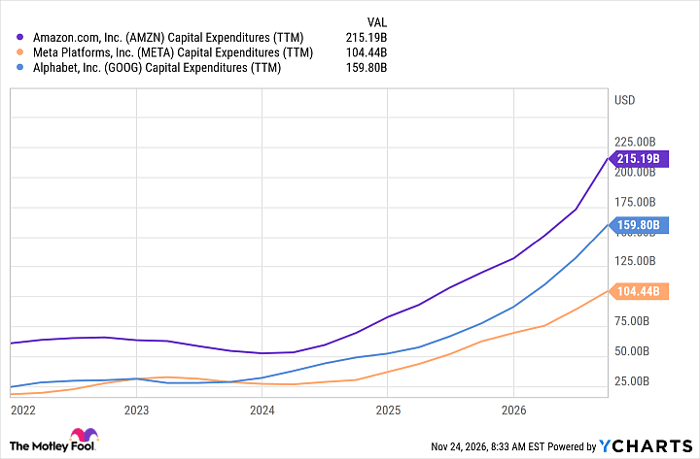
AMZN Capital Expenditures (TTM) data by YCharts
And since this issue has worried investors, it could continue to represent a headwind at least until we see more evidence that this investment is truly paying off. This could be ongoing demand for chips and a narrowing of the gap between spending and revenue among tech big spenders.
All of this means that while history offers us some clues about what might lie ahead, it’s also important to consider the elements driving market movement at the current moment. But here’s the good news: Even if this time around the S&P 500 continues its decline or remains in the doldrums, the major indexes have demonstrated that they always go on to recover and win over a period of years. And that’s fantastic news for long-term investors.
Should you buy stock in S&P 500 Index right now?
Before you buy stock in S&P 500 Index, consider this:
The Motley Fool Stock Advisor analyst team just identified what they believe are the 10 best stocks for investors to buy now… and S&P 500 Index wasn’t one of them. The 10 stocks that made the cut could produce monster returns in the coming years.
Consider when Netflix made this list on December 17, 2004… if you invested $1,000 at the time of our recommendation, you’d have $313,329!* Or when Nvidia made this list on April 15, 2005… if you invested $1,000 at the time of our recommendation, you’d have $1,014,158!*
Now, it’s worth noting Stock Advisor’s total average return is 796% — a market-crushing outperformance compared to 200% for the S&P 500. Don’t miss the latest top 10 list, available with Stock Advisor, and join an investing community built by individual investors for individual investors.
See the 10 stocks »
*Stock Advisor returns as of November 25, 2026.
Adria Cimino has positions in Amazon. The Motley Fool has positions in and recommends Alphabet, Amazon, Meta Platforms, and Nvidia. The Motley Fool recommends Anthropic. The Motley Fool has a disclosure policy.