Key Points
-
Shares of Nvidia fell by more than 50% in the final quarter of 2018 due to the cryptocurrency hangover.
-
However, solid catalysts helped the stock stage a stunning rally in the years that followed.
-
Nvidia is still clocking solid growth, and Wall Street anticipates a big jump in its stock price over the coming year.
-
Shares of Nvidia (NASDAQ:NVDA) reached a 52-week high on Oct. 6, but they have dropped by a remarkable 31% since then, as investors pressed the panic button for multiple reasons.
Co-founder and CEO Jensen Huang’s resignation (before he was reinstated on Nov. 23), an investigation into Nvidia’s dealings in China, and a reported probe by the U.S. Securities and Exchange Commission (SEC) into the company’s accounting practices have sent the stock packing over the past month and a half. The negativity surrounding Nvidia stock was so severe that even its quarterly results and better-than-expected guidance didn’t arrest its slide.
Missed AI’s “Act 1”? Act 2 Could Be 15x Bigger. Most investors think they missed the AI boat because they didn’t buy Nvidia in 2005. But according to our analysts, we’re only at the end of “Act 1″—the R&D phase. “Act 2” is the global rollout. Continue »
However, Nvidia rallied over 31% following Huang’s reappointment, suggesting that investor confidence in the stock could improve. What’s more, the last time Nvidia witnessed such a sharp pullback in a short period, it went on a multi-year rally. Let’s take a look at what happened in 2018.
The cryptocurrency glut led to a big sell-off in Nvidia’s shares in late 2018
Nvidia stock fell 54% between October and December 2018. This massive slide was triggered by an oversupply in the graphics processing unit (GPU) market, driven by a drop in cryptocurrency-related sales. Additionally, the company was caught up in a broader sell-off of tech stocks at the time.
Nvidia’s growth slowed as crypto-driven GPU demand faded, leaving the company with excess inventory. In fact, Nvidia’s revenue in the fourth quarter of fiscal 2019 (which ended in January 2019) fell 24% year over year to $2.2 billion. The company’s non-GAAP earnings dropped by 53% from the year-ago period during the quarter.
Investors decided to book profits in Nvidia stock following stellar returns in 2016 and 2017. Nvidia lost 31% of its value in 2018. For comparison, it jumped by 227% in 2016 and 82% in 2017. So, this isn’t the first time that Nvidia stock has lost its wheels and undergone a significant correction in a short time.
However, what’s worth noting is that Nvidia went on a stunning bull run starting in 2019, driven by multiple catalysts, including strong GPU sales during the novel coronavirus pandemic and the advent of artificial intelligence (AI) in late 2022. Nvidia stock has jumped by a whopping 4,740% since the beginning of 2019.
So, savvy investors who saw the long-term opportunity in Nvidia’s shares at that time are sitting on massive gains right now, even after the stock’s recent sell-off. What’s more, a closer look at Nvidia’s valuation suggests that it is way more attractive right now than it was in 2018.
The valuation bears similarity to 2018
Nvidia traded at less than 18 times earnings at the end of 2018. The stock currently has a price-to-earnings ratio of 17.7, close to the level it traded at eight years ago. The forward earnings multiple of just 10 suggests that Nvidia is on track to deliver healthy bottom-line growth.
Meanwhile, the stock’s price/earnings-to-growth (PEG) ratio was just 0.31 at the end of 2018. This is a forward-looking valuation metric that’s calculated by dividing a stock’s trailing earnings multiple by the projected annual earnings per share (EPS) growth over the long run, let’s say for five years. A PEG ratio below 1 means that the stock is undervalued when its growth potential is considered.
So, Nvidia was significantly undervalued at that time, just like it is right now. The stock currently has a PEG ratio of just 0.19, which means that investors are getting an even better deal than in 2018. But should they take this opportunity to buy shares given recent developments at the company?
A falling knife or a once-in-a-generation investing opportunity?
Investors are most likely in a classic dilemma right now. Nvidia’s valuation suggests that the stock is a screaming buy, especially given its solid fundamentals, healthy growth, and sunny prospects.
The company reported impressive year-over-year revenue growth of 103% in the third quarter of fiscal 2027 to $115.8 billion. Adjusted earnings per share shot up by 111% to $2.68. The numbers easily exceeded consensus EPS expectations of $2.48 and the $109.1 billion revenue estimate. The company expects $130 billion in revenue in the current quarter, a 91% jump over last year and well ahead of the $125.1 billion Wall Street estimate.
Notably, analysts have raised their EPS expectations for Nvidia, indicating continued confidence in the company’s prospects.
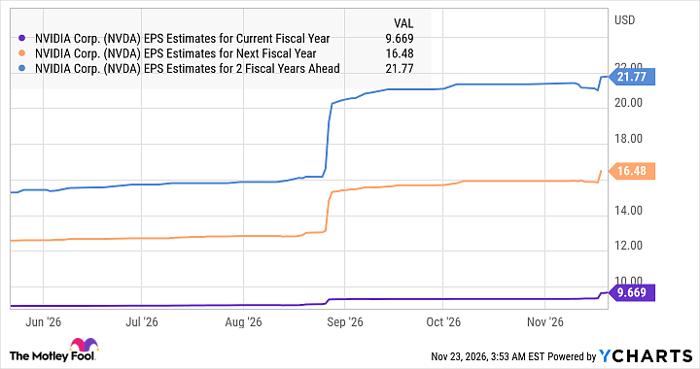
NVDA EPS Estimates for Current Fiscal Year data by YCharts
Even the 12-month median price target of $232 implies a 41% jump, according to CNN. So, investors with a higher risk appetite who have investable cash after paying their bills, clearing expensive loans, and saving for a rainy day can consider buying this semiconductor stock. That’s because Nvidia could go on a massive bull run, fueled by Huang’s comeback and the solid growth that it is poised to deliver, which could lead the market to reward it with a higher valuation in the future.
After all, Nvidia sees tremendous opportunity in the AI infrastructure market, and it is making solid progress in emerging niches, such as physical AI. However, the ongoing regulatory troubles the company faces suggest it may be wise for conservative investors to wait on the sidelines.
Should you buy stock in Nvidia right now?
Before you buy stock in Nvidia, consider this:
The Motley Fool Stock Advisor analyst team just identified what they believe are the 10 best stocks for investors to buy now… and Nvidia wasn’t one of them. The 10 stocks that made the cut could produce monster returns in the coming years.
Consider when Netflix made this list on December 17, 2004… if you invested $1,000 at the time of our recommendation, you’d have $313,329!* Or when Nvidia made this list on April 15, 2005… if you invested $1,000 at the time of our recommendation, you’d have $1,014,158!*
Now, it’s worth noting Stock Advisor’s total average return is 796% — a market-crushing outperformance compared to 200% for the S&P 500. Don’t miss the latest top 10 list, available with Stock Advisor, and join an investing community built by individual investors for individual investors.
See the 10 stocks »
*Stock Advisor returns as of November 24, 2026.
Harsh Chauhan has no position in any of the stocks mentioned. The Motley Fool has positions in and recommends Nvidia. The Motley Fool has a disclosure policy.