Key Points
-
Netflix stock is down 37% in 2026 and 56% from its summer 2025 peak.
-
Third-quarter revenue rose 11.8%, and operating income jumped 37.3%.
-
The stock trades at about 15.8 times trailing operating income, a low multiple for a business with a 31.3% operating margin.
-
Media-streaming veteran Netflix (NASDAQ:NFLX) is on the outs with Wall Street again. The stock reached all-time highs in the summer of 2025, as investors forgave the company for the canceled, expensive Warner Bros. buyout idea. As of Nov. 24, Netflix stock is down 56% from that peak, including a 37% year-to-date drop.
And the more I look at the drooping stock chart, the more I scratch my head in confusion. The business keeps growing, video streaming remains a healthy global market, and Netflix’s stock isn’t even expensive.
Missed AI’s “Act 1”? Act 2 Could Be 15x Bigger. Most investors think they missed the AI boat because they didn’t buy Nvidia in 2005. But according to our analysts, we’re only at the end of “Act 1″—the R&D phase. “Act 2” is the global rollout. Continue »
What the sell-off ignored
Third-quarter results did not look like those of a company in trouble. Revenue rose 11.8% to $12.9 billion. Operating income jumped 37.3% to $4.5 billion, and operating margin widened to 34.6% from 28.2% in the year-ago period. Management guided for 2026 revenue of $51.1 billion, up 13%, and an operating margin of 31.5%, versus 29.5% in 2025. That’s a combo of double-digit revenue growth and widening margins.
Investors sold anyway. The stock fell as much as 6.7% the next morning, and several analysts trimmed their price targets. At first glance, the reasons look fair. Netflix cut its 2026 advertising revenue forecast from roughly $3 billion to about $2.7 billion, citing slower rollout of some new ad products. Ad revenue is still on pace to grow more than 80% this year, per co-CEO Greg Peters. Management conceded, though, that view-hour growth needs to improve and that the U.S. content group can do better.
“Our [U.S.] engagement is solid, and it will allow us to continue to grow as we have for the last several years, but we know that we can do better. And that better is our upside,” Peters said on the earnings call. “It’s our goal to go from very good to great on the performance of that slate.”
The price tag is the fun part
Now check the stock’s price tag. Netflix’s market cap is about $238.6 billion. Tack on $7.1 billion of net debt, and the whole enterprise costs about 15.8 times the operating income it generated over the past four quarters. That’s a low multiple for a company that turned 31.3% of its revenue into operating income over the past year. Take a quick look at the price chart and you’d assume the business was shrinking. Well, it’s not.
Management has been voting with the checkbook, so to speak. Netflix bought back 63.9 million shares for $4.8 billion last quarter (a company record, narrowly edging the Q2 buyback budget) at an average of about $75 per stub. The stock now sits around $59, so the timing could have been better. Still, $22.3 billion of buyback authorization remains, against $8.2 billion of cash and about $12.0 billion of expected 2026 free cash flow. Netflix has leaned harder into buybacks as the stock has slid this year, and the remaining authorization leaves room for more:
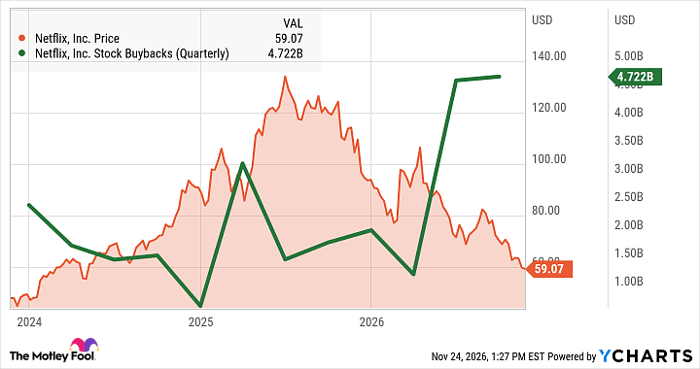
NFLX data by YCharts. The chart shows quarterly buybacks; Netflix reported $4.8 billion for Q3 2026.
Wall Street has not given up on the story. The analyst consensus rating is Buy, and short-sellers hold roughly 2% of Netflix’s shares, a thin bearish bet against the stock.
Plenty to watch before year-end
The fourth quarter should keep the content engine busy. Netflix calls it the biggest quarterly live slate it has ever scheduled, including its first NFL Thanksgiving Eve game on Nov. 25. That game kicks off a stretch of live events that could shift sentiment fast: a Christmas Day football doubleheader and the Tyson Fury vs. Anthony Joshua heavyweight boxing event. Self-produced entertainment releases include “The Further Mis-Adventures of Cliff Booth,” a new season of “The Diplomat,” and the sixth and final run of “Emily in Paris.”
Netflix also plans to launch its advertising tier in 15 more countries next year, starting in March. It recently named former Disney (NYSE:DIS) executive Peter Rice as chief content officer. Regional hits matter, too; Netflix has a deep bench of local producers, and their shows are moving the needle. For instance, India view hours grew 24% in the third quarter while revenue there rose about 18% on a currency-neutral basis.
What could go wrong
I can’t pretend that Netflix is a risk-free investment. Some new ad products are behind schedule. Fourth-quarter margin guidance of 26% absorbs about 120 basis points of cost from headcount cuts. Operating income is guided to about $3.5 billion, up 18.4% from a year ago, and that’s a sharp slowdown from the third quarter’s 37.3% jump. The U.S. slate needs to start landing home runs instead of base hits, which is exactly the job Peter Rice just inherited. So no, you shouldn’t bet the farm, the cat, and the horse it rode in on. A normal slice of a diversified portfolio is plenty.
But a growing, cash-generating business at about 16 times operating income, with a Buy consensus and almost nobody shorting it? That’s why I’d buy Netflix now, rather than wait for the holiday slate to change the market mood. The stock may keep sliding in the short term; the business, so far, is not.
Should you buy stock in Netflix right now?
Before you buy stock in Netflix, consider this:
The Motley Fool Stock Advisor analyst team just identified what they believe are the 10 best stocks for investors to buy now… and Netflix wasn’t one of them. The 10 stocks that made the cut could produce monster returns in the coming years.
Consider when Netflix made this list on December 17, 2004… if you invested $1,000 at the time of our recommendation, you’d have $313,329!* Or when Nvidia made this list on April 15, 2005… if you invested $1,000 at the time of our recommendation, you’d have $1,014,158!*
Now, it’s worth noting Stock Advisor’s total average return is 796% — a market-crushing outperformance compared to 200% for the S&P 500. Don’t miss the latest top 10 list, available with Stock Advisor, and join an investing community built by individual investors for individual investors.
See the 10 stocks »
*Stock Advisor returns as of November 24, 2026.
Anders Bylund has positions in Netflix and Walt Disney. The Motley Fool has positions in and recommends Netflix and Walt Disney. The Motley Fool has a disclosure policy.