Key Points
-
The pharmaceutical giant has increased its dividend for 64 consecutive years, making it a Dividend King.
-
J&J stock traditionally fares better than the overall market during downturns.
-
The company has 27 therapies or products that will generate $1 billion or more in sales this year.
-
It’s been a rough month for the stock market. Since hitting its all-time closing high above 7,800 on Oct. 6, the S&P 500 and tech-heavy Nasdaq Composite have both pulled back sharply.
The reasons include persistent inflation, which raises the likelihood of interest rate hikes, surging bond yields, and the Nvidia leadership shake-up. An additional concern for healthcare stocks is the Centers for Medicare & Medicaid Services (CMS) proposal to claw back Medicare Advantage overpayments dating back to 2018.
Missed Nvidia in 2009? This Rare Signal Is Flashing Again. In 2009, a “Double Down” signal flashed for a little-known chipmaker called Nvidia. For the first time in years, that same “Total Conviction” signal is flashing for a company 1/100th the size of Nvidia. Continue »
Swimming against that tide is pharmaceutical giant Johnson & Johnson (NYSE:JNJ), whose shares are up almost 7% in the past month. Here’s why I’m buying more Johnson & Johnson stock if the market crashes.
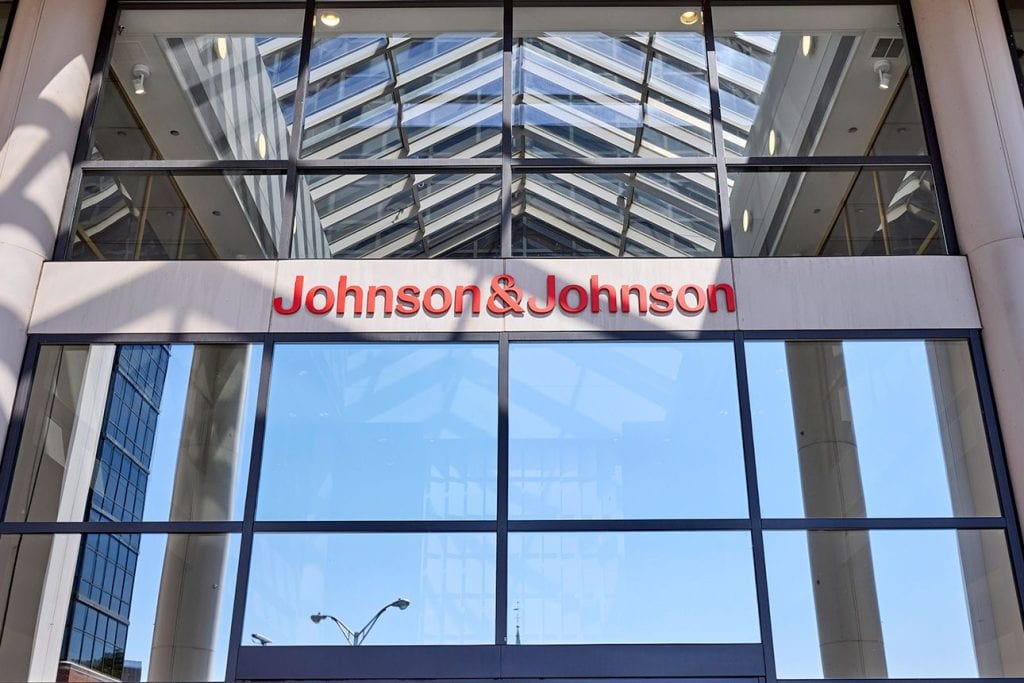
Image source: Getty Images.
J&J boasts a reliable and growing dividend
Johnson & Johnson is a Dividend King, one of the select group of stocks that have raised their dividends for 50 or more consecutive years. That signals a company that weathers financial crises with nary a hitch. The company, one of the few with a AAA credit rating, raised its quarterly dividend by 3% this year to $1.34, the 64th consecutive year it has increased its dividend.
The company’s guidance points to adjusted earnings per share (EPS) of $11.05-$11.15 this year, or $11.10 at the midpoint. With the company paying a full-year dividend total of $5.32 per share, the payout ratio is only 48%, leaving room for continued dividend raises.
The company reported sales of $25.4 billion in the third quarter, representing 5.9% year-over-year growth. Its adjusted EPS was $2.59, down 7.5% over the prior year, but that reflects $5.5 billion in talc lawsuit settlement costs, the $1 billion acquisition of Firefly Bio, and a strategic collaboration with Sail Biomedicines that included $785 million in up-front payments.
Demand for its products isn’t affected by downturns
Johnson & Johnson weathered the 2007-2009 financial recession and the 2020 COVID-19 pandemic crash better than the overall market because of its size, scope, and the inelastic nature of its products. Spending on life-saving oncology treatments, immunology drugs, and surgical equipment remains steady regardless of economic slowdowns or energy shocks.
Its predictable and safe dividend is another reason investors didn’t desert the stock when others slumped.
Massive spending on R&D is producing new blockbusters
Over nine months, J&J has spent $3.67 billion on research and development (R&D). That spending has consistently led to new therapies, including eight major FDA approvals and label expansions this year. The company is on track to have 27 blockbuster therapies or medical devices this year, those that reap sales of $1 billion or more.
Even though biosimilar competition for the immunology drug Stelara shaved roughly 690 basis points off the company’s innovative medicine growth in the third quarter, the segment still grew 7.9% operationally compared to the same period last year. That resilience was powered by a 17% year-over-year rise in oncology therapies, led by Darzalex, Carvykti, and Tecvayli, and by the immunology drug Tremfya, whose sales jumped 68% over the same period a year ago.
Should you buy stock in Johnson & Johnson right now?
Before you buy stock in Johnson & Johnson, consider this:
The Motley Fool Stock Advisor analyst team just identified what they believe are the 10 best stocks for investors to buy now… and Johnson & Johnson wasn’t one of them. The 10 stocks that made the cut could produce monster returns in the coming years.
Consider when Netflix made this list on December 17, 2004… if you invested $1,000 at the time of our recommendation, you’d have $305,941!* Or when Nvidia made this list on April 15, 2005… if you invested $1,000 at the time of our recommendation, you’d have $771,325!*
Now, it’s worth noting Stock Advisor’s total average return is 719% — a market-crushing outperformance compared to 192% for the S&P 500. Don’t miss the latest top 10 list, available with Stock Advisor, and join an investing community built by individual investors for individual investors.
See the 10 stocks »
*Stock Advisor returns as of November 23, 2026.
James Halley has positions in Johnson & Johnson and Nvidia. The Motley Fool has positions in and recommends Nvidia. The Motley Fool recommends Johnson & Johnson. The Motley Fool has a disclosure policy.