Key Points
-
At a recent conference, Fed Chair Kevin Warsh discussed three scenarios the Fed is modeling.
-
Warsh stressed that the scenarios aren’t predictions and might not even happen.
-
Two of these scenarios could have adverse implications for the economy and, likely, the stock market as well.
-
As chair of the Federal Reserve’s Board of Governors, Kevin Warsh has a powerful job. His words can move markets, and his view of the economy can play a big role in shaping the policy decisions that follow.
That’s why his thinking on artificial intelligence, or what Warsh refers to as “super intelligence,” matters. Super intelligence (SI) is the term adopted by President Donald Trump and his administration to describe AI, and has become a driving force of both corporate spending and stock market gains. Whether it delivers on its promise could impact growth, jobs, and inflation for years. These are the very concerns the Fed is charged with managing, so it has to try to figure out what’s coming before it arrives.
Missed Nvidia in 2009? This Rare Signal Is Flashing Again. In 2009, a “Double Down” signal flashed for a little-known chipmaker called Nvidia. For the first time in years, that same “Total Conviction” signal is flashing for a company 1/100th the size of Nvidia. Continue »
On Nov. 16, at a conference for the Fed’s Productivity and Jobs Task Force hosted by the Federal Reserve Bank of San Francisco, Warsh said the Fed is modeling three possible paths for the economy as AI continues to develop.
Two of these scenarios are “less positive,” including one where artificial intelligence outright disappoints.
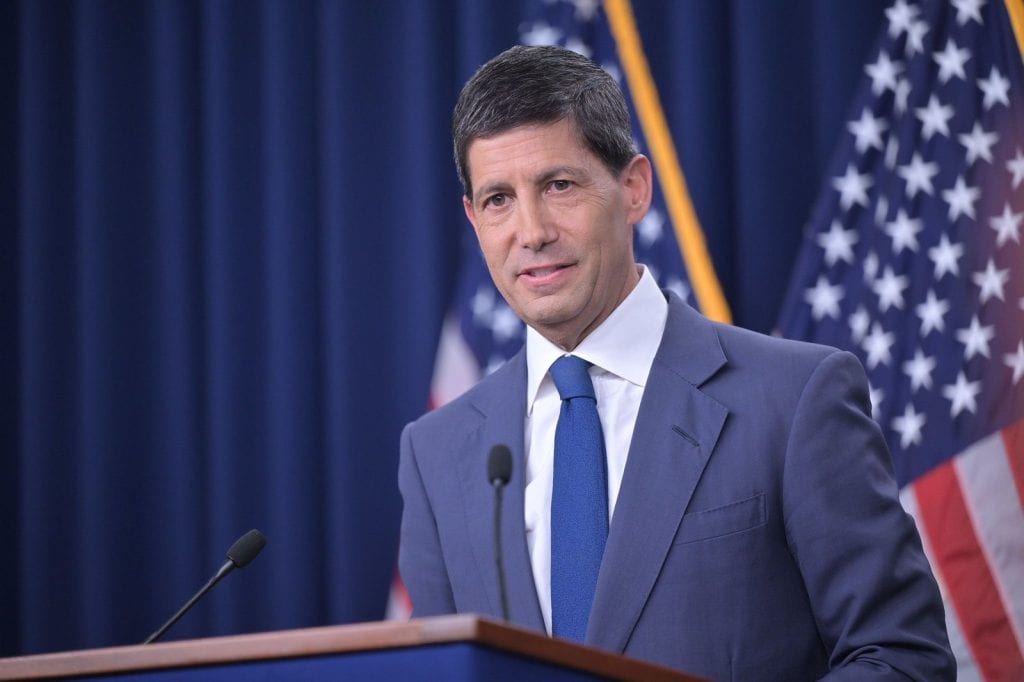
Image source: Official Federal Reserve Photo.
The three scenarios
During his opening remarks, Warsh said Fed staff had built three illustrative scenarios over the next several years, stressing that they are not forecasts and that he was not there to offer predictions.
The first is the one that every investor hopes for. Productivity rises, and the gains are shared evenly between workers and those who manage and own capital. In this scenario, growth remains above its long-run average, and the economy remains near full employment.
The second scenario is interesting because it doesn’t require artificial intelligence to fail. It requires it to work.
“An SI-driven expansion could bring substantial labor market disruption as some jobs are displaced, rather than complemented, by technology,” Warsh said. “GDP growth would still rise above its long-term average. But widespread automation, combined with labor market frictions, could push the jobless rate above levels consistent with full employment.”
The third is a letdown, where “SI could disappoint.” After heavy investment and the strong market rally we’ve seen, returns on capital are lower than expected, a concern some investors already share. This leads to a decline in valuations, and the economy slows before eventually recovering without the productivity gains.
Investors should consider what will happen if AI works too well
Again, these aren’t predictions from Warsh, who has tried to avoid any kind of forward guidance since becoming chair. Warsh also noted, “many other outcomes — probably including one that will prove most accurate — could be drawn.”
Still, if the Fed is beginning to model these three scenarios, it’s likely at least somewhat on the minds of Warsh and the rest of the Fed’s board. Interestingly, the first and third scenarios are easier to understand because they are more black-and-white. Either AI works, benefiting the economy, or it doesn’t, and the economy and likely the stock market struggle.
But it’s the second that I find most interesting, and likely the one most investors are not factoring in.
A successful AI boom that leaves workers behind is harder to see coming and likely harder to model. It’s also one that could make it difficult for the Fed to manage its two goals of stable prices and maximum employment, because this scenario could push them in different directions.
If AI delivers on its promise, companies will use it to do more with fewer people. This would lift margins and productivity in the near term, which is exactly what bulls are counting on, and may already be happening this year.
But the people who lose their jobs or are forced to switch to lower-paying jobs are also consumers. Consumer spending accounts for more than two-thirds of the U.S. economy.
Fewer or lower paychecks, or less confidence in keeping them, means less spending power. Over time, that could hit the revenue of the same companies that saved money by cutting costs.
AI investment is already a major source of growth. Business equipment spending jumped nearly 21% in the third quarter, helping lift GDP growth to 3.4%, according to Reuters. But this doesn’t replace the spending of millions of households.
Nobody knows what will happen. Everything may work out, but investors should remember that forecasts rarely pan out as expected. The best case for AI isn’t necessarily the best case for the consumers who power the economy.
Long-term investors should remain invested, but it’s important to consider these scenarios and make sure your portfolio is prepared.
Missed AI’s “Act 1”? Act 2 Could Be 14x Bigger
Most investors think they missed the AI boat because they didn’t buy Nvidia in 2005.
But according to our analysts, we’re only at the end of “Act 1″—the R&D phase. “Act 2” is the global rollout, a massive technology build-out that Google’s CEO says could be more profound than fire or electricity.
While everyone watches the chip designers, one “backbone” company provides the critical technology that Nvidia and AMD literally cannot function without. We’ve detailed this under-the-radar player in our new AI Playbook.
Continue »
The Motley Fool has a disclosure policy.