Key Points
-
Nvidia delivered impressive results and guidance, but concerns about the company’s future continue to weigh on the stock.
-
ASML presents an alternative way to capitalize on the AI chip boom, as it is one of the most important players in the chip ecosystem.
-
ASML sees strong demand for its chipmaking equipment over the next couple of years, which should translate into strong revenue and earnings growth.
-
Nvidia (NASDAQ:NVDA) delivered incredible results for the third quarter of fiscal 2027 (which ended on Oct. 25) and, more importantly, raised its revenue guidance for fiscal 2028.
Nvidia’s financial performance and outlook should come as a relief for investors during a difficult time. The company’s co-founder Jensen Huang recently resigned as CEO, and Nvidia is now in the hunt for a new one. However, comments from interim CEO Colette Kress on the latest earnings call clearly suggest that the company’s growth prospects remain solid.
Missed Nvidia in 2009? This Rare Signal Is Flashing Again. In 2009, a “Double Down” signal flashed for a little-known chipmaker called Nvidia. For the first time in years, that same “Total Conviction” signal is flashing for a company 1/100th the size of Nvidia. Continue »
Nvidia’s revenue increased by 103% year-over-year last quarter to $115.8 billion, driven by a 110% jump in data center revenue. The company anticipates $130 billion in revenue for the current quarter, an improvement of 91% over the year-ago quarter. Even better, Nvidia has raised its fiscal 2028 revenue guidance to 75%, up from the prior expectation of 70%.
So, I won’t be surprised to see this artificial intelligence (AI) specialist go on a bull run once again. But if you’re still on the sidelines about Nvidia’s prospects, it may be a good idea to take a closer look at another semiconductor stock — ASML Holding (NASDAQ:ASML). Here’s why.
Image source: Getty Images.
Nvidia’s improved guidance points to solid demand for advanced chips
Nvidia’s impressive data center growth in the previous quarter was driven by the incredible demand for its latest-generation Vera Rubin chip systems. The company noted that the Vera Rubin platform generated almost $20 billion in revenue last quarter, “making it the fastest product ramp in Nvidia’s history.”
The company noted that Rubin deployments will continue improving in 2027. Moreover, Nvidia management remarked that demand for its chips is outpacing supply. All this bodes well for ASML Holding, which manufactures the advanced chipmaking equipment that enables Nvidia to make the advanced Blackwell and Vera Rubin processors.
Nvidia’s Vera Rubin chip is built on a 3-nanometer (nm) process node, while the previous-generation Blackwell architecture, which remains in solid demand, is built on a 4-nm process node. These small process nodes are manufactured using extreme ultraviolet (EUV) lithography machines, and ASML holds a near monopoly in this market.
Not surprisingly, ASML has seen a significant increase in demand for its lithography machines. The company sold 113 new lithography systems in the third quarter of 2026, up from 66 in the year-ago period. As demand for advanced AI chips exceeds supply, ASML is looking to increase the production capacity of its EUV lithography machines.
The company aims to increase the production of machines that make advanced chips by 30% in 2027. What’s more, it is exploring the possibility of enhancing capacity by more than 30% in 2028. ASML management noted on the October earnings call:
Our leading edge high volume customers are sharing very good visibility, as a result of the increasing number of long-term commitments they are securing with their customers. This extended visibility has led them to conclude that demand for their product will outpace supply through at least 2028.
So, ASML seems well-positioned to sustain solid long-term growth, and what makes it a better investment than Nvidia is the fact that multiple foundries and memory manufacturers use its machines.
Why ASML stock could be a better investment than Nvidia
ASML’s customer base includes Nvidia’s foundry partner, Taiwan Semiconductor Manufacturing, Samsung, Intel, and Micron Technology, among others. This diversified customer base means that ASML stands to gain from both the foundry/logic and memory markets, making it a safer bet than Nvidia.
Additionally, ASML is now growing at a nice clip, driven by the increasing demand for its EUV machines.
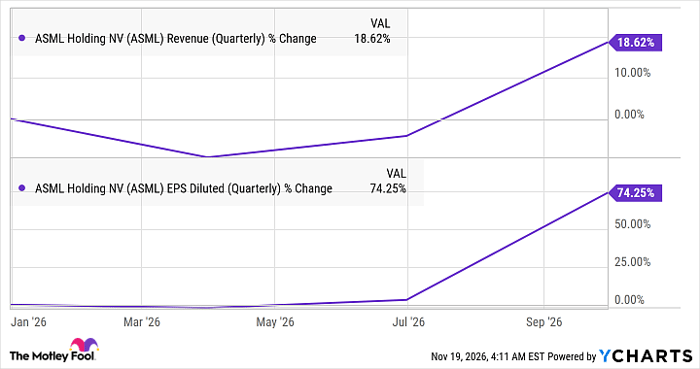
ASML Revenue (Quarterly) data by YCharts
Analysts are forecasting a 68% increase in ASML’s earnings in 2026, followed by solid double-digit increases over the next couple of years.
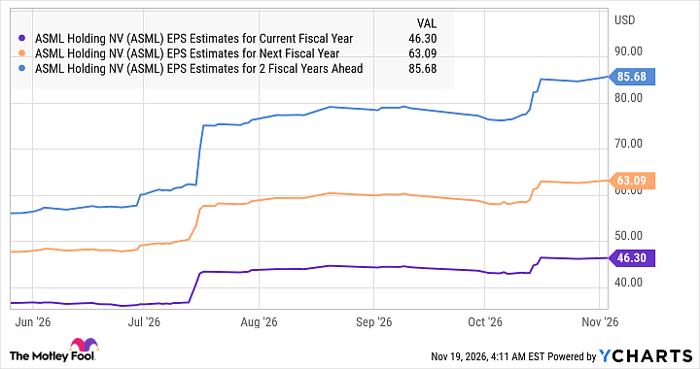
ASML EPS Estimates for Current Fiscal Year data by YCharts
If ASML’s earnings reach $85.68 per share in 2028 and it trades at 30 times earnings, in line with the tech-laden Nasdaq-100 index’s earnings multiple, its stock price could reach $2,570. That implies a potential upside of 78%. So, investors looking to avoid the uncertainty surrounding Nvidia can consider investing in ASML, as it trades at an attractive 22 times forward earnings and is likely to deliver steady gains over the next couple of years.
Should you buy stock in ASML right now?
Before you buy stock in ASML, consider this:
The Motley Fool Stock Advisor analyst team just identified what they believe are the 10 best stocks for investors to buy now… and ASML wasn’t one of them. The 10 stocks that made the cut could produce monster returns in the coming years.
Consider when Netflix made this list on December 17, 2004… if you invested $1,000 at the time of our recommendation, you’d have $305,941!* Or when Nvidia made this list on April 15, 2005… if you invested $1,000 at the time of our recommendation, you’d have $771,325!*
Now, it’s worth noting Stock Advisor’s total average return is 719% — a market-crushing outperformance compared to 192% for the S&P 500. Don’t miss the latest top 10 list, available with Stock Advisor, and join an investing community built by individual investors for individual investors.
See the 10 stocks »
*Stock Advisor returns as of November 22, 2026.
Harsh Chauhan has no position in any of the stocks mentioned. The Motley Fool has positions in and recommends ASML, Intel, Micron Technology, Nvidia, and Taiwan Semiconductor Manufacturing. The Motley Fool has a disclosure policy.