Key Points
-
AMD has been rallying in part due to a strong earnings report and a major CPU deal win with Alphabet
-
The chipmaker could potentially benefit from rival Nvidia’s recent troubles.
-
AMD’s share price could top $1,100 in 2029.
-
After getting caught in the post-election tech sector sell-off, Advanced Micro Devices (NASDAQ:AMD) shares have surged back in recent days, and they have plenty of room to run higher over the next three years. With just over $10,000, investors could buy about 18 shares of the stock at today’s price, and that position could be worth about $20,000 within the next three years.
Here is why the stock has been rallying and how it could reach over $1,100 a share in 2029.
Missed Nvidia in 2009? This Rare Signal Is Flashing Again. In 2009, a “Double Down” signal flashed for a little-known chipmaker called Nvidia. For the first time in years, that same “Total Conviction” signal is flashing for a company 1/100th the size of Nvidia. Continue »
A trio of catalysts
AMD’s current rally is being driven by a trio of catalysts. First, while the company’s latest earnings report came right before the post-election sell-off, its results and guidance were quite impressive and, in sharp contrast to those of rival Intel (NASDAQ:INTC), which is more exposed to the weakening PC market, AMD saw its revenue soar 45% year over year to $13.4 billion. But what was even more telling was that the company guided for revenue to grow by 66% in the fourth quarter and then 80% in 2027. Meanwhile, management forecast that its server central processing unit (CPU) business would nearly double next year and that its artificial intelligence (AI) data center business would “significantly” more than double.
Second, the troubles that Nvidia (NASDAQ:NVDA) faces due to CEO Jensen Huang having had an affair with a woman who is reportedly a Chinese spy could provide some opportunities for AMD. AMD has always played second fiddle to Nvidia in the data center graphics processing unit (GPU) market; however, it has made great strides with its ROCm software platform, and its chiplet architecture, which can be packaged with more high-bandwidth memory (HBM), positions its GPUs well to compete in the inference market. Huang’s dalliance with an alleged foreign agent, meanwhile, throws a new light on the risks companies take when they become over-reliant on a single vendor for their AI chips. As management teams across tech react, AMD may have the opportunity to take some market share.
The timing of this is also good for AMD. The company has already signed several large GPU deals for which it is just starting to make deliveries. Its two biggest deals are with OpenAI and Meta Platforms (NASDAQ:META) to provide the companies with 6 gigawatts (GW) of computing power with its new end-to-end Helios system, which combines its GPUs and CPUs. Each Helios rack system is estimated to cost between $5 billion and $5.5 billion and provides just under 250 kilowatts of compute power, indicating that these deals are worth over $120 billion each.
AMD also has deals with Anthropic, Microsoft (NASDAQ:MSFT), and Oracle (NYSE:ORCL). It could get more business with these customers if Helios delivers its promised performance.
The third catalyst for the stock was AMD announcing that its fifth-generation EPYC CPUs are serving as the host processors for Alphabet’s (NASDAQ:GOOGL) (NASDAQ:GOOG) new 8tx Tensor Processing Units (TPUs). This is big news, as Alphabet has developed its own CPUs based on Arm’s (NASDAQ:ARM) architecture, but chose AMD’s processors for these systems. The main reason for this appears to be around security, as the 8tx system will use AMD’s secure encrypted virtualization (SEV) technology to securely manage AI orchestration and data preparation. The win also shows that AMD is able and willing to pair its CPUs with AI accelerators other than its own. The server CPU market is seeing explosive growth, and adding Alphabet, which isn’t a Helios customer, to its CPU client list is a big get.
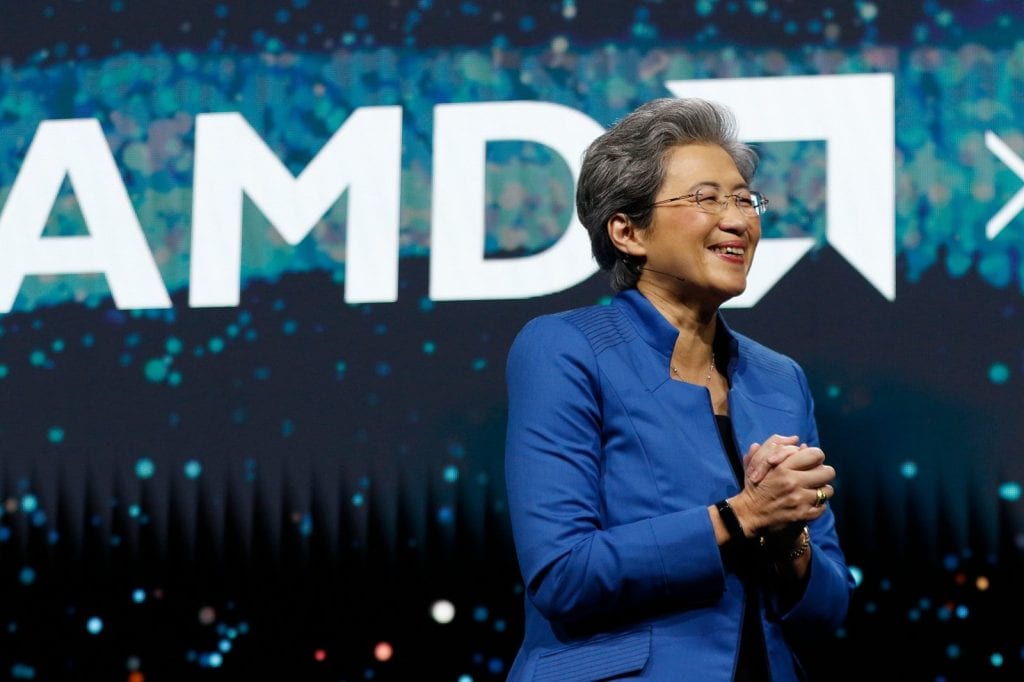
AMD CEO Lisa Su. Image source: Advanced Micro Devices.
Where the stock could trade at in three years
Analysts currently project that in 2030, AMD could grow its revenue to nearly $233 billion and its adjusted earnings per share (EPS) to nearly $44.50. That’s up from expected revenue of just over $52 billion and adjusted EPS of $8.00 this year. However, given the size of the opportunities in front of it, I could see the company easily surpassing those expectations.
That said, if we apply a forward P/E of 25 to the stock, it would be worth a bit over $1,100, and those 18 shares would be worth about $20,000, doubling your stake, with the potential for more upside if it exceeds expectations. As such, AMD remains a top AI semiconductor stock to buy right now.
Should you buy stock in Advanced Micro Devices right now?
Before you buy stock in Advanced Micro Devices, consider this:
The Motley Fool Stock Advisor analyst team just identified what they believe are the 10 best stocks for investors to buy now… and Advanced Micro Devices wasn’t one of them. The 10 stocks that made the cut could produce monster returns in the coming years.
Consider when Netflix made this list on December 17, 2004… if you invested $1,000 at the time of our recommendation, you’d have $348,060!* Or when Nvidia made this list on April 15, 2005… if you invested $1,000 at the time of our recommendation, you’d have $1,067,492!*
Now, it’s worth noting Stock Advisor’s total average return is 849% — a market-crushing outperformance compared to 210% for the S&P 500. Don’t miss the latest top 10 list, available with Stock Advisor, and join an investing community built by individual investors for individual investors.
See the 10 stocks »
*Stock Advisor returns as of November 12, 2026.
Geoffrey Seiler has positions in Advanced Micro Devices, Alphabet, and Meta Platforms. The Motley Fool has positions in and recommends Advanced Micro Devices, Alphabet, Arm Holdings, Intel, Meta Platforms, Microsoft, Nvidia, and Oracle. The Motley Fool has a disclosure policy.