Key Points
-
Nvidia stock fell sharply on news of Huang’s departure.
-
Most chip stocks sold off in tandem with Nvidia, but AMD, its closest competitor, rose.
-
Any challenges for Nvidia going forward should present as opportunities for AMD.
-
Jensen Huang has resigned as CEO of Nvidia (NASDAQ:NVDA).
Just four days after Huang disclosed an affair with a suspected Chinese spy, the Nvidia co-founder and tech titan who spearheaded the AI revolution has stepped down. The crisis that began on Sunday was compounded by reports in The New York Times on Wednesday night that Huang also had a romantic relationship with a direct report, Nvidia’s vice president of health, Kimberly Powell. CFO Collette Kress will now serve as interim CEO, while the board searches for a permanent replacement.
Missed Nvidia in 2009? This Rare Signal Is Flashing Again. In 2009, a “Double Down” signal flashed for a little-known chipmaker called Nvidia. For the first time in years, that same “Total Conviction” signal is flashing for a company 1/100th the size of Nvidia. Continue »
For investors, Huang was long seen as a crucial asset for the company, and the news prompts the question of what Nvidia is worth without him. Given his unusual level of control over the company, and the national insecurity implications of his misdeed, it’s a complicated matter.
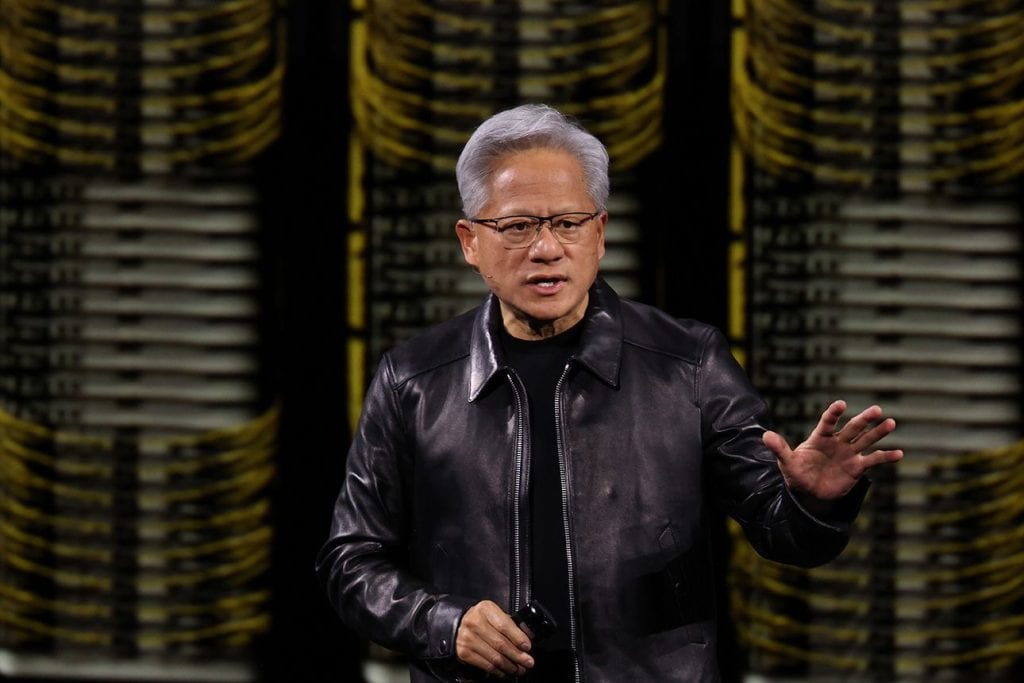
Image source: Getty Images.
A unique situation
Corporate CEOs are occasionally pushed out over affairs or similar actions, but the Nvidia saga has a unique twist. Huang’s involvement with a possible Chinese spy has already sparked calls for an investigation on Capitol Hill and elsewhere in Washington, and the implications for Nvidia, even without Huang, could be significant.
If the company is found to have knowingly broken chip export laws, which were already a point of concern, Nvidia could face fines, further restrictions, or an outright ban on certain exports. Huang’s decision to step down now might be a face-saving move for both him and the company, but it doesn’t change any wrongdoing that already happened, or the potential consequences.
Nvidia’s influence also expands far beyond its own corporate campus, as the company has propped up much of the AI sector through a series of financial backstops, investments, and purchase commitments. Nvidia holds stakes in companies like Space Exploration Technologies, Intel, Arm Holdings, CoreWeave, OpenAI and Anthropic, and it has served as a guarantor for companies like CoreWeave and OpenAI so they can expand operations and buy Nvidia chips.
If Nvidia falters, it could drag down partners like CoreWeave and OpenAI, which are burning billions in cash in a gambit to capture the massive opportunity in AI. Such an unraveling could crush the broader AI sector as well.
The indicator I’m watching to assess Nvidia’s future
Huang departs a company in stellar financial shape. Unlike, say, Elon Musk, Nvidia’s valuation is based on real profits and growth, not the future promises that have inflated Musk’s companies.
Nvidia’s near-term financial future isn’t in jeopardy. The company has dominant market share in the data center GPU market, and competitive advantages built into its technologies, including its CUDA software library and an army of AI developers accustomed to building on Nvidia.
However, Nvidia competes in a fast-changing industry, and that edge can erode over time. The company’s closest competitor is AMD (NASDAQ:AMD), which is a distant #2 in the data center GPU market. Any challenge to Nvidia presents an opportunity to AMD, and if investors expect Huang’s exit to diminish Nvidia’s market power, one way that should manifest itself is in AMD’s stock price.
While much of the chip sector was down on Thursday, AMD was in the green, whipsawing in early morning trading, and was up 4.3% as of 10:55 a.m. ET. That gain shows investors see AMD as a beneficiary from Nvidia’s crisis.
If you’re looking for clues into Nvidia’s future going forward, it’s worth monitoring AMD’s share price as an inverse indicator of Nvidia, as any weakness at Nvidia should be an opportunity for AMD.
What’s next for Nvidia
Nvidia won’t get any escape from the spotlight as the company is due to report third-quarter earnings on Tuesday afternoon.
The company will likely avoid discussion of Huang and the transition it now faces, though it may issue a blanket statement providing any additional update for investors.
In addition to revealing Nvidia’s latest numbers, the earnings call will give Kress and the company a chance to show what it’s capable of without Huang, and investors will be keen on any insights there.
Still, Huang proved himself to be a master strategist and tech visionary, as well as forming a far-reaching network of relationships with suppliers, customers, governments, and other stakeholders around the world. He won’t be easy to replace, and any federal investigation represents a separate overhang on the stock.
Nvidia is as vulnerable as it’s been in a long time. If there are any cracks in its leadership, AMD is likely to capitalize.
Should you buy stock in Nvidia right now?
Before you buy stock in Nvidia, consider this:
The Motley Fool Stock Advisor analyst team just identified what they believe are the 10 best stocks for investors to buy now… and Nvidia wasn’t one of them. The 10 stocks that made the cut could produce monster returns in the coming years.
Consider when Netflix made this list on December 17, 2004… if you invested $1,000 at the time of our recommendation, you’d have $348,060!* Or when Nvidia made this list on April 15, 2005… if you invested $1,000 at the time of our recommendation, you’d have $1,067,492!*
Now, it’s worth noting Stock Advisor’s total average return is 849% — a market-crushing outperformance compared to 210% for the S&P 500. Don’t miss the latest top 10 list, available with Stock Advisor, and join an investing community built by individual investors for individual investors.
See the 10 stocks »
*Stock Advisor returns as of November 12, 2026.
Jeremy Bowman has positions in Advanced Micro Devices, Arm Holdings, CoreWeave, and Nvidia. The Motley Fool has positions in and recommends Advanced Micro Devices, Arm Holdings, Intel, Nvidia, and Space Exploration Technologies. The Motley Fool has a disclosure policy.