Key Points
-
Nvidia’s AI lead rests on its CUDA platform, networking, and integrated systems built over decades, and those advantages won’t vanish overnight.
-
Apple, Microsoft, and Amazon each kept thriving after their famous founders exited their CEO roles.
-
Chief Financial Officer Colette Kress will serve as interim CEO of the chip giant.
-
Nvidia (NASDAQ:NVDA) has spent the past several years establishing itself as the dominant supplier of artificial intelligence processors. Now the company faces a problem that has nothing to do with its chips, its competition, or the enormous demand for AI computing power.
It’s a problem of replacing its founder and CEO, Jensen Huang.
Missed AI’s “Act 1”? Act 2 Could Be 15x Bigger. Most investors think they missed the AI boat because they didn’t buy Nvidia in 2005. But according to our analysts, we’re only at the end of “Act 1″—the R&D phase. “Act 2” is the global rollout. Continue »
Huang resigned Thursday from Nvidia, four days after Nvidia’s board of directors opened an independent investigation into reports that a foreign intelligence operation had targeted Huang. The announcement followed Huang’s admission that he had been unfaithful to his wife, raising questions about his relationship with a woman suspected of working for Chinese intelligence.
Nvidia stock fell more than 12% in premarket trading on Thursday.
It is an extraordinary development for one of the world’s most influential technology executives. And it raises a legitimate question for investors: How should investors evaluate Nvidia stock now that Huang is no longer at the helm?
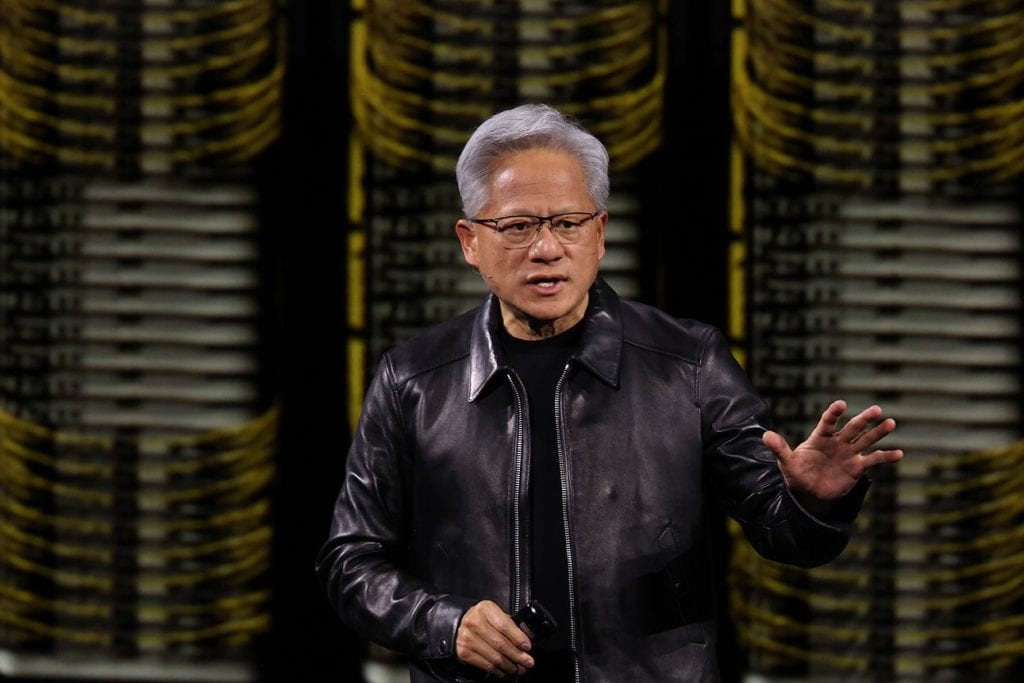
Jensen Huang has resigned as Nvidia CEO. Image source: Getty Images.
The investigation that took down Jensen Huang
According to reporting by The New York Times and other news organizations, U.S. intelligence officials suspect that Huang had a relationship with Alice Huang, a Chinese businesswoman and former executive at Singapore-based Megaspeed International, who was recruited to gather information for Beijing.
The allegations have not been independently established, and China has rejected them. In addition, The New York Times reported that Huang had a separate affair with a Nvidia employee.
Kress, who is stepping in as interim CEO, has been Nvidia’s executive vice president and chief financial officer since she joined the company in September 2013. Nvidia also named its first-ever board chairman, Harvey Jones, a former CEO of Synopsys.
“The board has full confidence in Colette and the leadership team, and we expect the company’s operations, customer commitments and product roadmap to continue without interruption,” Jones said.
Nvidia is bigger than Jensen Huang
Back in July, I wrote about the three “Magnificent Seven” companies that remained founder-led: Nvidia, Meta Platforms, and Tesla. I argued that Nvidia was the best long-term investment of the three, largely because of Huang’s strategic vision and the competitive advantages his company has built.
Huang co-founded Nvidia in 1993, initially focusing on graphics processors for video games. But one of his most consequential decisions was to create CUDA, a software platform that enabled developers to program Nvidia’s graphics processing units for applications far beyond gaming.
That decision helped establish Nvidia’s dominance in AI computing.
Today, Nvidia’s advantage extends beyond its processors. The combination of the company’s networking technology, CUDA platform, and integrated computing systems makes it difficult for its established customers to switch to competing hardware platforms.
Those advantages weren’t created overnight, and they won’t disappear overnight either.
Huang deserves enormous credit for building Nvidia into the company it is today. But thousands of engineers, researchers, and executives are responsible for developing its products and maintaining its customer relationships.
The company’s technological expertise doesn’t reside exclusively in the CEO’s office.
Great companies can survive their founders’ exits
There’s plenty of precedent for successful technology companies prospering after their founders step aside.
Steve Jobs was instrumental in turning Apple into a consumer technology powerhouse. But under the 15-year leadership of Tim Cook, Apple quadrupled its annual revenue, expanded its services business, and became one of the world’s most valuable companies. The company is still going strong today with new CEO John Ternus at the helm.
Then there’s Microsoft: Bill Gates relinquished the CEO position in 2000, but Microsoft kept moving forward. Under Satya Nadella, who became CEO in 2014, Microsoft became a dominant cloud computing provider and a major force in artificial intelligence.
Jeff Bezos is still synonymous with the company he founded, Amazon, but it has been five years since he handed over the CEO role to Andy Jassy. Under Jassy, Amazon has grown its cloud computing, advertising, and retail businesses, and the company’s market cap is approaching $3 trillion.
There’s no doubt that Huang’s technical expertise, customer relationships, and influence over the company’s direction will be difficult to replicate. But a company’s long-term success clearly doesn’t have to depend on one individual, even when that individual founded it.
Should investors worry about Nvidia stock?
The investigations into this situation introduce uncertainty that shareholders shouldn’t dismiss. Beyond the change in leadership, any evidence of compromised information or violations of U.S. export restrictions could have serious consequences. But there is currently no established evidence that Nvidia’s secrets were compromised.
Meanwhile, demand for AI computing remains the central driver of Nvidia’s business. Its customers still need powerful processors, and competitors still face the difficult task of matching Nvidia’s vaunted product line.
“Nvidia’s strength has always come from its people, and together with our leadership team, I am committed to building on the extraordinary foundation Jensen created over the last 33 years,” Kress said in a statement released by Nvidia today. “We will continue advancing the work that has made Nvidia a leader in accelerated computing and AI, and execute on the opportunities ahead. Our focus remains on serving our customers, partners, developers and shareholders.”
I still think Nvidia is an outstanding company to own for the long term. The board’s investigation deserves attention, and its findings could change the assessment of leadership risk.
For now, however, my investment thesis remains intact. Nvidia’s greatest asset isn’t any one executive, even Jensen Huang. It’s the business he helped build, and will continue without him.
Should you buy stock in Nvidia right now?
Before you buy stock in Nvidia, consider this:
The Motley Fool Stock Advisor analyst team just identified what they believe are the 10 best stocks for investors to buy now… and Nvidia wasn’t one of them. The 10 stocks that made the cut could produce monster returns in the coming years.
Consider when Netflix made this list on December 17, 2004… if you invested $1,000 at the time of our recommendation, you’d have $348,060!* Or when Nvidia made this list on April 15, 2005… if you invested $1,000 at the time of our recommendation, you’d have $1,067,492!*
Now, it’s worth noting Stock Advisor’s total average return is 849% — a market-crushing outperformance compared to 210% for the S&P 500. Don’t miss the latest top 10 list, available with Stock Advisor, and join an investing community built by individual investors for individual investors.
See the 10 stocks »
*Stock Advisor returns as of November 12, 2026.
Patrick Sanders has positions in Nvidia. The Motley Fool has positions in and recommends Amazon, Apple, Meta Platforms, Microsoft, Nvidia, and Tesla. The Motley Fool has a disclosure policy.