Key Points
-
Truist and Craig-Hallum have downgraded Nvidia to Hold, with new price targets of $174 and $180, only slightly above where the stock trades.
-
Truist says the risks now include Nvidia’s culture and whether its chips reached buyers in China, not just the CEO’s departure.
-
DA Davidson kept its Buy rating, and Jensen Huang still owns roughly $133 billion of Nvidia stock, a stake investors should watch closely.
-
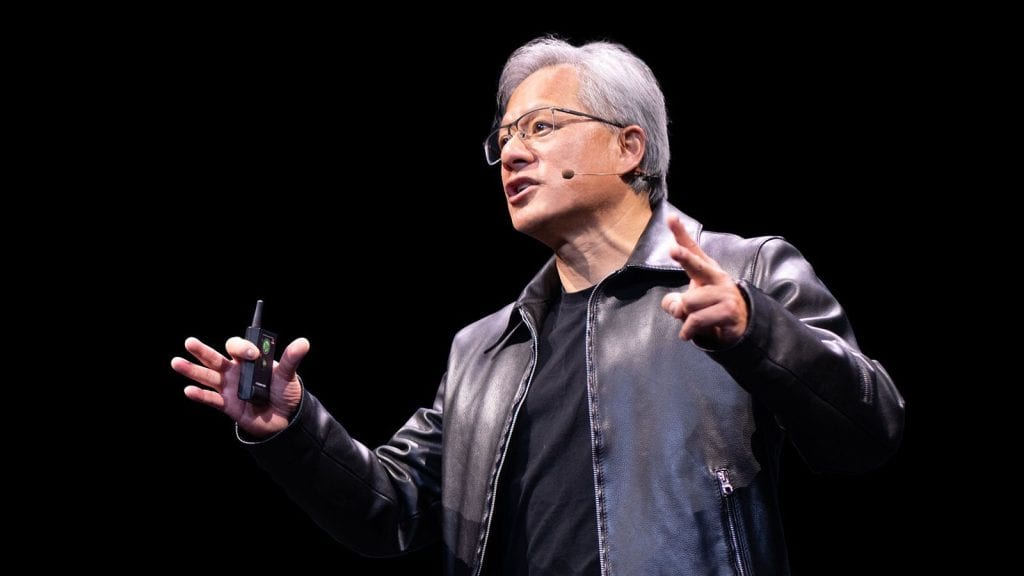
Shares of Nvidia (NASDAQ:NVDA) fell about 6% to roughly $164 on Thursday afternoon after the company said Jensen Huang had resigned as chief executive, effective immediately. Huang co-founded Nvidia in 1993 and had run it ever since. The announcement also moved others, with rival Advanced Micro Devices (NASDAQ:AMD) moving the other way, rising about 6%.
Wall Street analysts also reacted quickly. By the afternoon, two firms had downgraded the stock.
Missed Nvidia in 2009? This Rare Signal Is Flashing Again. In 2009, a “Double Down” signal flashed for a little-known chipmaker called Nvidia. For the first time in years, that same “Total Conviction” signal is flashing for a company 1/100th the size of Nvidia. Continue »
Why Truist turned cautious
Truist cut Nvidia to Hold from Buy and slashed its price target to $174 from $346. “Risks are more relevant than valuation,” the firm said.
Truist argued the problem isn’t only Huang’s personal conduct or his resignation. It also pointed to the risk that Nvidia’s culture could be compromised and to the possibility that the company shipped GPUs that became accessible to companies and government entities in China, potentially hurting future revenue.
That worry about culture got sharper Thursday, when Reuters reported, citing two people familiar with the matter, that Huang also had an intimate relationship with another Nvidia employee.
Truist admitted the stock’s valuation “looks incredibly attractive.” But it said the risks are too great to forecast revenue or earnings with “enough confidence to continue our Buy rating.”
“A big hole” at the top
Craig-Hallum also moved to Hold from Buy, cutting its target to $180 from $275. Huang’s departure “creates a big hole that will be very difficult, if not impossible, to fill,” the firm said.
The right replacement “could create some stability,” Craig-Hallum added. But it warned that other problems, including scrutiny of Nvidia’s China and Asia-Pacific sales and rising competition, won’t be solved soon and “may even worsen.”
Nvidia itself flagged this risk long before Thursday. Its annual report warns that “we are highly dependent on the services of our long-standing executive team.”
The bull case hasn’t disappeared
Not every analyst is backing away. DA Davidson cut its target to $200 from $300 but kept its Buy rating. It expects Nvidia’s product lead to last, though it said the company’s ability to orchestrate the broader AI industry could weaken without Huang. That target still sits about 22% above Thursday’s price.
DA Davidson also said interim CEO Colette Kress is “up for the task.” Kress has been Nvidia’s chief financial officer since 2013, after nearly 25 years in finance roles at Cisco and Microsoft. The board said it expects “operations, customer commitments and product roadmap to continue without interruption.”
The $133 billion question
There’s another overhang investors haven’t talked about much: Huang’s own shares.
He held about 811.5 million Nvidia shares as of September, according to his latest insider filing, worth roughly $133 billion today. Nvidia hasn’t said anything about his plans for the stake, and the proxy notes the company has no severance agreements with its executives. If he decided to sell heavily, it could weigh on the stock for months.
Should you sell?
For long-term shareholders, selling in a panic probably isn’t the answer. Nvidia’s chips still power most of the AI build-out, and even Truist calls the valuation attractive. But this isn’t a simple dip to buy, either. A new CEO search, questions about China, and a possible shift in culture make the next few quarters hard to predict.
The next clue comes Tuesday, when Nvidia reports quarterly results. Last quarter, management guided to about $108 billion in revenue for this period. Listen to see whether that holds, what Kress says about China, and any updates on the CEO search.
If you own Nvidia, keep the position at a size you can live with through that uncertainty. If you want exposure to semiconductor stocks without betting on one leadership team, a broader mix of AI stocks may be the safer route for now.
Missed AI’s “Act 1”? Act 2 Could Be 14x Bigger
Most investors think they missed the AI boat because they didn’t buy Nvidia in 2005.
But according to our analysts, we’re only at the end of “Act 1″—the R&D phase. “Act 2” is the global rollout, a massive technology build-out that Google’s CEO says could be more profound than fire or electricity.
While everyone watches the chip designers, one “backbone” company provides the critical technology that Nvidia and AMD literally cannot function without. We’ve detailed this under-the-radar player in our new AI Playbook.
Continue »
Jonathan Ponciano has no position in any of the stocks mentioned. The Motley Fool has positions in and recommends Advanced Micro Devices and Nvidia. The Motley Fool has a disclosure policy.