Key Points
-
Several industrial companies could suffer if Huang’s departure from Nvidia slows the AI build-out.
-
Bloom Energy’s valuation could be harder to justify if its growth falls short of expectations.
-
Vertiv’s and Eaton’s power and cooling equipment sales could suffer if data-center construction slows.
-
Well, it’s the end of an era. For Nvidia (NASDAQ:NVDA) that is. After more than three decades at the helm, co-founder Jensen Huang has resigned as CEO of one of the world’s most influential and valuable companies.
How this shake-up will shake out for the AI boom remains to be seen. And yet if this change at the helm were to affect the spending behind that boom — if, for example, his departure were to rattle investors’ confidence in the AI build-out — the fallout would have consequences beyond Nvidia shareholders.
Missed Nvidia in 2009? This Rare Signal Is Flashing Again. In 2009, a “Double Down” signal flashed for a little-known chipmaker called Nvidia. For the first time in years, that same “Total Conviction” signal is flashing for a company 1/100th the size of Nvidia. Continue »
If that were to occur, the following three AI industrial stocks could become collateral damage.
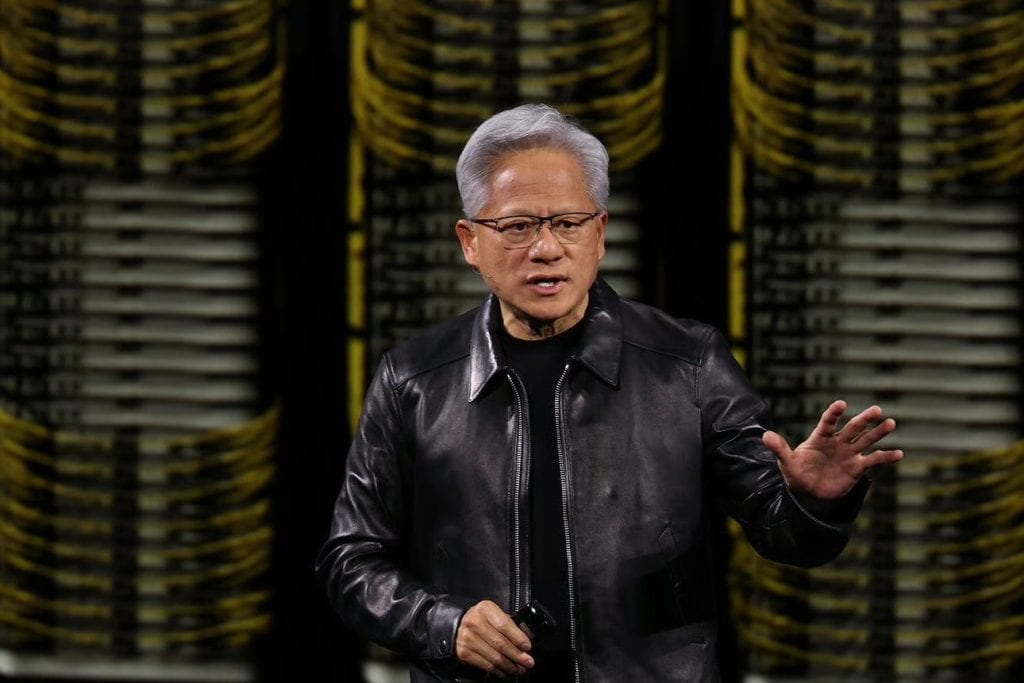
Image source: Getty Images.
Bloom Energy
Bloom Energy (NYSE:BE), a poster child of growth from the AI energy boom, could take a huge hit if Huang’s departure gives investors cold feet about pouring more money into AI infrastructure.
It’s not hard to imagine why. Bloom sells fuel cell systems that generate electricity onsite for customers. While Bloom serves businesses well beyond the AI build-out, its systems have become a hot commodity among data-center developers scrambling to secure power. Indeed, one of Bloom’s advantages is “time-to-power,” which means customers can get power sooner than by waiting for a utility connection.
But here’s a potentially troubling thought for Bloom: If the AI build-out slows down, will developers still be in a rush to secure power? Probably not. Bloom might still beat utilities to the punch, but if customers have more time to wait, then “time-to-power” might not be as compelling a selling point as it would in a race to get data centers up and running.
There are other ways Bloom could feel Nvidia’s fallout. For example, it could feel the effects through its relationship with Brookfield (NYSE:BAM). Just think: Nvidia is a founding investor in Brookfield’s AI infrastructure fund, and Brookfield’s $25 billion financing framework with Bloom is part of that same investment strategy. If Brookfield were to shy away from funding new AI projects, Bloom could end up with less business coming its way.
Again, Bloom serves customers beyond the emerging AI industry, so its future doesn’t depend on it. Still, investors might find Bloom’s valuation a lot harder to swallow if the company grows more slowly than expected.
Vertiv
Vertiv (NYSE:VRT) has a much more direct connection to Nvidia than Bloom.
In a nutshell, Vertiv makes power and cooling equipment for data centers. More specifically, it has worked with Nvidia to develop equipment capable of handling the demands of Nvidia’s AI chips. It follows, then, that if uncertainty at Nvidia causes customers to postpone new data centers, then they could also postpone buying the equipment that Vertiv sells.
This could be a significant concern for Vertiv, especially since it has begun expanding its production capacity. If demand grows more slowly than expected, some of that capacity could sit around unused, thereby reducing the return on those investments.
Eaton
Like Vertiv, Eaton (NYSE:ETN) works closely with Nvidia to integrate its power and cooling systems into the chipmaker’s designs for AI data centers. As a matter of fact, Eaton has put serious money behind the AI build-out, even going so far as to acquire liquid-cooling specialist Boyd Thermal for $9.5 billion.
That purchase was equivalent to about 35% of its 2025 revenue ($27.4 billion), so not exactly pocket change for the electrical equipment giant. If customers were to scale back their plans for new data centers, then Boyd’s cooling business could grow more slowly than expected, with the acquisition generating less profit than Eaton would have wanted.
Although the three stocks above could be vulnerable to an AI slowdown, I wouldn’t rush to sell them based on Huang’s departure alone. The thing is, AI data centers still need power and cooling, and customers could stick to their original plans despite the change at the helm. As this drama plays out, I would watch for any changes in the companies’ forecasts, but I would also shy away from making decisions based on a single dramatic headline.
Missed Nvidia in 2009? This Rare Signal Is Flashing Again
In 2009, a “Double Down” signal flashed for a little-known chipmaker called Nvidia. If you’d invested $5,000 then, you’d be sitting on $2,258,311 today.*
Now, for the first time in years, that same “Total Conviction” signal is flashing for a company 1/100th the size of Nvidia. It’s a key player in the $1.8 trillion space race, and with the stock recently sitting 20% off its highs, the window to get in early is closing fast.
Continue »
*Stock Advisor returns as of November 12, 2026.
Steven Porrello has positions in Nvidia. The Motley Fool has positions in and recommends Bloom Energy, Brookfield Asset Management, Eaton Plc, Nvidia, and Vertiv. The Motley Fool has a disclosure policy.