Memory stocks have had quite the year in 2026. Two of the best performers are Sandisk (NASDAQ: SNDK) and Micron (NASDAQ: MU), which are each among the top five best-performing stocks in the S&P 500 (SNPINDEX: ^GSPC) this year.
Sandisk holds second place, rising around 270%, while Micron has risen about 150%. However, I think both of these stocks are due for more over the next few years, and all investors have to do is listen to what they’re saying.
Missed AI’s “Act 1”? Act 2 Could Be 15x Bigger. Most investors think they missed the AI boat because they didn’t buy Nvidia in 2005. But according to our analysts, we’re only at the end of “Act 1″—the R&D phase. “Act 2” is the global rollout. Continue »
I think these two will be great stocks to buy and hold over the next few years, and could deliver monster returns.
Both stocks are incredibly cheap versus the broader market
Memory chips are required for many devices to function. Long-term data storage utilizes NAND memory, such as in solid-state drives (SSDs). Computing units need DRAM memory to function, and these are being deployed heavily in data centers for computing power.
While memory chips are necessary, there isn’t much to differentiate one memory chip from another. With no competitive advantage, memory chips basically became a commodity. As a result, pricing depends heavily on supply and demand. This makes memory chips a cyclical industry, and investors have historically given companies in these fields deep discounts to avoid losing vast sums of money when the cycle turns.
That’s what the market is betting will happen for Micron and Sandisk. With the AI build-out in full force and consuming all available memory, demand for chip production capacity for their products has never been higher. With production capacity sold out, prices have also skyrocketed. This has led to ludicrous growth rates for each company, but the market isn’t valuing them fully because of their cyclical nature.
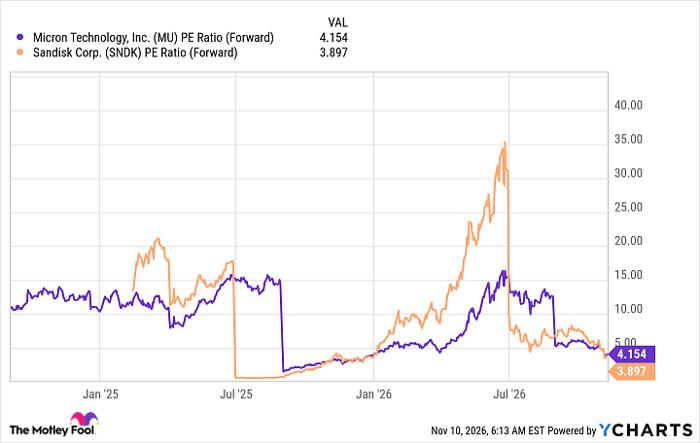
MU PE Ratio (Forward) data by YCharts
For reference, the S&P 500 trades at 19 times forward earnings, so if both stocks just had a market-average valuation, they would rise nearly 5 times in value. But because the market is betting on a downturn, they’re cheap.
The memory chip industry is being reshaped
Both of these companies are taking steps to reduce the cyclical nature of their businesses. Instead of selling products on the open market, both are now entering into long-term agreements with their clients. Sandisk calls this its “New Business Model” (NBM), and a large chunk of its revenue is coming from these agreements. Micron is doing the same thing and has locked in approximately 35% of revenue through 2030 with these types of contracts.
Why is this a big deal? It raises the floor for the companies. Instead of dealing with a significant pricing decline as demand falls when the AI build-out ends, there are floor pricing levels with their clients that keep the business running well. So, Micron and Sandisk may not see the massive pricing highs they’re seeing now ever again, but they won’t experience the lows that result in the stocks not being highly valued. This means the market should reprice the stock accordingly, which could lead to massive upside in the near future.
Furthermore, the industry has been sold out for many years, and Micron told investors that market conditions in 2027 and 2028 will likely be tighter than in 2026. The reality is that the memory space will be tied up for multiple years, likely through 2030, and these two stocks will make for excellent investments during that time. There’s a good chance memory stocks will become a hot commodity sometime in the near future, and that makes now the perfect time to load up on them.
Should you buy stock in Micron Technology right now?
Before you buy stock in Micron Technology, consider this:
The Motley Fool Stock Advisor analyst team just identified what they believe are the 10 best stocks for investors to buy now… and Micron Technology wasn’t one of them. The 10 stocks that made the cut could produce monster returns in the coming years.
Consider when Netflix made this list on December 17, 2004… if you invested $1,000 at the time of our recommendation, you’d have $341,157!* Or when Nvidia made this list on April 15, 2005… if you invested $1,000 at the time of our recommendation, you’d have $1,037,753!*
Now, it’s worth noting Stock Advisor’s total average return is 834% — a market-crushing outperformance compared to 207% for the S&P 500. Don’t miss the latest top 10 list, available with Stock Advisor, and join an investing community built by individual investors for individual investors.
See the 10 stocks »
*Stock Advisor returns as of November 12, 2026.
Keithen Drury has positions in Micron Technology. The Motley Fool has positions in and recommends Micron Technology. The Motley Fool has a disclosure policy.