Key Points
-
Qualcomm stock has underperformed the broader market this year, which isn’t surprising considering its declining revenue and earnings.
-
The drop in smartphone industry shipments will weigh on Qualcomm’s performance in the current fiscal year.
-
The company’s diversification into the automotive and data center markets is likely to lift its earnings growth, paving the way for a big jump in the stock price.
-
The sharp decline in smartphone sales this year has weighed on Qualcomm‘s (NASDAQ:QCOM) business, which isn’t surprising as the chip designer derives the majority of its revenue from smartphone chips.
Qualcomm’s flat stock performance in 2026 can be attributed to declines in its revenue and earnings. The company released fiscal 2026 fourth-quarter results (for the year ended Sept. 27, 2026) on Nov. 4, and the numbers weren’t pretty. However, patient investors seeking a top semiconductor stock that could deliver multibagger returns over the long run may consider buying Qualcomm despite the challenging business environment it currently faces.
Missed Nvidia in 2009? This Rare Signal Is Flashing Again. In 2009, a “Double Down” signal flashed for a little-known chipmaker called Nvidia. For the first time in years, that same “Total Conviction” signal is flashing for a company 1/100th the size of Nvidia. Continue »
Let’s look at the reasons why.
Image source: Getty Images.
The handset business will continue to weigh on Qualcomm’s results
Qualcomm’s fiscal 2026 revenue dropped 2% from the prior year to $43.2 billion. The company’s non-GAAP earnings per share (EPS) dropped 12% last fiscal year to $10.54. The drop was more pronounced in the final quarter of 2026, with revenue declining 7% from the year-ago period and non-GAAP EPS contracting 28%.
The handset business produced 55% of Qualcomm’s revenue in the previous fiscal year. Counterpoint Research notes that the global smartphone market declined 20% year over year in the third quarter of 2026. Things won’t be pretty in 2027 either, as high component costs will take a toll on shipments.
Not surprisingly, Qualcomm’s earnings are expected to shrink by 9% in the current fiscal year. However, analysts expect a turnaround in the company’s fortunes in fiscal 2028 and 2029, as evidenced by the following chart.
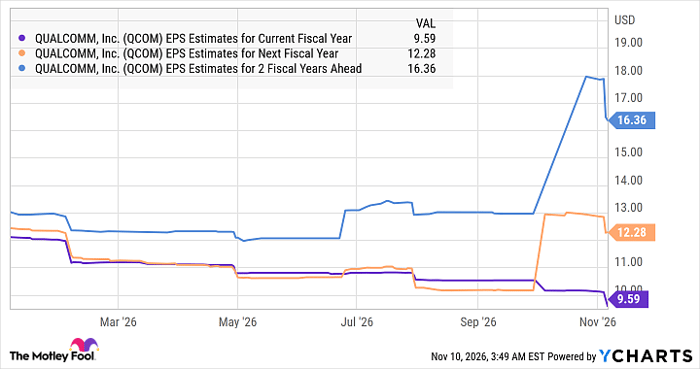
QCOM EPS Estimates for Current Fiscal Year data by YCharts
This potential turnaround will be driven by solid growth in Qualcomm’s automotive business and the company’s growing influence in artificial intelligence (AI) data center chips.
New catalysts could help Qualcomm stage a comeback
Qualcomm’s automotive business delivered impressive growth of 52% in fiscal 2026, generating $6 billion in revenue. Management noted on the recent earnings call that the annualized revenue run rate of the automotive business was $8 billion at the end of fiscal 2026, higher than the prior expectation of $7 billion.
Meanwhile, the company expects the data center segment to contribute $5 billion in revenue from fiscal 2027. Even better, Qualcomm anticipates the data center segment will exit fiscal 2027 with an annualized revenue run rate of $7 billion, suggesting it is on track to deliver stronger growth. Qualcomm has signed agreements with major hyperscalers such as Meta Platforms and Amazon, which will be instrumental in driving growth in the data center segment.
In fact, Qualcomm sees a potential $60 billion revenue opportunity over the next 10 years from its agreement with Amazon. Another important point worth noting is that the company’s design win pipeline in the data center and automotive segments increased by 70% year over year in the previous quarter.
As a result, it is easy to see why Qualcomm is confident of achieving $40 billion in non-handset revenue by fiscal 2029. The company’s non-handset revenue projection has nearly doubled in two years, primarily due to its entry into the data center segment and improving opportunities in the automotive segment.
Qualcomm’s non-handset revenue from sales of automotive and Internet of Things (IoT) chips landed at $13.1 billion in fiscal 2026. So, this segment’s revenue is on track to triple over the next three years. As such, there is a strong likelihood that Qualcomm’s earnings per share will indeed meet Wall Street’s expectations in fiscal 2029.
The chart provided earlier in the article showed us that Qualcomm’s EPS growth will accelerate from 28% in fiscal 2028 to 33% in fiscal 2029. As a result, the company’s price-to-earnings ratio could be much higher than the current reading of 13.6 after three years. Assuming Qualcomm trades at 30 times earnings after three years, in line with the tech-focused Nasdaq-100 index’s earnings multiple, and its EPS reaches $16.36 (as seen in the chart earlier in the article), its stock price could hit $491.
That’s 187% higher than Qualcomm’s stock price right now. So, this AI stock has the potential to become a multibagger, which is why investors with a long-term investing horizon who can wait out the smartphone weakness can consider buying it for healthy returns.
Should you buy stock in Qualcomm right now?
Before you buy stock in Qualcomm, consider this:
The Motley Fool Stock Advisor analyst team just identified what they believe are the 10 best stocks for investors to buy now… and Qualcomm wasn’t one of them. The 10 stocks that made the cut could produce monster returns in the coming years.
Consider when Netflix made this list on December 17, 2004… if you invested $1,000 at the time of our recommendation, you’d have $344,878!* Or when Nvidia made this list on April 15, 2005… if you invested $1,000 at the time of our recommendation, you’d have $1,097,846!*
Now, it’s worth noting Stock Advisor’s total average return is 852% — a market-crushing outperformance compared to 208% for the S&P 500. Don’t miss the latest top 10 list, available with Stock Advisor, and join an investing community built by individual investors for individual investors.
See the 10 stocks »
*Stock Advisor returns as of November 10, 2026.
Harsh Chauhan has no position in any of the stocks mentioned. The Motley Fool has positions in and recommends Amazon, Meta Platforms, and Qualcomm. The Motley Fool has a disclosure policy.